Review: You Can See Everything, but what can you trust?
The hotly anticipated ‘documentary’ You Can See Everything, which follows former Theranos CEO Elizabeth Holmes under the scrutinous observation of co-directors Nathan Fielder and Lance Oppenheim, is an unsettling experiment in trust.
The film transcends genre, breaking away from ‘documentary’, and probes at the line between fact and fiction, with moments that can only be described as psychologically charged reality TV. It speaks in a language of doubt, inviting us, at every twist, turn, and teary eye, to consider whether or not we have just been lied to.
Never has a film been so aptly yet ironically titled. You can see everything, as Fielder and Oppenheim, cinematic cameras and microphones in tow, move in with the very subject of their documentary. No intimate moment is left unseen, no awkward angle is removed in the interest of ‘taste’, no conversation, it seems, is ever cut away from too quickly.
Through Oppenheim’s invasive lens, and under Fielder’s gently probing interrogation, Holmes is still an enigma
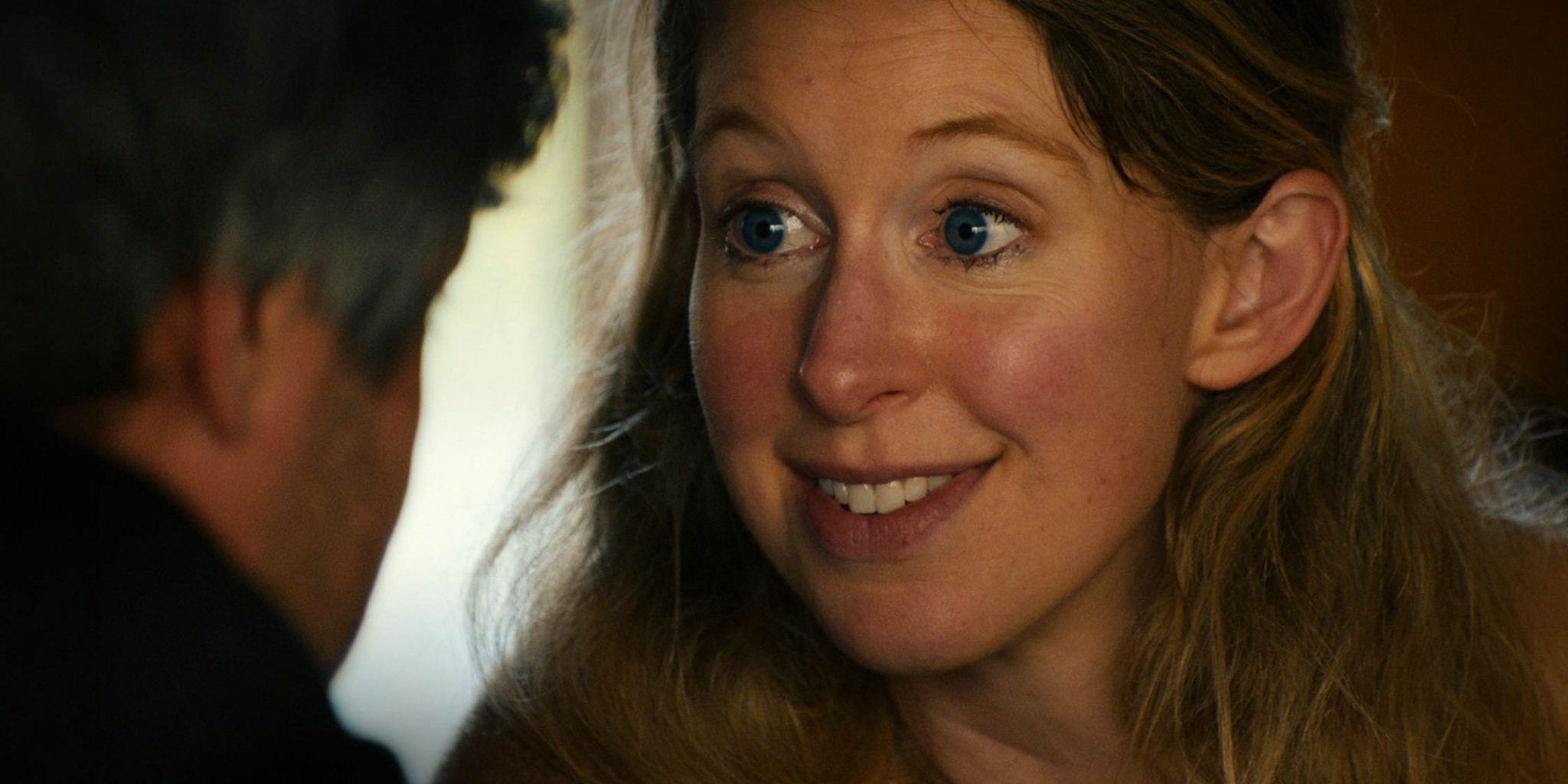
The three-hour runtime is deserved, and rewarding, but there’s no doubt a significant chunk of it comes from the lingering cameras, fixed on the uncomfortably authentic smile and piercingly blue, unblinking eyeballs of Elizabeth Holmes.
Through Oppenheim’s invasive lens, and under Fielder’s gently probing interrogation, Holmes is still an enigma. She was once the world’s youngest self-made female billionaire, a respected public figure in the world of science, until, that is, her company was revealed by journalists and whistleblowers to be a scam.
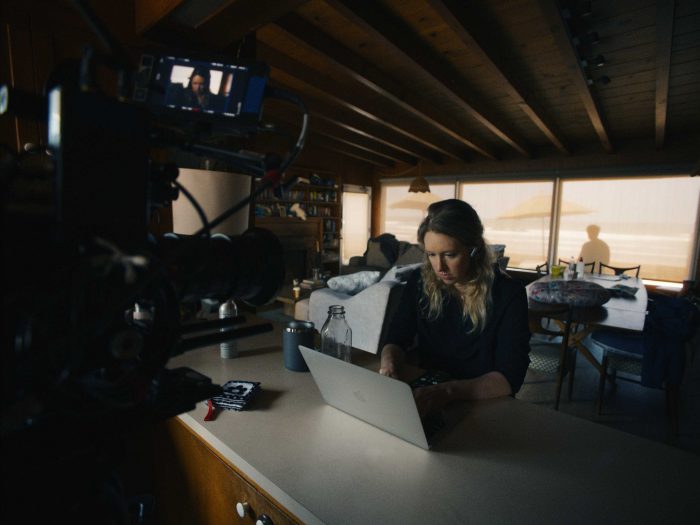
Image: Courtesy of A24
Holmes then became a cultural icon, made more famous by an HBO documentary and a Hulu series about her life. Her image became undetachable from the shocking truth behind Theranos. But now, her characteristic bleach blonde hair and Steve Jobs-esque black turtlenecks are swapped for roots-on-show and slouchy loungewear. She’s human! And yet, her unmistakable deep-toned voice is almost haunting, the sole defiant remnant of a now-unreachable past.
That past – Holmes’ company Theranos, her defrauding of investors, and her deception of the public – is not really the focus here, though. Fielder and Oppenheim are instead interrogating whether the convicted fraudster, notorious for her shockingly unashamed and disturbingly confident fidelity to a barefaced lie, deserves to be considered a human being, a victim, or anything more than a scammer.
Holmes remains confident that she never lied. The more perplexing part, Fielder’s apparent willingness to believe her
You Can See Everything meets Holmes just over a month before her 11-year prison sentence is set to begin, and despite her imminent incarceration, Holmes is not focused on savouring the fleeting time she has left with her husband and children, but on showing the world, a world she believes has used her image and name to construct a misrepresentative caricature of her, who she really is.
No number of heartfelt scenes or moments of vulnerability, however, is able to hide the fact that Holmes remains confident she never lied. The more perplexing part, Fielder’s apparent willingness to believe her.
Fielder is himself a sinister presence at times, jovial and laughable at others. One moment, the camera finds him lurking in the background, watching with lidded eyes and a downturn gaze as Holmes and her family go about their ‘daily lives’, the next, he’s wittily diffusing tension with Holmes or making light of her prison sentence with a “gag gift” of hair dye and sunglasses – in case she decides to go on the run, of course.
Fielder is a powerful pursuant of truth, and Holmes does not seem to work against him… The main obstruction is the husband
Ultimately though, Fielder is a powerful pursuant of truth, and Holmes does not seem to work against him, he seems to have her on side. The main obstruction is the husband.
The documentary opens with a shot of Billy Evans, Holmes’ husband, and from that moment, his constant presence is a tangible hindrance to the effectiveness of Fielder’s investigation. He asserts himself into every interview, attempting not just to control the narrative, but to effectively prevent the film from being made.
Evans is a significant part of why this film works, as his involvement in Holmes’ puzzling attempt at redefinition is so intense, that his motivations become compellingly questionable.
Fielder is visibly irritated by Evans’ interjections, but the husband’s presence is at the same time a tool for the documentarian. In some twisted mimicry of Evans’ affection towards his wife, Holmes is frequently referred to by Fielder as “Liz”, perhaps in an attempt to disarm her – or us, it’s hard to tell.
Here and in many other ways, there is an impenetrability and objective distance typically adopted by documentarians which Fielder seems unable or unwilling to put on. The result is a film in which we have no consistent grounding figure. Instead, we are independent, forced to come to our own conclusions, encouraged even, to question the man asking the questions.
Even the most unfortunate victim of internet spoilers will be stunned by this monumental second half
And this uncertainty only multiplies as the film continues. The time Fielder spends with Holmes and Evans only fills the first half, and what comes next is entirely unexpected. Even the most unfortunate victim of internet spoilers will be stunned by this monumental second half.
To preserve the surprise though, let’s settle – in the spirit of many of the answers given by Holmes and Evans to Fielder in the film – for something vague and almost insubstantial.
From the moment we cross over into the second half, what was witty and amusing becomes gasp-out-loud, what was a growing absence of any figure we could truly relate to is resolved in the best way possible, and what was unsettling, intriguing and inconsistent is recast, forced into such intense scrutiny, that there is nothing safe from doubt and interrogation.
There are moments in this film where, due purely to its sheer audacity, irony and creative liberty, we the powerless spectator become an unwilling accomplice in an endeavour of part investigative journalism, part psychological experiment. The film replays itself, reimagines itself, forces us to rethink and revaluate. The defiance in the filmmaking is enticing, addictive, and in its inherently inconclusive nature, it makes us an active participant, leaving the answer to the question at the core of the film – who is telling the truth? – entirely up to us to determine.
Go in expecting to question it all, because when you really can see everything, it becomes suddenly difficult to trust anything.
★★★★★
Comments