No Questions Asked: Caryl Churchill’s Triumph at the Almeida
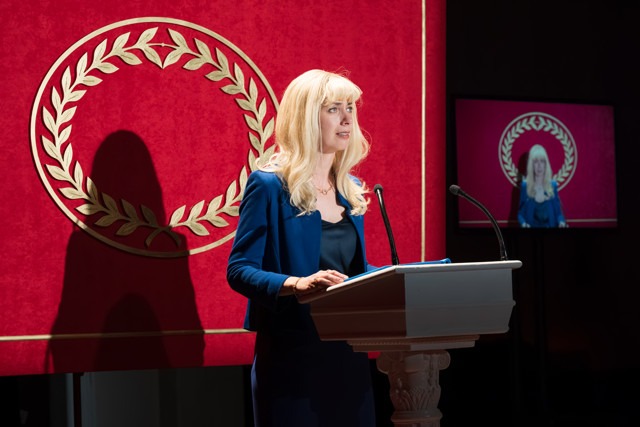
Hideous violence and alluring ideology are predictable lovers. It’s a pairing that’s bound to stir up romance. But soon it’s disturbed. For it turns each into cannibals, half-eaten in their death dance. I’m reminded of the neurotic, doomed revolutionaries in Dostoyevsky’s Demons and Toni Morrison’s Song of Solomon. The youngest and the strongest, attempting to lay the foundations of justice, find themselves unable to be just. This is the paradox that press secretary Iris (Kate O’Flynn) and journalist Marcus (Matthew Beard) fall into in Caryl Churchill’s new short play Triumph. Yet the young lovers are no students torching city hall. They’re merely part of the media package for one revolutionary, murderous Roman emperor after another. And from the bloody pages of Suetonius, Churchill stuffs the Caesars’ terrifying, real life degradations of human beings into our ears, spoken by a blonde wigged Iris behind a glamorous, imperial flag.
Running concurrently in The Public Theatre in NYC, Churchill brings to the Almeida a playful irony and dramatic economy unlike any in modern drama. It’s more indicative of Beckett and Pinter. Churchill in fact is following the same path that both Nobel laureates did, writing shorter, condensed pieces to great acclaim in their older years. She has been working in this form for near twenty years and it’s one that works well. Seven Jewish Children, Churchill’s response to Israeli war crimes, is a play that takes even less of a conventional form than Triumph, yet depicts the tragic history of an entire people through a back-and-forth of voices. Triumph builds a new form that’s in harmony with its content.
The form of a press conference expresses this perfectly
Switching between Iris and Marcus’s fledgling love story and the press conferences, the play lures the audience with this personal and professional regularity. There’s some hope that Marcus will get Iris on his righteous side. There’s a moment where we think Iris will pull down the curtain and expose the horrific crimes. But these feelings are cut off. A need for change is pulled into darkness, just like the actors who sit in the unlit sides of the stage. The audience are induced with this unchanging feeling. The form of a press conference expresses this perfectly. The final “I will take questions” is chilling. Nobody in the theatre raised their voice. A great theatrical trick, yet you can’t help but feel a pit in your stomach after realising. It’s the failure of confidence. When unseen murderers hold the butcher’s knife over everyone’s heads, a polite audience nervously laughs, smiles, and nods.
In every drama, there are forces that want to break out and forces that want to contract. If there is a strong sense of form, these molecules can clash and smash together. It moves like a living thing and therein moves people with it. Triumph does this science in fifteen minutes. A love story is turned into a black comedy which morphs to a devastating tragedy. Sargon Yelda’s role as Rufus, the ominous imperial aide, expresses this change. He’s at first a bubbly, promoting boss and, by the short end, an eager propagandist for mass executions. “Everything said about the emperors comes from The Twelve Caesars by Suetonius” is put on a screen as the audience walk in. Most wouldn’t think of this as a history play.
Yet just like Churchill’s earlier works Cloud 9 and Light Shining in Buckinghamshire, Triumph makes sense of today’s horrors through the known ghost stories and childhood fables of the past. Her work may be, then, more in common with Günter Grass or Heiner Müller. They were writers of Germany’s post-war “overcoming the past” movement, facing readers and audiences with uncomfortable history through irony and satire. Churchill today writes within this idea. The Caesars and their empire is a big part of popular history. Invoked by nationalist politicians and manosphere influences alike, such history can so easily be seen as irrelevant, near cartoon-like. Churchill weaves a web that has all the interest and allure of the Roman era. But, when the laughs are had and the brutalities keep being read out, it leaves even history nerds like myself with a deep dread: that such things did happen in ‘idealised’ societies, are happening, and could happen again.
Triumph runs in the Almeida Theatre until Friday 23 October. Tickets are available here: https://almeida.co.uk/whats-on/triumph/.
★★★★★
Comments