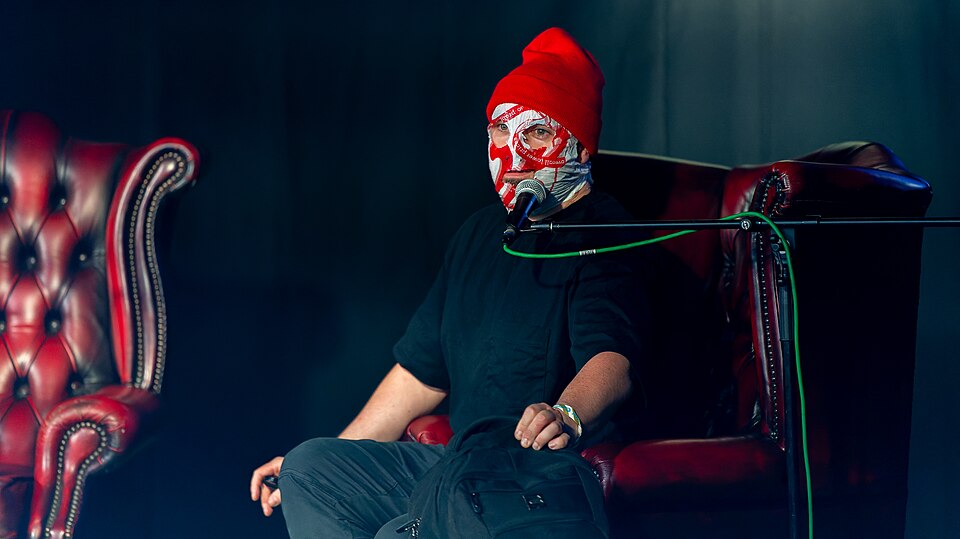
Consistent Openness, Persistent Curiosity: Blindboy Boatclub speaks to The Boar
The best writers aren’t always the best talkers. There is a kind of writer who, if you were to ask them about their work, would sit perpetually uncomfortable and give you a couple blunt, opaque words. This bluntness, finding the right words for the right time, is the language of Blindboy Boatclub. Yet rather than merely signalling to work that’s written and opting out of a dialogue entirley, the masked Limerick native communicates with a dynamic quality and carnal glee that can be found on the page. From the satirical sketches of the Rubberbandits era to a podcast that reaches tens of millions worldwide to his collection of short stories adapted for Ireland’s National theatre, Blindboy has a become a true original in my country’s muddled cultural matrix and beyond. And while the famous shopping bag was not worn, my interview with him could have been lifted right from a podcast segment — filled to the brim with folk stories, history, cultural insight and glorious swearing that I’m not going to risk publishing in a student newspaper.
What I’m always trying to do is to feed my unconscious mind… you need to get to a point where, when you sit down to a laptop and type those words, stuff just flows from you.
“I was up to five in the morning recording my podcast” he says as I start recording in his signature calm tone, familiar to the loyal podcast fanbase he’s garnered over ten years. And just as I ask him my most eager question, about his fidelity to folklore, no sooner does he begin what could be a continuation of where he left off on the podcast. “What I’m always trying to do is to feed my unconscious mind… you need to get to a point where, when you sit down to a laptop and type those words, stuff just flows from you.” He speaks about the fear of the blank page, that sitting with frustration and reserving judgement of yourself can open a flow state where dreams can come in words. Whatever makes you comfortable, whatever opens the unconscious reservoir in your mind, even if it’s just watching Netflix for an hour, is his philosophy.
There is a clarity, a sureness and sensitivity to truth that draws you in as a listener, nearly making you forget about your other questions. It’s evident in his literature. In Topographia Hibernica, his first collection of short stories, you’ll find no revenge fantasies, no moralising soap tales. Blindboy’s personal vision embraces messiness that others wouldn’t touch. In a culture where an image of Irishness has become a brand name, a “figment of the Anglo-Saxon imagination” as Brendan Behan once said, Blindboy has his characters and himself speak what they feel, not what history or ideology has told them to say. For Blindboy, St Patrick is so central to Irish culture not out of story book myths but because he popularised literacy, bringing over “a book of symbols which could make memory permanent.”
Questioning if such writers are accessible anymore is the mark of a true original voice.
Writing as “a technology of memory” set up the rest of the conversation, which touched such a wide range of topics. Blindboy is not only satirical, he has a sharp eye towards history and spoke passionately about the Troubles and the cultural battles that has so scared the North. I asked him, for someone who is so well read, does he take inspiration from the great writers of Ireland’s past? “Is their work still relevant now in 2026… because the world their speaking about it so different.” This then lead to the most original take on Samuel Beckett and absurdity that I’ve ever heard. Absurdity, he explains, is “when humans know that life is meaningless, but we still pursue meaning anyway. Beckett’s thing was in moments of boredom we experience the meaningless of absurd… But I think the work of Beckett is very relevant to people who exist in a time where you have free time. We don’t even have that free time anymore because of the doomscroll.” I’ve been to a lecture on Beckett done by a quite acclaimed scholar. I’ve talked Endgame in a seminar. Blindboy, someone who spent him and all of our writing lives in Beckett’s satirical shadows, strikes in a couple sentences the best lesson anyone could get. Questioning if such writers are accessible anymore is the mark of a true original voice.
He spoke with passion of new writers as well. Notably about Wendy Erskine, the Belfast short story writer, whose relatable prose is a keen reading companion to Blindboy’s. And after talking for thirty minutes, you can tell that his strong suit is short stories. A tight, condescend form where a character or a fable or a parable can be breath is reflective of how he talks to you, audience or interviewer. “It’s gets lost through a new pair of shoes or money in your pocket” he says as he responds to why England’s folklore isn’t as a potent culturally as Ireland’s. We ended with why storytelling is so vital. The special guest coming to the Arts centre is Claire Murphy, a travelling professional storyteller, someone keeps very old traditions like this alive. “What I love about speaking to Claire is that she is fascinated about how different cultures tell stories.” The same can easily be said of Blindboy as well. Just as we were finishing the interview he spoke about what drives writing “Consistent Openness, Persistent Curiosity.” It’s those themes that were the driving force of our conversation, that will certainly be spinning and whizzing in the Arts centre as Blindboy arrives to Warwick.
The Blindboy Podcast Live comes to the Arts Centre on Wednesday 21st October in the Theatre. Tickets are available at https://www.warwickartscentre.co.uk/whats-on/qmU-the-blindboy-podcast-live/
Comments