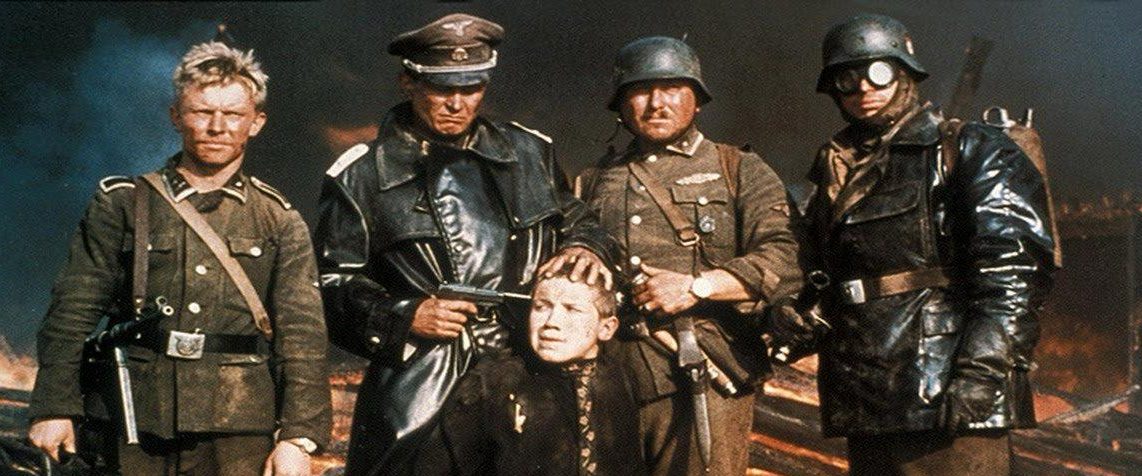
Klimov’s Come and See is an explosion of memory
After seeing a genocide erupt before his eyes, a boy looks down to a dirty puddle, sees a portrait floating in the water, and aims his gun. The final scene of Elem Klimov’s harrowing World War Two Epic Come and See, though working in harmony with its story, is not what anybody expects.
Think of an ending to a war film. You might conjure up in your mind the old veteran breaking down at Normandy Cemetery from Saving Private Ryan or even the euphoric escape of the child soldiers in Beasts of No Nation. Most war films gradually arrive to this kind of personal climax, where emotions pour out from the inward journey of the characters, calming their brutalisation by the catastrophe they’ve endured. Come and See, a film praised for its unrepenting realism, ends in a documentary and metaphysical way.
Following the story of Flyora, a young Soviet partisan who witnesses the Khatyn massacre and the beginnings of the Holocaust, Come and See is regarded by many as unwatchable. Unlike Schindler’s List, where Spielberg used Amon Goth – a real yet largely unknown character – to symbolise the inhumanity that Nazism let loose, Klimov slowly draws our attention to a persona that is visually and audibly distinct, his namesake the film’s intended title ‘Kill Hitler’.
Hitler is an ominous presence from the very beginning
Perhaps with the exception of Downfall and Inglorious Bastards, no western audience has seen Hitler depicted in a dramatic form. What makes Klimov’s depiction stand out as the most insightful movie about Hitler is how it is achieved, fusing cinematic techniques together with history and poetry.
Hitler is an ominous presence from the very beginning. In the pre-credits opening, Flyora and another kid eagerly try to find a rifle beneath the sand so they can join the partisans, all the while being harangued by an angry old man. Just as Flyora finds one, the gun that he’ll use in the final montage, a spy plane looms overhead.
Klimov starts the credits from the aircraft’s point of view and, over its radio, the infamous shrieking of one of Hitler’s speeches creeps in. Having this follow Flyora’s discovery draws a perceptive connection. Klimov, through the purely cinematic traits of mise-en-scène and mixed audio, links the boy’s excitement over violence to who Auden called ‘a psychopathic god’, the origin of the violence Flyora will encounter.
Klimov marks Hitler in Come and See not as a literal character nor an offscreen villain but the wild hunting catastrophe that will destroy everything in Flyora’s life and, nearly, his inner self entirely. The gun is the seed and Hitler is the tree. The old man’s barking warning to Flyora is, on a second viewing, a harrowing moral “Who are you playing with? Digging? Digging again?”
Driving forces from both past and future crystalise in how Klimov symbolises Hitler
In an interview in 2001, Klimov said that he made Come and See for two reasons. First, he was a child in Stalingrad during the siege and felt he had to make something about the hell he’d been through and, second, back in 1982, a nuclear apocalypse felt like a cripplingly real situation. These driving forces from both past and future crystalise in how Klimov symbolises Hitler.
When a croak-voiced commander riles up the young, untrained partisans, he states: “Hitler is waging a total war against us. A war to wipe us all out.” The head commander Kosch doubles down: “Hitler’s greatest weapon is our fear.”
Through dialogue, Klimov places Hitler specifically as the embodiment of the bloodhounds that they are facing. This is where the madness begins and there is not a moment to reflect on the devastation being wrought until Flyora gets to a refugee camp. There, a few of the resting partisans mould a scarecrow from a skeleton. The boy looks on as they bicker about how it should look – “Get rid of the nose. He’s got syphilis… He lost it in the First World War.” Anyone in the know can guess who they are slowly moulding an effigy of.
Flyora gazes in shock as he sees a mock Hitler, with busy moustache and an arm raised in salute, staring down at him. It’s an obvious symbol yet Klimov places it at a mid, calm point in the film – a poetic reminder of who is responsible for the boy’s despair.
Again, the terror ensues. Flyora witnesses the Khatyn massacre, an annihilation of a village, 26 houses and 157 people. The sequence speaks for itself.
I repeat the verse from Revelations that Klimov used for the final title ‘And when he had opened the fourth seal, I heard the voice of the fourth beast say, Come and see. And I looked, and behold a pale horse: and his name that sat on him was Death, and Hell followed with him.’
A break in form follows…documentary footage of death camp corpses cuts in
When the partisans capture the SS brigade responsible, a moral game is played over their lives. The breaking point comes when a fanatical SS officer explains why they are to murder the children as well: “Because all the trouble starts with the kids. Your nation doesn’t deserve to exist…inferior races spread the communist contagion.” Done in the film’s signature closeup, it’s as if the man has been possessed with his eyes wide open.
A break in form follows this. Just after the captured Nazis have been riddled with bullets, documentary footage of death camp corpses cuts in. It’s unnerving, considering that there’s been no intercutting of any contemporary footage up to this very late point.
Klimov has this shock come as a prelude to what is, for Flyora, an explosion of memory, looking down at a filthy puddle where a portrait of Hitler floats with the caption: ‘HITLER THE LIBERATOR’.
In this exhilarating, metaphysical whirlwind, the boy shoots his gun for the very first time at the picture. A montage of closeup and documentary imagery begins as, with every shot Flyora makes, Hitler’s life is told in reverse. The last footage of him alive, greeting Hitler youth. The Holocaust, the war and his triumphant marching into country after country. Note Klimov’s music choices here, as Wagner’s ‘Ride of the Valkyries’ plays as Hitler is at the height of this power. Remilitarised army marching backwards and the Nuremberg rally sped up. Hitler a meagre politician to a street preacher. All culminating back to World War One and reaching his childhood. Here Flyora’s mad barrage stops. A picture is shown of a mother with a baby in her arms.
The boy has all the power to destroy, if only in his mind, the man responsible for the mass murder he’s seen
“What we meant by that was to kill the Hitler within yourself,” Klimov remarked about the film’s original title. The director came to the same conclusion in this masterpiece sequence that the American historian Timothy Snyder made in his book Black Earth, that the Holocaust began in Hitler’s mind. The boy has all the power to destroy, if only in his mind, the man responsible for the mass murder he’s seen. Flyora chooses mercy.
Perhaps Klimov thought of the same Auden poem while he was cutting this montage: “I and the public know / What all schoolchildren learn, / Those to whom evil is done / Do evil in return.” And by the bitter end, Flyora resists this incredibly tempting victory. He does not resist the horror he’s been subjected to, burying trauma in his mind by shooting a baby Hitler. He affirms his total experience and sees clearly the origin of it as a mere man who, even once, was a child in his mother’s arms. For Flyora, it’s the beginning of a unified self-awareness, a unique strength to live without revenge.
Comments