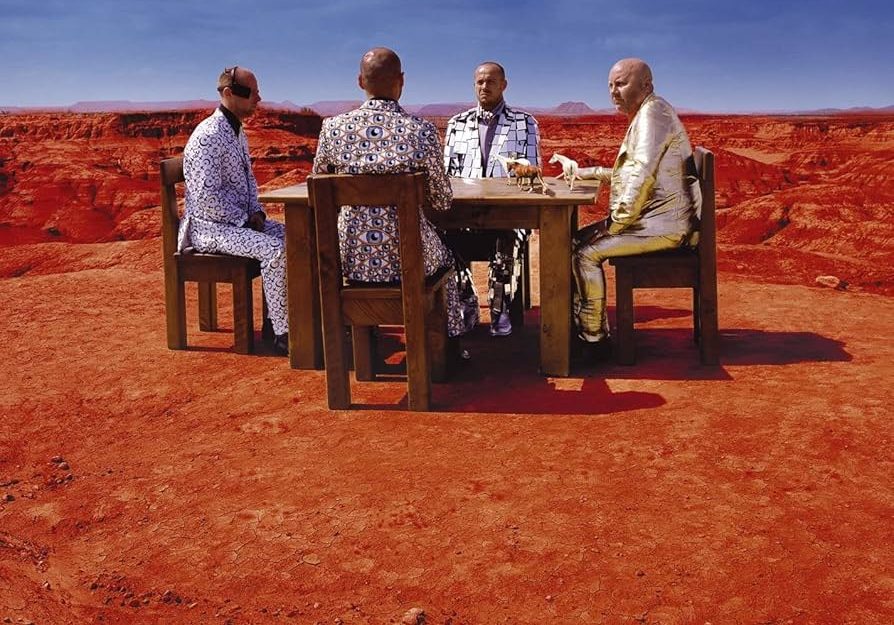
Twenty Years On: ‘Black Holes and Revelations’ by Muse
It’s been twenty years since Muse released their fourth studio album, Black Holes and Revelations, but has it managed to pass the test of time? Formed in 1994 by Matt Bellamy, Chris Wolstenholme and Dominic Howard, Muse has irreversibly influenced and transformed rock, from Bellamy’s unmatchable falsetto to Wolstenholme’s iconic basslines. Released on 3 June 2006, Black Holes and Revelations remains their highest-selling album, boasting their biggest hit, ‘Supermassive Black Hole’, renowned as the song used in the Twilight baseball scene. However, in 2026, does Black Holes and Revelations still deserve the same acclaim?
Track 1: Take a Bow
‘Take a Bow’ is undeniably one of the album’s defining tracks, dripping with seductive disdain aimed at corrupt world leaders and politicians, who “bring corruption to all that (they) touch”. Although relatively simple in composition, the instrumental arrangement is impressive, perhaps intentionally constructed to reflect the repetitive nature of party propaganda, a critique of populism still very relevant to this day. For an album opener, ‘Take a Bow’ is unprecedentedly strong, but it would be slightly fallacious to assert that it’s the best song on Black Holes and Revelations, considering the album’s strength as a whole. In addition, although the lyricism and symbolism are strong, for a band as instrumentally talented as Muse, it does seem a little too restrained. Then again, perhaps holding back at the beginning works in their favour. After all, the best is yet to come.
Lyrics Rating: 9.5/10
Instrumental Rating: 7/10
Overall Rating: 8.5/10
Track 2: Starlight
In comparison to the previous track, ‘Starlight’ is relatively light, no longer focusing on corruption but instead lamenting about longing to be with loved ones. Easy to listen to, ‘Starlight’ is timeless, but underneath the pleasant facade, it is devastatingly raw, inviting the listener, or rather the lost muse Bellamy is singing to, to “conspire to ignite all the souls that would die to feel alive”. In the same way ‘Take a Bow’ scathingly reveals the cruellest elements of humanity, ‘Starlight’ implores us to recognise that we all, regardless of class or creed or race, long for something human, a genuine connection to shield us from the hate that seems to spew from every corner of humanity. Instrumentally, ‘Starlight’ is arguably rather bland, at least for Muse. Personally, ‘Starlight’ is usually a skip, but only because Muse have much greater offerings in their discography.
Lyrics Rating: 7/10
Instrumental Rating: 6/10
Overall Rating: 6.5/10
Track 3: Supermassive Black Hole
Now for the big one, their most known song not only on this album, but in general. It’s impossible not to adore ‘Supermassive Black Hole’, whether that be for the 33 second intro thumping with the bass’ bravado, or for Bellamy’s falsetto, a heavenly sound which many have tried and failed to match. The lyrics, predictably but lovably ostentatious, are no poetic masterpiece, mentioning “supermassive” sixteen times throughout, but never fail to hit that sweet spot. In particular, the instrumentals are particularly strong, pushing against the limits of progressive rock, as Bellamy continued to play around with guitar distortion, using fuzz pedals to transform the latter half of the song. Recently, in collaboration with Manson Guitars, which Bellamy co-owns, a fuzz pedal called the Supermassive Black Fuzz has been released, which supposedly mimics the distortion apparent within the track. It remains to be said, however, that ‘Supermassive Black Hole’ is a masterpiece that deserves all the love it receives.
Lyrics Rating: 9.5/10
Instrumental Rating: 10/10
Overall Rating: 9.5/10
Track 4: Map of the Problematique
Ever felt trapped within a system programmed against you? ‘Map of the Problematique’ perfectly encapsulates that hopeless feeling, morphing from mere song to philosophical musings, all encased within intricate instrumentals designed to asphyxiate the listener. If the album is to be taken as a concept album, as many of Muse’s latter albums are, ‘Map of the Problematique’ illustrates the struggles of the narrator to balance their wishes to conquer corruption with attempting not to succumb to the desires of their heart. But even without the symbolism behind it, the track is an aesthetic tour de force, unafraid to manipulate the listener into a state of “fear and despair”. After all, “when we all bleed, we bleed the same”.
Lyrics Rating: 10/10
Instrumental Rating: 10/10
Overall Rating: 10/10
Track 5: Soldiers Poem
A track fairly unremarkable, ‘Soldiers Poem’ is one of very few acoustic tracks released by Muse, although perhaps one of their most relevant to the present day. Essentially written from the perspective of a soldier realising that they are merely a pawn to be sacrificed by their corrupt leaders, ‘Soldiers Poem’ presents to the listener just how pointless war is, stark in comparison to earlier tracks from the album brimming with hope for humanity. Regardless, I must say that Bellamy’s vocals, free from the usual ornate instrumentalism of Muse, are remarkable, truly marking Bellamy as one of the greatest vocalists of the 21st century.
Lyrics Rating: 7/10
Instrumental Rating: 5/10
Overall Rating: 6/10
Track 6: Invincible
Hidden among politically loaded tracks, ‘Invincible’ is a refreshingly intimate ballad, spurring the listener to get up and fight in the face of corrupt forces trying to bring humanity down. Once again, instrumentally the majority of this track leaves a fair bit to be desired, although that is rectified by Bellamy’s strong vocals, perhaps marking ‘Invincible’ as an opportunity for Muse to differentiate themselves from other contemporary bands (ahem, Radiohead) who lack the kind of uninhibited intensity Bellamy brings to the table. Around the mid-point, however, Wolstenholme’s bass begins to get slightly heavier, leading to another one of Bellamy’s inimitable guitar solos, perfectly complementing each other. Truly a hidden delight.
Lyrics Rating: 8/10
Instrumental Rating: 7/10
Overall Rating: 8/10
Track 7: Assassin
Chaotic and undercut with arguably Howard’s greatest performance on drums, ‘Assassin’ is overtly a protest against blindly accepting the lies of our leaders, urging the listener that the time is now to “shoot your leaders down”, to escape from their oppressive control. It’s often remarked that Howard designed his drum section to be impossible to recreate, although it is rather reminiscent of boots on the ground, once again invoking military imagery to prove that the “demoncracy” must be overthrown. The term “demoncracy” is perhaps the greatest product of this song, for truly what is democracy when it is ruled by those worthy of emulating Satan himself?
Lyrics Rating: 7/10
Instrumental Rating: 9/10
Overall Rating: 8/10
Track 8: Exo-Politics
Oh dear. Indicating where Muse were fated to head, ‘Exo-politics’ is a conspiracy wrapped within pretentious grandiosity. Although the drums once again are rather impressive, track eight fails to land. Perhaps in Muse’s alternative reality, the “zetas in the sky” are truly “our leaders in disguise”, but compared to the relative brilliance of the rest of the album, ‘Exo-Politics’ is purely a hedonistic ramble into delusions. Speaking of delusion …
Lyrics Rating: 5/10
Instrumental Rating: 7/10
Overall Rating: 6/10
Track 9: City of Delusion
‘City of Delusion’ is pure, euphoric chaos, a cacophony of rising riffs, trumpet solos and Spanish-inspired guitar crescendos. Not only is it musically perfect, but lyrically brilliant, reflecting upon how propaganda and ever-confusing lies by state and state actors force the public into a state of confusion, and thus delusion, ever accurate today as populist leaders such as Donald Trump and Nigel Farage wage a war against truth and transparency.
Lyrics Rating: 8/10
Instrumental Rating: 10/10
Overall Rating 9/10
Track 10: Hoodoo
Hidden towards the end of the album is ‘Hoodoo’, a devastatingly raw ode to human nature, with perhaps the greatest lyrics Muse has ever produced. Beginning quietly again with Spanish-inspired guitars, ‘Hoodoo’ reaches the pinnacle of poetry with the last lines, mournfully lamenting that “I’ve had recurring nightmares, that I was loved for who I am, and missed the opportunity to be a better man.” Those last few lines stick in my psyche, repeating over and over again, because what is the point of existence, if not to be loved and be the best version of yourself?
Lyrics Rating: 10/10
Instrumental Rating: 9/10
Overall Rating: 9.9/10
Track 11: Knights of Cydonia
And finally, the magnificent finale, over six minutes long and compositionally a tour de force yet to be rivalled by any contemporary artists. Bellamy’s vocals are at their best, switching from falsetto to vibrato constantly, whilst urging the listener to “fight for their rights”, a message which today is ever important in this hellish landscape the Western world is transforming into. Instrumentally, ‘Knights of Cydonia’ is also flawless, but somehow delightfully enjoyable to listen to. Raising questions about whether those in power truly look out for their citizens, through imagery of a “God (who) falls asleep on the throne”, the track is not just the finale to one of the greatest albums ever produced. It is a warning, a call to arms, informing the people of the world that they must rise up against the oppressive ruling class and fight to survive.
Lyrics Rating: 10/10
Instrumental Rating: 10/10
Overall Rating: 10/10
It’s clear that, twenty years on, Black Holes and Revelations is still just as brilliant, and just as relevant. Filled with conspicuously political tracks hidden behind grandiose vocals and innovative instrumentals, Muse undeniably created a timeless masterpiece that, as the corrupted ruling class continue to remove the rights of individuals and taunt us with their lies, will continue to inspire and call listeners to the revolution. Overall, Muse remain not just one of the greatest musical talents Britain has to offer, but also a great philosophical gem.
Recommended Listening: ‘Map of the Problematique’, ‘Knights of Cydonia’
★★★★★
Listen to Black Holes and Revelations here:
Comments