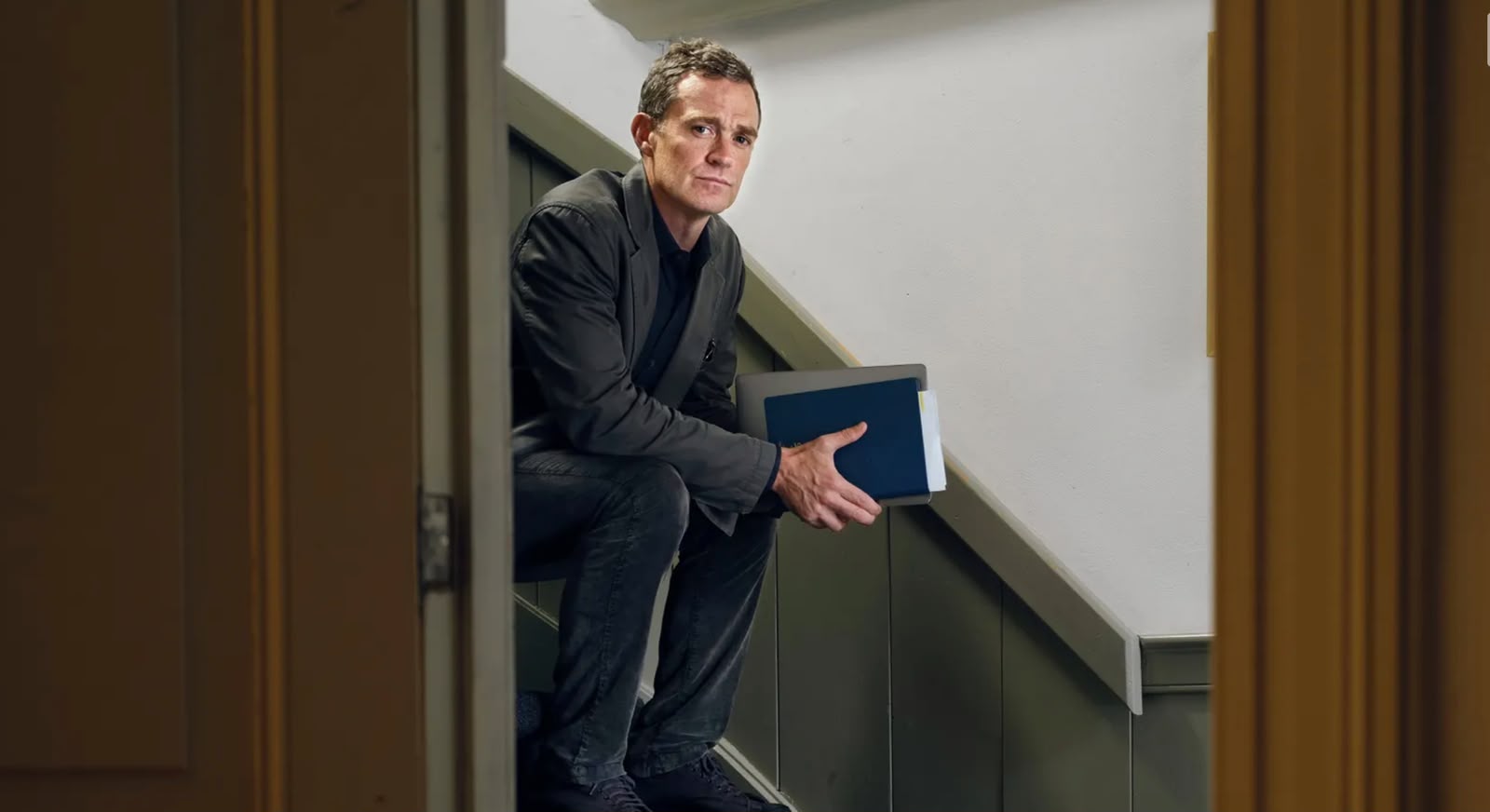
What is wrong with this picture? Patrick Radden Keefe speaks to The Boar
The morning following my interview with New Yorker staff writer Patrick Radden Keefe, taken place in a calm meeting room in Derry’s Seamus Heaney Homeplace, something terrible occurred. I, alongside the rest of Northern Ireland woke to a horrific video. A man had reportedly been attacked on North Belfast’s Kinnard Avenue, he was pinned down in the middle of the street as his attacker brutalised his face with a kitchen knife. The video ignited a fear within me and many others, as the collective realisation that this act of violence, reportedly committed by an immigrant, would incite a night of riots and terror dawned upon us. The reality proved even worse than predicted. In the end, destruction was reaped across two nights, on a scale the province has not seen in decades. A small insight into this scale of destruction was given through the harrowing footage of a family rushed into a police Land Rover from a home engulfed in flames.
All this confusion and anger eerily coalesced the themes that reappear in Keefe’s journalism. Keefe, fifty, has all the hallmarks of the typical liberal East Coast reporter. With his Dorchester, middle class Boston accent, he could be any talking head or podcast host, and despite what must have been a demanding schedule of literary festivals and arts events, he remained composed and thoughtful throughout our interview. His latest work, London Falling, his newest non-fiction book, is subtitled ‘A Mysterious Death in a Gilded City and a Family’s Search for Truth’. If you look at his two most recent and prestigious works, Say Nothing and Empire of Pain, a similar connection of death to the wider tragedy of society is threaded throughout. “I’m trying not to appeal to specialists” Keefe responds to this assessment of his last three books, “we all have families and so it’s a kind of point of entry for readers”.
“There’s the small story in the big story…and then becomes a way to illustrate some bigger phenomenon through the story of a handful of characters”
What was gratifying about our conversation was the time he took with my questions. He was measured and very articulate – his language was chosen with the careful weighting of a man accustomed to conducting interviews, such as these, himself. He thinks that these singular mysteries and tragedies are like puzzles that open a world of questions and therein stories.
“There’s the small story in the big story…and then becomes a way to illustrate some bigger phenomenon through the story of a handful of characters.” Laying his approach out, he notes these stories create “narrative momentum…and once you have that narrative momentum going, I think you can explore a series of deeper issues.”
In London Falling, Keefe digs deep into Maidenvale’s underworld. It’s the story of Matthew and Rochele Brettler, an upper-middle-class Maidenvale family whose lives are upended by the strange death of their teenage son Zach. Readers are guided through a tale of gangsters, drug traffickers, grifters and police informants, where the truth fluctuates and everyone is a suspect. The way Rochele conveys the grief of losing her child, “he should have been an actor. He should have been a writer. He should have been anything. He shouldn’t be a dead nineteen-year-old.” delivers an emotional blow one always desires from a great novel yet rarely receives. Zach Brettler, a nineteen-year-old con artist who claimed he was the son of a Russian oligarch, became dangerously out of his depth, his decision and actions ultimately culminating in his untimely death. Many a person have created a fantasy existence for themselves, but not all of them are dealt with the cruel hand that Zach was given. Matthew, Zach’s father, finds a connection in the young Bob Dylan – a trickster who spins tales for his own amusement, in order to elevate his fame.
Asked why his work repeatedly returns to divided societies, I questioned Keefe’s repeated focus, one commonly expressed through the story of one, mysterious death, and he responded by urging the need for compassion when writing about victims. Keefe went to law school, then to Hollywood to write screenplays before he started his career as a journalist. His style is not that of a salacious writer and he avoids the typical conventions of gory thriller, instead choosing to return to the core unities of time and place. He stressed the importance of creating a language to describe complicated places and complicated histories – illustrating a larger, disturbing phenomenon told through the lens of one personal story. He spoke about finding stories for his next project “I’m really interested in Barcelona and Catalonia. I’m interested in South Africa because of the history of Apartheid and Beirut.”
The deaths at the heart of these stories nudge readers to confront the secret sacrifices that we make in our lives
The deaths at the heart of these stories nudge readers to confront the secret sacrifices that we make in our lives. The funeral of Zach, described with the same sombre attention to detail as the murder of Jean McConville, is a prime example. This approach is most evident in Say Nothing, which was a watershed for my generation in Northern Ireland – a conflict that bore so much horror, that were you to pick a random week across the course of three decades you would undoubtedly find any number of tales depicting atrocities and degradations of humanity. Keefe was able to find one story that told it all.
That same approach similarly underpins London Falling: the driving theme behind this novel being ‘lies’. A lie saves Zach’s grandfather, the public intellectual rabbi Hugo Grin, from the gas chambers at Auschwitz. Affecting accents. Phony degrees. Magic surpluses of money. Arriving at the final scene, with all these disparate lies colliding with one another, Keefe creates a classic, yet compelling narrative, weaving together themes and ideas that unite the suspicions raised in the first chapter to the revelations revealed in the last.
That concern with illusion recalls motifs present within Scott Fitzgerald’s own writing, as like Gatsby, Zach lived in dreams. He accomplished some of them. He fatally failed in others. But, in his online persona and in-person bravado, he was a dreamer. Fitzgerald thought America would always live in dreams and would always have nightmares as a result. Keefe offers a similar lesson for London. A city where it doesn’t matter if you’re a teenage grifter like Zach or a striving immigrant like Hugo or even a student at Russell Group University. If you fall into that dream, the dream will swallow you whole.
For every journalist, for every writer, there is always something to learn
Speaking to Patrick Radden Keefe, even just for nineteen minutes, I learnt so much by simply listening. There are many examples of journalism that reads as detached and cold, inhibited by the author’s own bias. For every journalist, for every writer, there is always something to learn. In his three-play odyssey The Coast of Utopia, playwright Tom Stoppard has the Russian philosopher Alexander Herzen ask, while looking at a busy skating rink in Moscow, “What is wrong with this picture?” Keefe asks the same persistent question. It is perhaps the purest thing any writer can do.
Comments