The Horror in the Heart of this Farce: Arturo Ui at the RSC
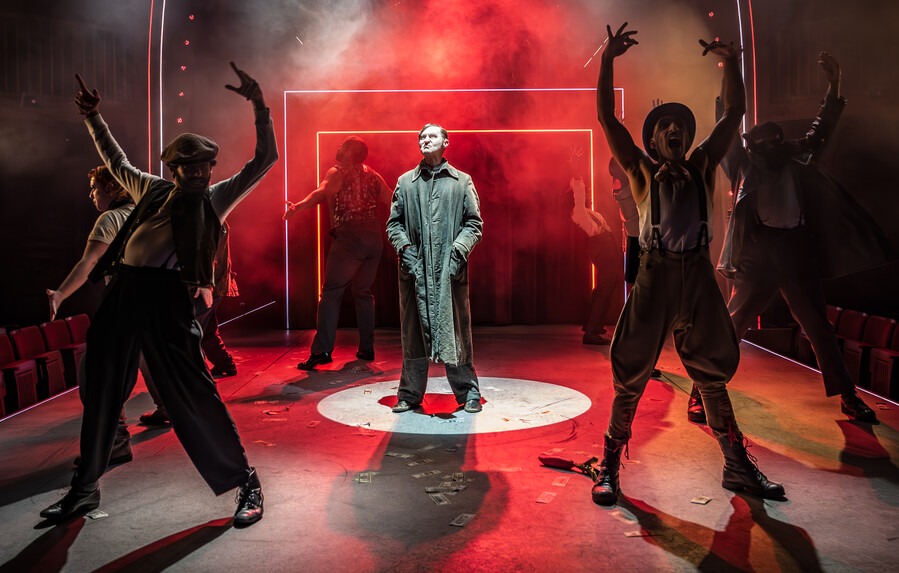
Scowling. Squinting. Decaying jowls. A reptilian, piano key smile. A dirty jacket and hat. In the prologue to the RSC’s production of The Resistible Rise of Arturo Ui, Mark Gatiss creeps into the titular role. His entrance, introduced in the middle of the prologue, comes as stark. Moments earlier, we were with Mawaan Rizman’s sardonic Barker, beginning the play with shrewd asides to the audience and jokes about comp tickets. The prologue’s end is also light hearted and bombastic; dollar bills flying into the air and Placebo’s techno-alt sound making the intimate Swan Theatre feel epic. Yet, in the heart of this most tongue-in-cheek of satires, Director Seán Linnen finds the real darkness that centres Brecht’s parable of Hitler.
Bounded with what Tony Kushner coined ‘the Big Brechts’ (Mother Courage, Galileo, The Good Person of Szechwan and The Caucasian Chalk Circle) the play is of one of the writer’s most popular and performed works. Brecht wrote the first draft Arturo Ui in under three weeks. Exiled in Sweden in March 1941, he and his family fled Germany the day after the Reichstag fire. Brecht was condemned by the Nazis, his wife Helene Weigel was half Jewish. His shrewd instincts proved right, as the Gestapo arrived at their apartment a mere hour after they fled. The gangster allegory he wrote years later, inspired by pulp paperbacks andPaul Muni, puts Hitler his rogue’s gallery of Goering, Goebbels, Rohm into a comic allegory.
Linnen, with a perceptive new translation by Stephen Sharkey, unites the company in this cartoon Chicago circus. From Rebakah Hinds’ perfect Betty Boop accent to LJ Parkinson’s clowning menace as the Goebbels substitute Givola, the play wears it’s playful satire proudly. This energy, coupled with Brecht’s structural pace so that there is an easy bounce from one scene to another, is readily watchable. Yet, of course, all this a trick. Each scene, a change from Brecht’s usual conventions, ends with a title card detailing by the exact episode in the Nazis rise. Most of these historical incidents are of violence. The attacks on communists, the Reichstag fire, intimidation of voters and Anschluss. But in Ui’s underworld, this terror is done through leeks and beetroots –– a prop nod to the wealthy cauliflower market that, bit by bit, puts Ui in power.
In the heart of this most tongue-in-cheek of satires, Director Seán Linnen finds the real darkness that centres Brecht’s parable of Hitler.
The proof of the pudding is in the eating. An old phrase that Brecht took as his mantra for the theatre. The incomprehensible is made sense. When you mask an uncomfortable truth with comedy and satire, it helps the medicine go down. Brecht uses signature wit to mask the violence that blast beneath the play’s surface, such as Ui’s observation “Kindness is a luxury / Who can afford it? Not poor me.” Shakespeare, fitting for the venue, is also used to enertain and distract the audience from the destination that the play is taking us too. The prologue references Richard III and the bloody Wars of the Roses, an old Shakespearean actor trains the gangster for public and the speaking and the ghost of the backstabbed Roma haunts Ui with the warning “Cos just as treachery has made you, soon It will undo you. And the day is coming, when all the corpses you have made will rise up”. However, by the play’s end, there’s no need for literary allusions or slapstick. The audience knows too well what it has laughed into, as the title reveals the terrified vote that put’s Hitler into total power. In the epilogue, done in a stark white light, Gatiss wipes off the greasepaint moustache and speaks in his own voice “This bastard almost won the human race! / The World fought back, and put him in his place.” The play’s last moment; the company standing solemn whilst the sound of train cars hurtling and hurtling. I’m reminded of Brecht’s successor Heiner Müller’s infamous quote that “Hitler came to power in a free election, which makes Auschwitz also the result of free elections.”
Arturo Ui has always been criticised for not tackling the Holocaust and Nazism’s inherent racism. It’s a fair argument to make. This translation doesn’t try to change that. Although, this production strikes what Brecht is and should be satirising. Watching this play for the first time, I’m reminded of Springtime for Hitler and Mel Brooks’ anti-fascist in The Producers. Brecht and Brooks are working from the right kind of satire. For them there is always a limit. A point where the jokes stop because there’s nothing funny to joke about. Brooks remarked that he would make Nazi jokes but not Holocaust jokes. There was nothing funny about the violence the Nazis committed. Springtime for Hitler was satirising the shoddy theatrics of fascism, not the suffering that they inflicted on millions. In the same way, Brecht focused in on the inherent violence of the Nazis, putting a comic veil on it that is slowly. This production’s great sleight of hand, that we see and hear real words and actions yet don’t take seriously because of this thin wall of fedoras and funny voices.
Janie Dee’s line puts it perfectly “God protect us from our protectors!”. And those who leave a performance of The Resistible Rise of Arturo Ui, though maybe shaken by the ominous final warning, may also shiver at the worrying reality around them. A man calling for national security emergency. A party declaiming to be Britain’s protectors, who are fine with cruelty yet shudder at the smallest act of kindness. Arturo Ui and his gang sit on a middle bench in parliament. Their rise is certainly resistible, if there’s a will to resist.
★★★★★
Comments