‘¿Y por qué no?’ Spanish magic in a football pitch
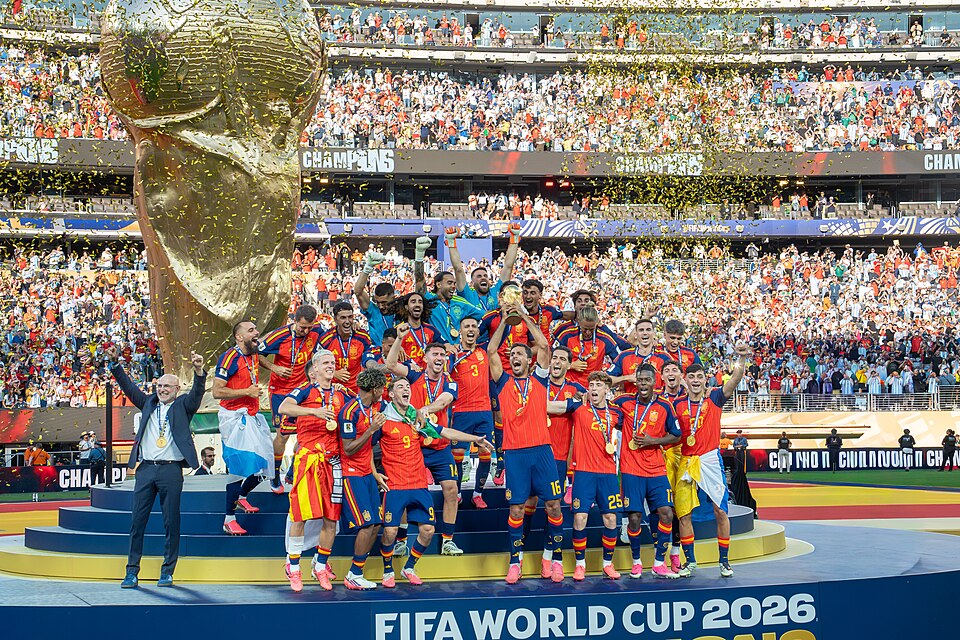
U nai Simón. Cata Coll. Luis de la Fuente. Pere Romeu. Lamine Yamal. Vicky López. Alexia Putellas. Women’s Barça. With eight winners in the Ballon d’Or ceremony, it is unquestionable that Spanish football is experiencing a most exciting time. And their success does not only come from individual titles – Spain is currently the defending champion of the men’s Euros as well as the gold medallist at the Olympics and women’s Nations League. The future seems bright for Spanish football, as the country is also dominating in inferior categories, winning both the women’s and men’s U19 Euros and the first ever U15 World Cup, with the women’s team also holding the U20 World Cup title. This, of course, must be added to the fact that Spain is the only country that has won the women’s and men’s World Cups simultaneously, titles that have been won in 2023 and 2026.
Spanish coaches must be federated to be able to train little kids
But where does all this come from?
Firstly, is important to mention that Spanish coaches must be federated to be able to train little kids. This means that there are very qualified trainers in charge of the football development of these children. In relatively small cities, there are two or three clubs training kids under highly qualified coaches. Five of the trainers in the Premier League are Spanish, proving the competency of these highly qualified instructors.
Moreover, the Spanish league has long been home to some of the biggest football stars, such as Messi or Cristiano Ronaldo, which has inspired children all around the country, influencing their football style and allowing them to dream of a career like theirs. Altogether, Spanish clubs hold more than 70 European titles.
Football is the sport of excellence. It’s the sport little kids play in the schoolyard. The one teenagers play when they go out with friends. The one adults come together to watch at home with a couple of pizzas, and the one elders watch at bars with a beer in hand. This environment encourages kids to play and, considering that many big clubs send out scouts to get these kids enrolled in their youth academies (known as canteras in Spanish), children feel that becoming a professional footballer is a real possibility.
All these factors have heavily influenced the development of Spain’s characteristic game play. First, it was la furia roja (the red fury) which has now transformed into the distinctive way of keeping the ball through passes.
Who is the star? No one. Everyone. Spain plays as a team
Still, Spain’s football has a special charisma that can only be attributed to their unique personalities. All players perform for a team and they know it. They have an inherent sense of loyalty and faith that, in many cases, comes from playing together in inferior categories, developing a special bond that allows them to trust each other. Many national teams are formed around a ‘star figure’: Messi for Argentina, Ronaldo for Portugal, Courtois for Belgium – but not Spain. Spain’s national teams do not consist of a great star and ten players running support, which is precisely the magic of a team like Spain. All positions work towards a single goal, which again allows for Spain’s specific brand of football.
Who is the star? No one. Everyone. Spain plays as a team.
Comments