Warwick physicists help find first evidence of rarest beauty particle decay
Physicists have found the first evidence of an extremely rare particle decay, with the University of Warwick playing a leading role.
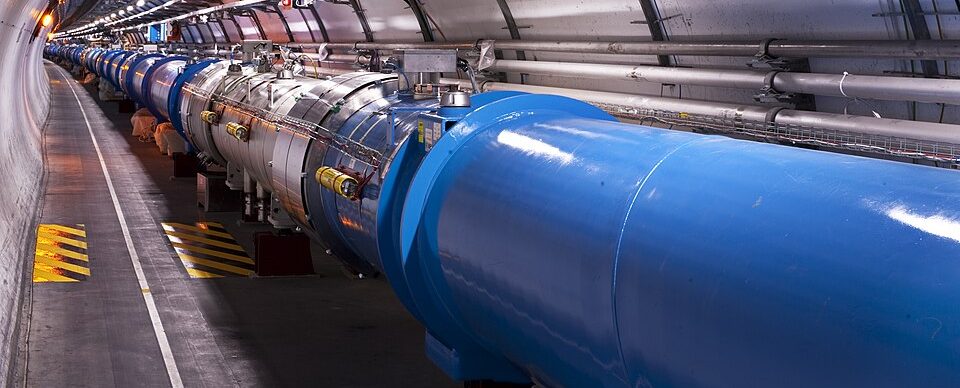
Physicists from 10 UK universities worked on the upgraded LHCb experiment at CERN’s Large Hadron Collider (LHC), the world’s highest-energy particle accelerator, which started up in 2008.
The experiment explores a region known as the Zeptoverse, a scale 100 billion times smaller than an atom.
The team studied the decay of beauty particles, which are subatomic particle produced in collisions at the LHC.
They found the first evidence of a decay in which a beauty particle breaks down into two muons, which happens around once in every ten billion beauty particles.
According to the University of Warwick: “The rarer the decay, the more sensitive it is to Zeptoverse influence.”
This means the result could help physicists understand how particles that have not yet been discovered, such dark matter, might interact with beauty particles.
The result is not yet strong enough to be classed as a confirmed discovery, which requires a higher level of statistical certainty.
This fantastic result showcases the extraordinary capabilities of LHCb to probe nature at the fundamental level
Professor Tim Gershon, leader of LHCb experiment
Professor Tim Gershon of the University of Warwick, who leads the LHCb experiment, said: “This fantastic result showcases the extraordinary capabilities of LHCb to probe nature at the fundamental level.”
The result comes after the BBC reported that UK funding on for a planned upgrade to the experiment had been “pulled”.
Without the upgrade, LHCb is likely to stop operating in 2033, according to Physics World.
Dr Harry Cliff, Ernest Rutherford Fellow at the University of Cambridge, told the BBC: “It seems like a kind of mad decision to be damaging a sector that is genuinely so important and successful.”
The Science and Technology Facilities Council, which made the decision, has said project cuts were needed after inflation, energy costs, and exchange rates raised its annual costs by more than £50 million.
Comments