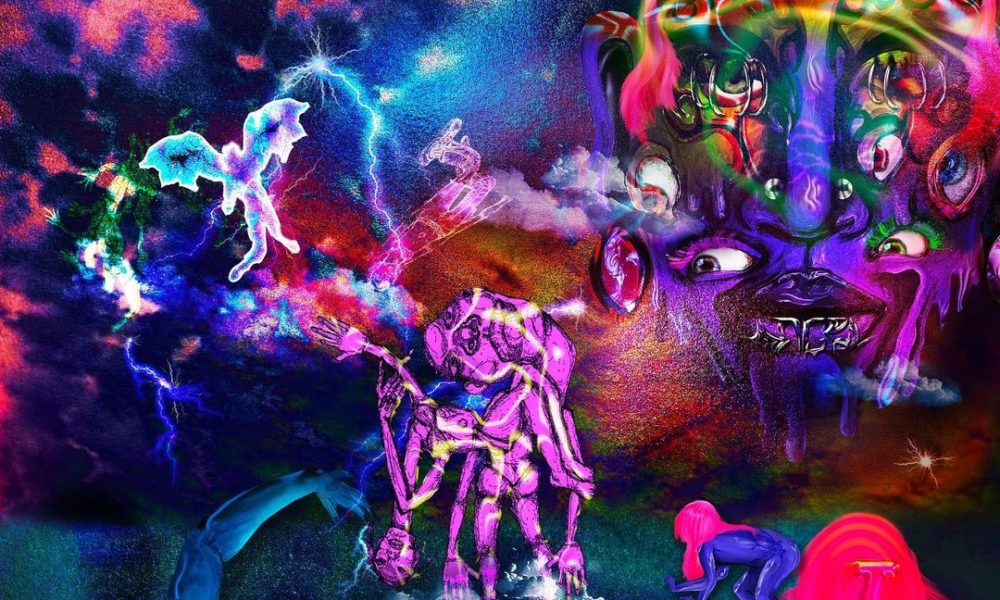
The music that made me: ‘The Angel You Don’t Know’ by Amaarae
I was going mad during the lockdown. I had overestimated how much of an introvert I really am. I was worried everyone from my friends to my favourite footballers were going to die. Music helped mollify this anxiety. Often, I would freeze myself in my dad’s study to revise my subjects, the revision always accompanied by a new album. Whether it be Freudian by Daniel Caesar when I was studying mathematics, or Wunna by Gunna for chemistry.
My first time hearing Amaarae was her song with OIEE and M3NSA, ‘Still Dey Inside’, probably after clicking on an Audiomack playlist titled something like ‘New Music Ghana’. The timbre of her voice struck me as unusual, and I immediately dug through any content I could find of her on YouTube. Music videos, interviews, everything. She released her debut album on 12 November 2020. Sometime in December, a friend of mine posted it on her Telegram story. I responded asking if it was any good. She sent me the album: “listen and see for yourself”.
That night I clicked play and I knew I could never be the same. Few albums have been as sonically seismic for me as Amaarae’s The Angel You Don’t Know.
Amaarae describes the album as “non-stop affirmations and incantations 4 bad bitches”. The 14 tracks pull from an eclectic mix of genres and are layered with braggadocious raps and urges to dance and party. However, beneath this hedonistic foreground runs an undercurrent of longing for the intimacy lost to the lockdown.
‘D*A*N*G*E*R*O*U*S’ has a classic mall rock guitar riff, and ‘FANTASY‘ samples Lee’s lo-fi track ‘Rain’
The artist draws upon influences far and wide to create a beautiful amalgamation. Though based in Accra, Ama Serwah Genfi has lived in the Bronx, Atlanta and New Jersey. In an interview on Stay by Plan she touts her varied influences, spanning from Janet Jackson, Prince and Kanye West to highlife legends such as Kojo Antwi and Daddy Lumba . You can hear that provenance in the first few tracks alone. She interpolates Darkoo’s afroswing hit ‘Gangsta’ in ‘LEAVE ME ALONE’, ‘D*A*N*G*E*R*O*U*S’ has a classic mall rock guitar riff, and ‘FANTASY’ samples Lee’s lo-fi track ‘Rain’. Further in, verses from Cruel Santino and Moliy lean to reggae and dancehall.
This fusion is rare. Often African musicians’ creative visions are stifled by audiences who mandate what sound they should create. Ghanaian rapper M.anifest, on The African Imaginary Podcast, pushes for African musicians to let their imaginations run free and create, without filing their sound under one of the several arbitrary ‘afro-‘ variants.
Many Gen Z kids have their tastes shaped by their milieu and the media they consume on the internet and on TV. Where would a Ghanaian kid get to listen to U2 and The Cure? My only references for rock music up until that night were gospel songs on the WOW Hits CDs and the Austin & Ally song ‘I Got That Rock ’n’ Roll’ on Disney Channel. Notably, this album was my introduction to alté, the subgenre of alternative afro-fusion pioneered by Nigerian musicians BOJ, Fresh L and Teezee. Today Cruel Santino and Odunsi (The Engine) are at its forefront, and both appear here: Santi with a verse on ‘JUMPING SHIP‘ and Odunsi on ‘PARTY SAD FACE/CRAZY WURLD‘.
What made me realise this album was alté was when I sent the song ‘CÉLINE’ to a girl I had a crush on at the time and she responded with “wtf is this”. I thought because our favourite song was ‘Psycho’ by Post Malone she’d like everything else I did. How wrong I was. That was only the start of when I began to hear the following phrases a lot, from different people: “I don’t understand what you’re listening to”, “how can you enjoy that?”, “you and your strange music”. To this day I get deceived by the internet echo chambers and forget that nobody in real life listens to Lancey Foux, then spins through some Mk.gee and Beach House, finishing off with some Freddie Gibbs. The same mix of sounds that made the album alien to everyone around me is what made it so exciting to me.
The decadent bars, akin to what you’d hear on a trap album by Future, do not seem out of place at all
Amaarae’s overindulgent lyrics remind us to not take life too seriously and to revel in good times, and they place the album in a very Ghanaian landscape. She initially started off rapping before pivoting to singing, and her cousin Kojo Cue is a lyrical giant in Ghanaian hip hop. So the decadent bars, akin to what you’d hear on a trap album by Future, do not seem out of place at all on ‘FANCY, TRUST FUND BABY’ or ‘HELLZ ANGEL’, the most boastful of all, where she raps “I can’t even lack, I’m blessed, Rolls Royce windows tinted, I’m going down, everyday is mine, I flex.”
Some would call this vacuous. I disagree. Yes, there is a need for music with social commentary, but when your life is pretty bleak and repetitive, as it was for many during the drudgery of lockdown, you need escapism. People trapped in their homes needed to be reminded to have fun. In ‘FANCY‘ she sings “everyday I do my dance in the mirror cause I feel so damn fancy”, and on ‘3AM‘ she reminds you to “wini, wana, whine about your waist.”
Despite the fusion, the music is still very Ghanaian. On ‘3AM’ she interpolates KiDi’s ‘Odo’ and draws on feelings of that blissful, quiet journey back home after the party, with his lyrics still repeating in your head. I like music that doesn’t take itself seriously. My favourite kind of songs are short, include a guitar riff, 808s or some kind of electronic elements, and are about either love, sex, money, drugs, or all of that in one. I don’t know if it’s just a Ghanaian thing or this album is particularly to blame for that. Either way, in 2020 the bragging had a job to do.
It will surprise you that in 2026 songs of this nature are still demonized in Ghana. Older generations would happily listen to Amakye Dede’s innuendos but fold their faces into a frown at the first sound of an 808. When they hear a rap song it suddenly becomes ‘secular’ music. After all Ghana is still a pretty conservative society but I hypothesise that their nostalgia for the music of their childhood clouds their objectivity. They are more so opposed to anything new. I believe we should appreciate art that moves us whether literature, music or film even if it is not overtly religious.
Image: Michelle Helena Janssen / 032c
However, this fast life can clearly be seen as a proud façade. A veneer to hide the pain. Of the last five track titles, three contain the word ‘sad’. Even on the earlier tracks we see a fear of being alone. Moliy makes this very clear in ‘FEEL A WAY’: “You got the kinda thing that I like, don’t wanna be alone smoking marijuana”. Clearly the overindulgence is a coping mechanism. A case of drugs to numb the pain. But it is compounded in the capricious turn the album takes on ‘CÉLINE’, one of my absolute favourites on the project. She croons about Céline, an excellently crafted double entendre: masking the fact that she’s missing an actual person by inserting the name of LVMH’s subsidiary, luxury brand. It is the most wistful moment on the album. Moliy, again, who nails both features on this album and certainly outshines Amaarae on ‘SAD GIRLZ LUV MONEY’, says it plainest of all: “all this lockdown don make me kolo”.
And that’s a reprise of how I started this article. I was going mad during the lockdown, and many of us were, to be honest. A 2021 study in JAMA Pediatrics found that 1 in 5 young people worldwide were showing signs of anxiety during the pandemic, double the figure from before it. For all its flexing, the album sounds like a longing for the lost intimacy, a craving for community and socializing in a time of social distancing.
She has certainly succeeded in carving out her own distinct sound in the ever-expansive category of alternative African music
Amaarae was not the first to release an alternative music project in Ghana. No, not by any means. Joey B released Darryl in 2017, and the collective La Même Gang released their tape Linksters in 2018, a seamless blend of trap and afrobeats. FOKN Bois, Wanlov the Kubolor and M3NSA, had been entertaining with shock lyrics and breaking the mould of the conventional musician as early as 2010. In that sense Amaarae is not doing anything revolutionary. She has certainly succeeded in carving out her own distinct sound in the ever-expansive category of alternative African music.
It hasn’t stopped there. Ghana is still fertile ground for artists to push forward their own forms of musical expression without being bound to conventional highlife or dancehall sounds. Sisters Moliy and Melissa, first platformed under the album’s aegis, are enjoying success of their own. With artists like 95ANTNY and Baaba J and collectives like SuperJazzClub and All My Cousins, we can rest assured the nascent Ghanaian alternative scene is in safe hands.

Image: Our Eastern Child
The album introduced a whole new audience to sounds they previously had no encounter with. It pulled rock, trap, highlife and alté into one place. It reminded us to have fun when there was very little of it going around. And underneath all the flexing, it was a desire for human connection. Alien, ethereal, yet inviting: an angel you did not know.
Recommended Listening: ‘CÉLINE’, ‘SAD GIRLZ LUV MONEY’
★★★★★
Listen to The Angel You Don’t Know here:
Comments