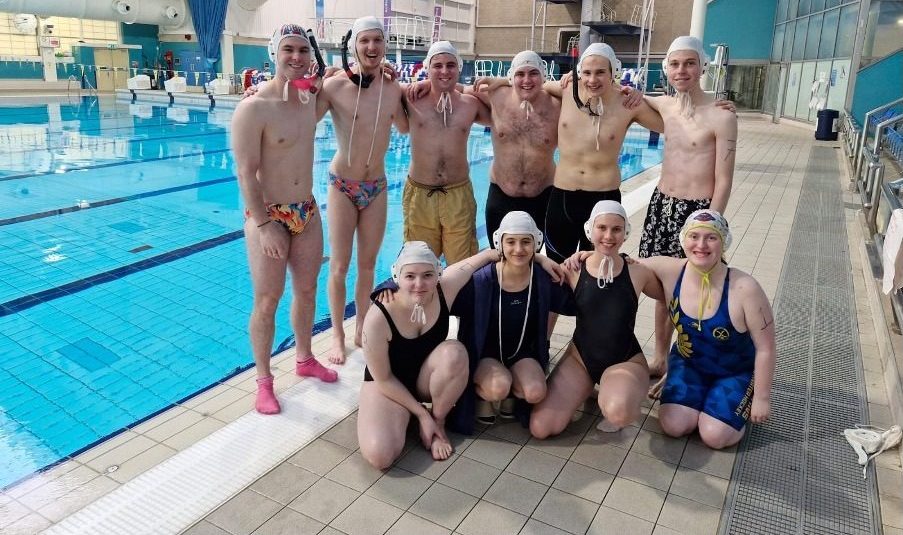
The best sport you’ve never heard of: A fresher’s guide to underwater hockey at Warwick
If you’re anything like me, you’re probably thinking: what on earth? Underwater hockey? How does that even work? And, simultaneously, how can I get involved?
The premise is both simpler and more complex than you might first assume. The aim itself is the easy part; you want to push a weighted puck lying on the bottom of the pool floor into a metal goal at either end of the court using a short, curved stick. The ‘push’ part of that is where the sport gets its infinitely catchier name – ‘Octopush’ – or 99 times out of 100, just ‘Push’.
The complex part is everything else.
If you become a regular, you’ll also gradually get to grips with being able to play in three-dimensional space
You have to be able to hold your breath, for starters (and if that puts you off, trust me, you’ll get pretty good at it if you’re anywhere near as competitive as I am), and have awareness not just of your own limited oxygen but that of your teammates too. If you become a regular, you’ll also gradually get to grips with being able to play in three-dimensional space (up, down, forward and back, and diagonally). The stick you use to push the puck also takes some getting used to: lots of curling, sliding, and body blocking is involved. If you’re familiar with the rugby play of a scrum-half, it’s basically like that – except it’s the job of every player to curl around the puck when they have possession until another teammate can come to retrieve it.
Technically, the game is a ‘limited-contact sport’ – but just like any other non-contact game (think netball in Year Seven), that rule only really applies when the referee is looking. Even though there is always one underwater in tournament play, they can’t see everything. And even if you do follow that law to a T, you’ll still get bumped and knocked by accident more than you would in a game like netball (I’ve had someone’s fins kick my mask off of my face on more than one occasion).
The sport is madness and chaos distilled down into its purest form. It’s probably also some of the most fun I’ve had so far at Warwick.
That’s in no part thanks to the fact that it’s one of the few sports so niche you can start playing at University and still be able to go toe to toe with professional players at competitions (don’t believe me? I’ll show you the silver medals we won at the Student and Alumni Nationals tournament in Term 2 last year).
It is a mixed sport too. Since most players start later in life, sex makes very little difference; it doesn’t matter how fast you can swim if you can’t avoid getting tackled.
We’re far too small to afford to be clique-y, and I’d argue our small size is our greatest strength
The society that runs our University club is called ‘Warwick Sub-Aqua’ (referred to as such because it’s actually mostly divers and a smaller minority of push players). We train twice a week on Thursday and Sunday evenings at the pool over at the Sports and Wellness Hub.
Gear-wise, you don’t have to purchase anything except a swimming costume (or a pair of budgie smugglers if you’re anything like some of our male players). The club here provides everything else, which is surprisingly a lot. To play you need a snorkel (and a mouthguard for tournament play), a cap, a snorkel mask, fins, a stick (which will be black or white depending on the team), the puck, and a glove on your dominant hand to protect yourself from abrasion and impacts.
But it’s not just the bonkers premise, the strange gear, or the fact that it’s a great way to keep fit on campus that makes me love it so much. It’s also the people (as cliche as that sounds). I got introduced to the club by a friend I made on my course during Freshers’ (shout out Lauren), but I know that even if I hadn’t known anybody there at my first session, I would have still made all the same friends regardless.
We’re far too small to afford to be clique-y, and I’d argue our small size is our greatest strength (also pretty cliche, I get it). It means that all players get tons of attention from the more experienced players during drills and match play. It also means you can start playing in Term 1 and still get tons of playtime in national-level tourneys.
If I ever got asked what the best kept secret on campus is, I would, without a doubt, say ‘push’
If I ever got asked what the best kept secret on campus is, I would, without a doubt, say push, and I’m quite confident admitting that. I know that even after reading this, you might still not check us out – but I also would love to be proven wrong.
I’ll see you in the pool.
Comments