The night owl: Sleeping like animals
Hello lovely reader.
Dim the lights and take a breath. You’re reading The Night Owl.
Given the name, I think we should talk about sleep for this first column. So let’s take a look at something fun.
Generally, teenagers aged 13-18 need 8-10 hours of sleep, while adults from 18 onwards need 7-9 hours. Some of us forget and make it 5 – this could not be me, and while the standard amounts apply to most people, they are not universal. Personal circumstances and health come into play with how much rest your body needs. Anyone who’s still stuck with the fresher’s flu and just sneezed should be getting into bed; sleep is a tasteless healing potion. At the same time, there is also a study which states that “variations in how much sleep you need may even be genetic”, and this is where a fun thing called chronotypes comes in.
Your chronotype is the natural inclination for when your body sleeps, wakes, and holds peak energy during the day, or, “what most people understand as being an early bird versus a night owl”. It’s driven by the circadian rhythm, which is your internal clock in the brain, and emerging evidence shows that the chronotype has more to do with genetics than simple lifestyle choices. Though of course, choosing to go to Neon Friday will effect your personal sleep needs on Saturday. Again, some people wake up early despite the late night, while others are dilly dallying until 1 pm! So, do we have genetic explanations for our differences?
A popular quiz developed by Dr. Michael Breus categorises chronotypes into four categories based on sleep-wake patterns seen in animals
For the biologists, there’s a link with having a longer allele (an alternative version of a gene) on the circadian clock gene and tendencies towards early mornings, amongst other findings. Researchers believe the variation may have been passed down as a survival technique from hunter gatherers, who needed to take turns sleeping.
Chronotypes “fall on a spectrum, with most people landing in the middle”, however, a popular quiz developed by Dr. Michael Breus categorises chronotypes into four categories based on sleep-wake patterns seen in animals. This way, we can come to understand our own sleep profile, as well as go ooooh when we seem to match the behavioural traits associated with it. The chronotype categories from Dr. Breus are: bear, wolf, lion, or dolphin. Yeah, urgh, the owls are not listed.
Traits associated with the lion include morning productivity, a tendency for routine and moderation, with some difficulty following social schedules in the evenings
A lion hunts in the morning. Traits associated with the lion include morning productivity, a tendency for routine and moderation, with some difficulty following social schedules in the evenings. In Breus’s words: “Studies show that morning types with early bedtimes have a lower risk for cardiovascular disease, less obesity, and may have lower risks for mental health disorders, including depression, anxiety, and others”.
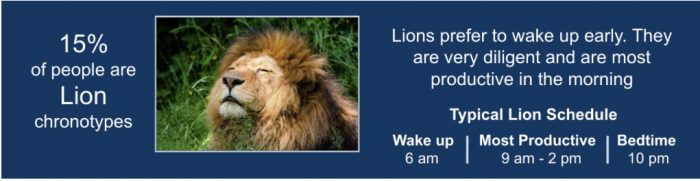
Image: Public Domain Pictures and Emily Van Hollebeke
Then, the bear: the all-day hunter. The bear is the majority of people, representing most of us who “follow the sun” and are consistent with energy throughout traditional office hours but also less prone to eventful evenings. “Bears are easy going and social, fun-loving team players. They have a high sleep drive and tend to sleep deeply. But many Bears carry a sleep debt – they don’t get enough sleep to meet their needs”, as well as “excess weight being a common challenge”.
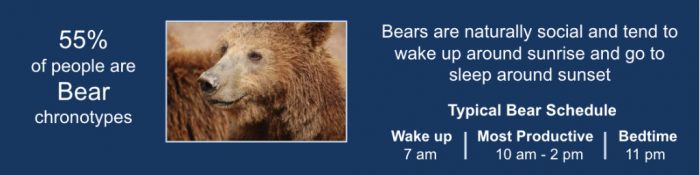
Image: Pxhere and Emily Van Hollebeke
Wolves are night time hunters. Ding Ding Ding! “The wolf chronotype is equivalent to the classic night owl”, who thrive more at night. They are “creative, impulsive, and emotionally intense” but because their sleep time isn’t in accord with general society, “wolves are highly vulnerable to chronic social jet lag and insufficient sleep and that can have consequences for their mental and physical health. Research shows evening chronotypes are at greater risk for chronic diseases, including cardiovascular illness and diabetes, and for depression.” Keep yourself on track if you’re a wolf!
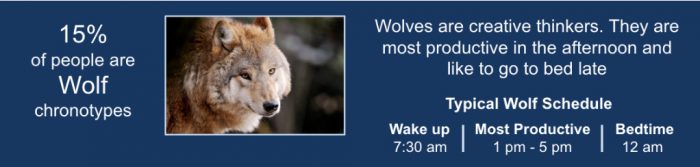
Image: Flickr and Emily Van Hollebeke
Finally, “The dolphins of the mammalian world are uni-hemispheric sleepers. That means they sleep with one-half of their brain at a time, with the other half awake and active.” In other words, “Human ‘dolphins’ are best described as insomniacs.” Good luck to you. “Unlike other chronotypes, Dolphins’ blood pressure and cortisol levels rise in the evening, which leaves them in a state of physiological arousal at bedtime.” Personality-wise, “dolphins are highly intelligent, cautious, detail-oriented (perfectionism is a common Dolphin trait), and often anxious”.
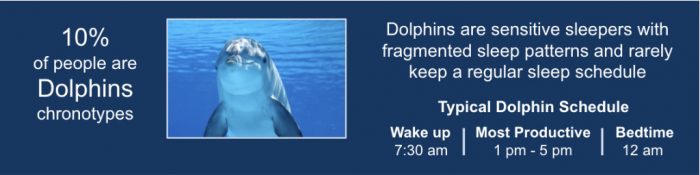
Image: Wikimedia Commons and Emily Van Hollebeke
Click this link to do the quiz and find out your own chronotype!
Finally, for your weekly prophecy: Be it lion, bear, wolf, or dolphin, go to bed and go all in.
Goodnight x
Comments