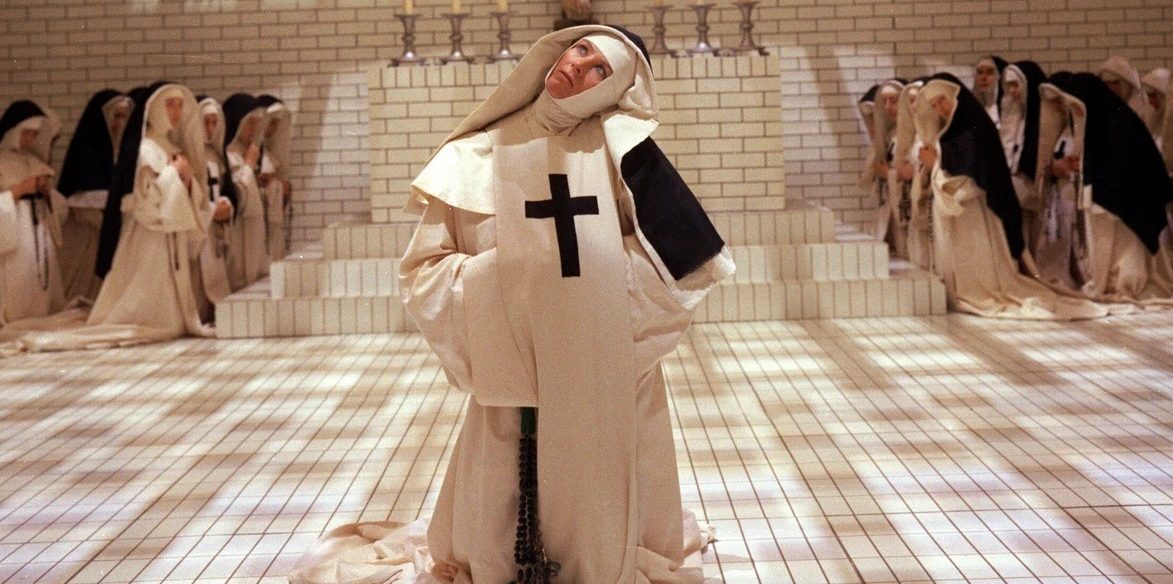
Ken Russell’s The Devils: A now-uncensored collision of the erotic, religious and political
Censored for more than half a century, Ken Russell’s The Devils has finally returned to cinemas in its definitive 4K restoration. A provocative collision of erotic horror, religious hysteria and political oppression, the 1971 film remains one of British cinema’s most controversial works.
Its history of censorship is almost as extraordinary as the film itself, raising questions about the boundaries of artistic expression, religious sensitivity and institutional power. It explores themes of religion through the dramatization of Father Urbain Grandier’s downfall. Grandier is portrayed as a sexually liberated priest whose defiance of religious conventions makes him a target of suspicion and political hostility.
This article contains heavy spoilers for Ken Russell’s The Devils.
As the film progresses, several nuns, most notably Sister Jeanne des Agnes, find themselves overcome with erotic desire for Grandier, and a wave of collective sexual hysteria erupts. Grandier is subsequently accused of using sorcery to unleash demonic forces upon the people of Loudun. He is subjected to severe torture and publicly burned at the stake, charged with being a sorcerer.
After Grandier’s death, state forces dismantle the protective walls of Loudun, leaving Sister Jeanne distressed and the town in a state of spiritual and physical devastation.
Ken Russell did not view his creation as anti-religious but as highlighting the church’s hypocrisy
The film is already extremely explicit, so what exactly was cut? The main point of debate surrounding the film’s release is the ‘rape of Christ’ scene, which depicts a ridiculous pantomime of blasphemy in which the nuns attack the huge crucifix and pull it down, raping it. Concerns were understandably raised about whether such a scene was appropriate to be released on screen, with it ultimately deemed unsuitable and subsequently cut it from the film entirely.
It must be noted, however, that director Ken Russell did not view his creation as anti-religious. Instead, he viewed the Loudun incident as highlighting the church’s hypocrisy, and it was his disillusionment with corruption in the church and state which led him to make the film. In a 2011 interview, Russell described it as a Christian film about “the degradation of religious principles […] about a sinner who becomes a saint”. To continue, other cuts ranged from minor close-ups of graphic torture and nudity to a brief scene of a nun pleasuring herself with a charred human femur bone.
Scenes of such an explicit nature shocked film boards to their core. The British Board of Film Classification (BBFC) approved the film; however, several local authorities proactively denied exhibition licenses. Municipalities such as Blackpool, Cambridge, Dundee, Plymouth, and Nottingham imposed restrictions or outright bans, while Finland maintained a legal prohibition until 2001.
Film boards such as the BBFC decide how to rate newly released films. They do this by evaluating films against their official classification guidelines before assigning a rating from U to 18. The BBFC was rapidly expanded in the 1980s due to the ‘video nasties’ panic. Campaigners such as Mary Whitehouse argued that explicit films were directly causing social decay in Britain.
Lost footage from The Devils began to re-emerge in the early 2000s, with Mark Kermode playing a significant role in recovering the missing material
The Video Recordings Act 1984 introduced a legal requirement for most video recordings supplied in the UK to be classified, significantly extending the BBFC’s regulatory responsibilities into the home-video market. However, the shift toward liberalisation saw many previously cut or banned films restored and re-released uncut, or with fewer restrictions, by the BBFC. Such films included pop culture favourites such as A Clockwork Orange and The Texas Chainsaw Massacre.
As a product of this, the lost footage from The Devils began to re-emerge in the early 2000s, with Mark Kermode playing a significant role in recovering the missing material from the Warner Bros. archives.
In 2004, a partially reconstructed version was screened at the National Film Theatre under Ken Russell’s supervision, with the collaboration of editor Michael Bradsell, Kermode and Paul Joyce. Russell died in 2011, before the definitive version received its long-awaited 4K restoration in 2026. The restoration, completed using the original camera negative, finally brought his intended version of the film to cinemas.
The Loudun possessions are one of the most notorious demonic events of the 17th century, involving an entire convent of Ursuline nuns who allegedly became possessed
The film, as unlikely as it sounds, is based on some historical truth. The Loudun possessions are one of the most notorious demonic events of the 17th century, involving an entire convent of Ursuline nuns who allegedly became possessed, leading to the execution of priest Urbain Grandier.
The episode began on September 22, 1632, when three nuns reported nighttime visitations by an apparition. The resulting exorcisms attracted large crowds, but the possessions spread to other nuns, with Mother Superior Jeanne des Anges as the main accuser. Her claims of being consumed by erotic desire during her possession were fundamental in convicting Grandier of sorcery.
A fabricated document served as key evidence against him, leading to his execution by burning at the stake on August 18, 1634; however, reports of the possessions continued until 1638.
Ultimately, The Devils is more than an exercise in cinematic shock value. Its depiction of religious persecution, institutional corruption and the manipulation of public hysteria but remains strikingly relevant.
Ken Russell’s The Devils is screening at Warwick Arts Centre from Friday 13 November.
Comments