How does Art turn Protest into Power?
The American novelist and editor, Toni Morrison, once said during an interview for Poets and Writers that: “All good art is political. There is none that isn’t.” Art is never neutral and it challenges the status quo of norms deeply rooted in society that sometimes need to be overturned. It gives a voice to the minorities that are often invisible, particularly during events, such as protests, that we can see happening all over the world. Therefore, art acts as an object of resistance and as a weapon used to fight for rights.
Throughout history, artists have always acted as activists. There was not a time when art was not political. In ancient Egypt for example, artists used their skills to create artworks that challenged the authority of the pharaohs and the ruling class. Later, during the Renaissance, they started criticising the religion and politics of that time, often at the risk of their lives. In the 1960s and 1970s, art as a form of protest became even more widespread against the backdrop of the Cold War, but also as many movements, such as feminism, came to light, or issues like racism needed to be addressed. At the same time, a new form of art reemerged and became one of the most powerful instruments in terms of protest: street art. Through graffiti, protests moved from traditional institutions to the streets; an open museum for all and a canvas that anyone can use.
The purpose of his graffiti is to confront the global audience to the atrocities of wars and violence and therefore advocate for peace.
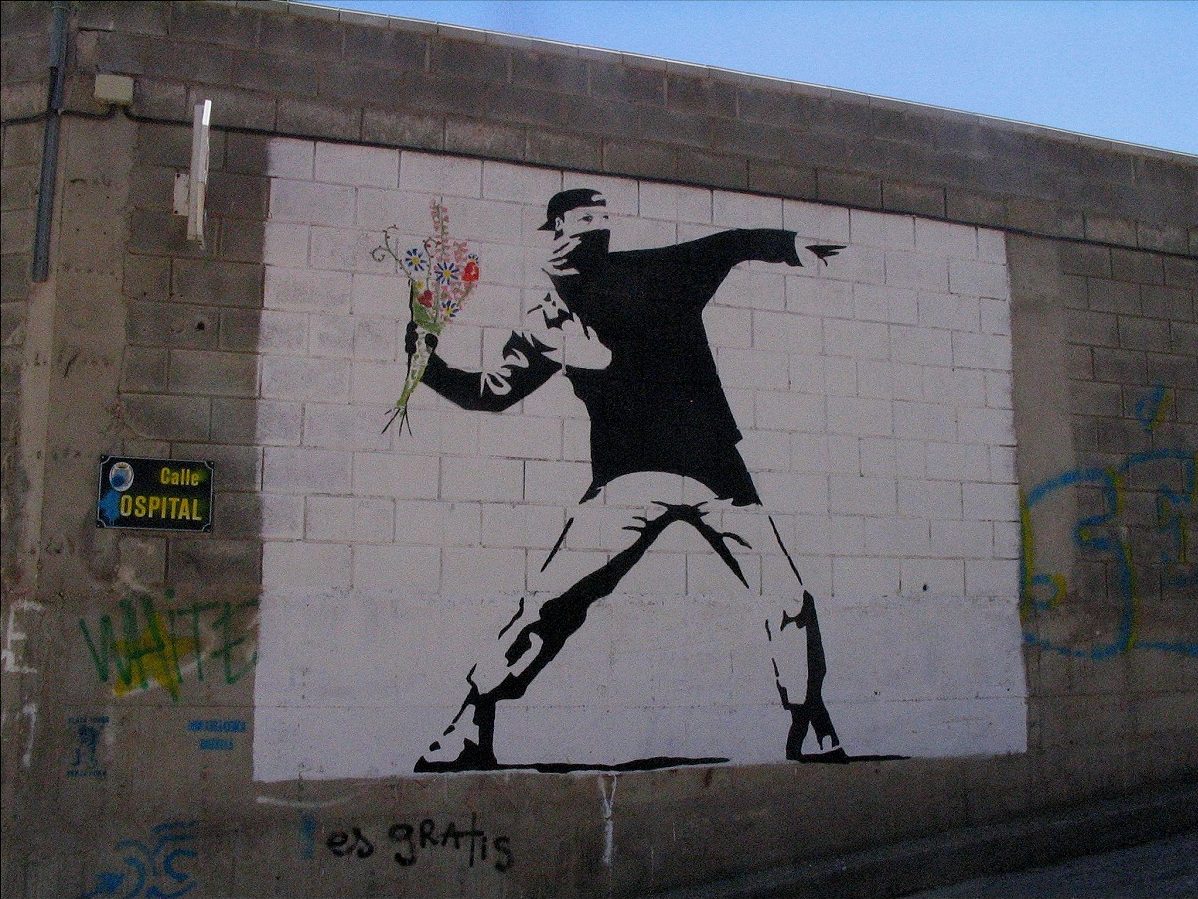
Banksy and Keith Haring are two great examples of artists that are and were true activists. The Tate Modern Museum in London depicts “activist art” as “a term used to describe art grounded in the act of ‘doing’ and addresses political or social issues”. Keith Haring’s work is easily one of the most recognisable, often using clean, dynamic silhouettes and bold, striking colours. His characters never have distinctive facial features because he wanted them to represent humanity in a state of constant flux. Through his work, the artist sought to advocate for LGBTQIA+ rights and played an important role in raising awareness about the HIV/AIDS crisis, having been diagnosed himself with AIDS. Today, his legacy lives on through artists from all over the world who use their platforms to leverage activism. If Haring’s paintings are based on an imagery that is immediately recognisable and reproducible, Banksy’s work, on the other hand, results in an intervention in a politically sensitive location. The purpose of his graffiti is to confront the global audience to the atrocities of wars and violence and therefore advocate for peace. One of his most famous pieces is ‘Love is in the Air’. Located originally on a wall near Bethlehem, the image shows a masked protester throwing a bouquet of flowers instead of a Molotov cocktail, representing a powerful call for peace. It became a work that reminds us of the injustice that exists around us and offers a simple message of hope.
Yet, art as a form of protest is no longer confined to the work of recognised artists. Today, it can also emerge spontaneously from the streets, where ordinary people become creators themselves. During the high school protests in France, for instance, original signs came to light representing a new form of art through their drawings and poetically resonant slogans. The Mexican painter Diego Rivera once claimed that: “Great protests are great works of art.” His wise words remind us today that art and activism are inseparable, as both have the power to challenge injustice and inspire change: “Art as protest, and protest as art—the two concepts will hold hands forever.”
Comments