France protests and the dismissal of legitimate public anger
Revolution and protest have long been ingrained in human society. These are ways in which individuals express dissatisfaction with the structures that govern their lives. Yet, throughout history, the right to protest has existed in tension with the state’s responsibility to maintain public order. When demonstrations become disruptive, the reasons that brought people to protest can become overshadowed.
As the scope of what the protests were about expanded, some of the worst urban violence in France began to unfold
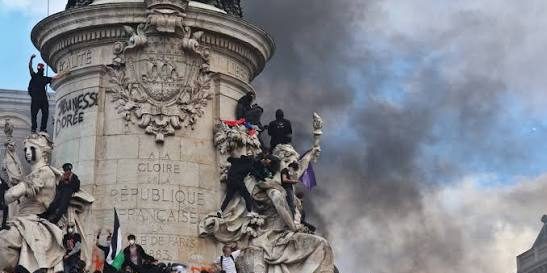
Since late September, protests have been happening in France over underfunded education. This largely concerns the country’s lycées and their inadequate facilities and staff shortages. Students are unsatisfied with the depth and level of education, with only around 80% of students passing with a baccalaureate (equivalent to A levels). However, the protests as of October had started to involve broader examples of economic grievances, such as the cost of living. As the protests expanded beyond their initial concerns, the movement became increasingly difficult to define. French president Emmanuel Macron condemned the protests in an address to the nation, stating that there must be a differentiation between the “legitimate demands” and “those who destroyed, smashed and looted”. According to Article 11 of the European Convention on Human Rights, authorities may restrict demonstrations if they pose a threat to public safety. As the scope of what the protests were about expanded, some of the worst urban violence in France began to unfold. Almost 1,000 members of the police had been injured by the time of Macron’s address, with seven seriously injured. The President’s address also made it exceptionally clear that authorities were going to be “uncompromising” towards the “agitators” who “unleashed unbridled violence in our cities”.
So, when does legitimate public anger start being branded a threat to public order?
This is not a new dilemma. From women’s suffrage to the Poll Tax Riots, history is replete with examples of groups whose demands for change were initially dismissed as disruptive. Yet many of the rights now regarded as fundamental to democratic society were secured through movements that challenged the boundaries of what those in power deemed acceptable.
So, when does legitimate public anger start being branded a threat to public order?
The most well-known and easiest-to-discuss case of this is the suffragette and suffragist movement. The suffragists and suffragettes fought for women’s right to vote. The two groups followed the same hierarchical structures and aims but went about their actions vastly differently. This led to the peaceful movement being deemed more legitimate compared to the suffragettes. Instead, they were seen more as a threat to public order. However, the suffragettes are largely more remembered for the role they played in getting women’s suffrage due to their bigger displays of action. Does this necessarily mean that their anger stopped being heard? They certainly were viewed as a threat to public order, and yet still prevailed. Action against the suffragettes was brutal, ranging from force-feedings to the events of Black Friday. On 18 November 1910, 300 suffragettes stormed Parliament, which led to them being brutally attacked by the police. Instead of the state being reprimanded for police brutality, the event signified that the suffragettes were to blame. This was due to how the suffragettes were defying conventional roles for women.
The divide between the suffragettes and suffragists is key to this, as it is a clear example of a paradox that repeats over history. The suffragists offered those in power a disciplined, respectable campaign – one they could safely ignore. The suffragettes, by contrast, forced a response; yet this gave opponents a pretext to portray them as too volatile to be trusted with democratic power. Overall, the suffragettes played a significant role in keeping women’s suffrage in the political spotlight. But the suffragists, by changing political attitudes, also contributed to women’s suffrage.
To argue the other side of this, Margaret Thatcher introduced the poll tax in 1990, which was rightfully criticised, as it charged individuals a flat rate of tax regardless of their income or ability to pay. The Poll Tax Riot in London (31 March 1990) was a protest that erupted into clashes with police and widespread damage. This led the government to face a debate about public disorder rather than simply the unfairness of the tax. The ensuing violence overshadowed the original grievance; the Poll Tax Riots show how disorder can drown out a legitimate cause. However, the poll tax was abolished, and although the riots cannot be credited as the sole reason for this, the scale of public opposition undoubtedly contributed to it. Did the government’s retreat acknowledge public outrage, or was it because the situation had become difficult to manage?
By disrupting everyday life and attracting media attention, they attempt to highlight an issue that might otherwise be overlooked
Groups like Just Stop Oil argue that conventional methods of campaigning are insufficient when addressing urgent issues. By disrupting everyday life and attracting media attention, they attempt to highlight an issue that might otherwise be overlooked. However, this strategy presents an obvious contradiction: disruption may generate publicity; it can also alienate the public whose support is necessary to achieve change. Actions such as blocking roads and throwing soup at artwork risk shifting the conversation from climate policy and towards the legitimacy of the protest.
A democracy must protect the right to protest, while recognising that this right exists alongside rights and safety
Ultimately, tactical disruption is a double-edged sword. Legitimate anger does not lose its legitimacy simply because it becomes inconvenient. A democracy must protect the right to protest, while recognising that this right exists alongside rights and safety. The challenge is not to eliminate disruption, but to ensure that the preservation of public order never becomes an excuse for protecting the status quo.
Comments