Film50 at the BFI: Proof that Film Studies has never been more important
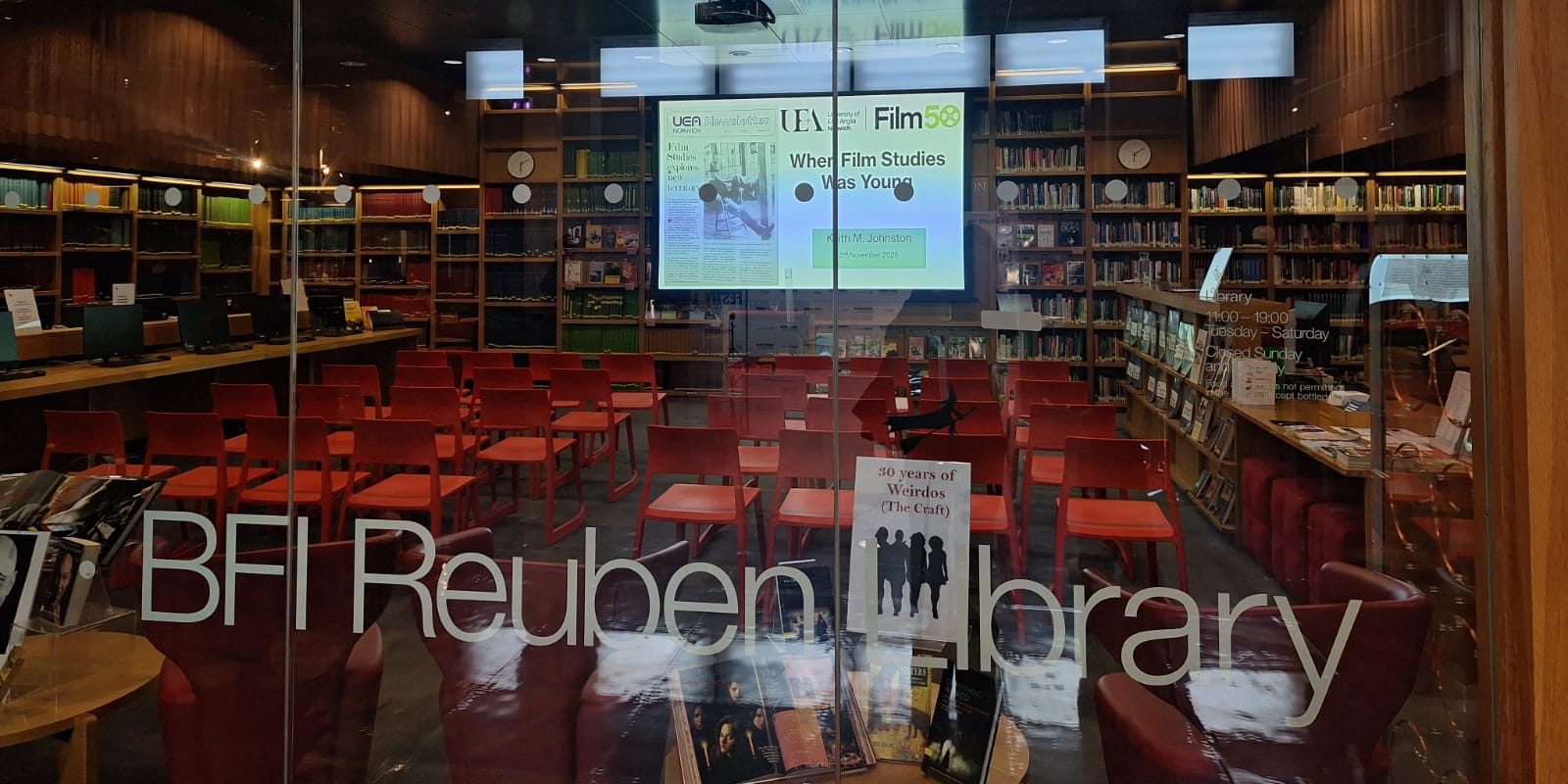
Last week, I was given the opportunity to attend the University of East Anglia (UEA)’s collaborative event with the British Film Institute in Southbank, London. This series of talks – aptly titled ‘FILM50’ – celebrates 50 years of teaching Film Studies at UEA. Professor Keith Johnston (who specialises in film history) led this initial ‘When Film Studies Was Young’ event, which took place in the iconic BFI Reuben Library.
The talk focused on the important role that BFI funding played in the emergence of Film Studies and the origins of film theory being taught at an undergraduate level. This included the messy (and severely under-documented) beginnings of teaching film in the seventies, a timeline noting the key institutions which received funding, and the shifting societal attitudes towards Film Studies education in contemporary culture.
I went along to investigate just how significant the BFI’s funding has been in fuelling undergraduate-level Film education at Warwick
Given Warwick’s Film Studies course is ranked by The Guardian as second-best in the UK, I went along to investigate just how significant the BFI’s funding has been in fuelling undergraduate-level Film education at Warwick.
Despite being the youngest person in the room, it felt exciting to be immersed in a community who shared my interest towards film. Ever since I took A-Level Film Studies, I’ve been filled with an unexpected love for the beauty of film. Films are a way of translating a person’s complicated and individual web of experiences, emotions, and beliefs into something which can be interpreted by others.
Filmmakers have an incredible ability to use the visual medium as a tool to turn their complex ideas about society, politics, and identity into something that can be understood by the audience. Watching a film offers the viewer a chance to escape their reality and live through something completely new. It also offers them the chance to feel seen, and encourages them to learn new ways to empathise with and understand each other.
Therefore, when I heard about this FILM50 event, I knew I had to be in that room.
The BFI’s role in establishing Film Studies has been monumental. In the early-to-mid seventies, the British Film Institute “pump-primed” six universities with funding that was – according to Professor Johnston – “almost unprecedented” for a new subject. This was utilised to create a three-year lectureship post at each institution, with positions filled by film critics and senior academics working in other relevant subjects. The BFI funded these positions in an attempt to create a stronger film culture within universities, so that Film Studies could eventually become a respected undergraduate degree.
Founded in the sixties, brutalist “plate-glass” architecture, a strong focus on interdisciplinary studies, and “more willingness” for fresh subjects. Sounds exactly like Warwick, right?
Johnston also posits that the BFI clearly had a strong idea of what type of university they should target with funding, since almost every institution followed the same pattern. Founded in the sixties, brutalist “plate-glass” architecture, a strong focus on interdisciplinary studies, and “more willingness” for fresh subjects. Sounds exactly like Warwick, right?
Well, as far as the University of Warwick is concerned, the BFI has definitely achieved what they set out to do. In 1973, four film modules were introduced into Warwick’s curriculum: ‘Intro’, ‘World Cinema’, ‘Hollywood’, and ‘The Western’. Led by film critic and educator Robin Wood, these modules were open university-wide for students and covered the basics of film theory and analysis. Now, the Film and Television Studies Department at Warwick is a highly-respected and prestigious course with nearly fifty different modules.
Wood created a strong theory-based curriculum, which combined his Leavisite views surrounding “the expressive potentialities of the film medium” with developing film theory
During Wood’s first year of teaching Film, around 40 students took his modules. Upon the realisation that film was not the “soft option” they had originally anticipated, some dropped the course, but a report in 1976 found the modules to be an overall success. This is because Wood created a strong theory-based curriculum, which combined his Leavisite views surrounding “the expressive potentialities of the film medium” with developing film theory. He brought in various socio-political and ideological frameworks, including Marxism.
Wood has also previously expressed that he felt a sense of social and political responsibility, as an openly gay man and educator living in 1970s Britain. He took the post at Warwick during a time of increased Queer visibility and LGBTQ+ freedom movements, as homosexuality had been decriminalised in 1967, the Gay Liberation Front had been founded in 1970, and the first London Pride March was held only a year prior to the beginning of his post.
During his time in Britain, Wood also divorced his wife and went on to marry a man. Later in his life, Wood spoke on the importance of his homosexual identity in his film analysis, as he believed the “one valid motive” for his teaching and writing was to “contribute, in however modest a way, to the possibility of social revolution, along lines suggested by Radical Feminism, Marxism, and gay liberation” whilst tackling oppression.
Following Wood’s departure from Warwick in 1977, the position was taken over by Andrew Britton (a previous graduate student of Wood). Following this, Victor Perkins took the permanent position as lecturer in 1978. Perkins remained a deeply influential figure in Film Studies at Warwick until his retirement in 2004.
Finally, Professor Johnston’s talk touched on the increasingly negative attitudes towards Film Studies.
It is not surprising that – as Arts and Humanities subjects are being reduced to worthless ‘Mickey Mouse’ degrees by political figures in the media – modern-day Britain feels lost
I believe that national pride and a country’s cultural output are deeply interlinked. So, it is not surprising that – as Arts and Humanities subjects are being reduced to worthless ‘Mickey Mouse’ degrees by political figures in the media – modern-day Britain feels lost.
These courses encourage important critical thinking skills and help people to understand the world. But a precedent has been set that any non-STEM degree is worthless. For example, the University of Nottingham recently conducted a historic scrapping of their Modern Languages and Music courses. Similarly, the University of Leicester has closed their Film and Modern Languages degree for 2026/27 students, and onwards.
Therefore, when we continue to devalue our cultural contributions (such as film, art, and media) it is no coincidence that Britain feels like it is lacking a sense of national identity. There was once a time when it felt like the whole world was obsessed with Britain. In the 2010’s, One Direction and Little Mix were international successes, the Brit Crew were some of the most popular YouTubers in the world, and the London Olympics in 2012 created a “joyful, optimistic period” of national pride throughout the country.
As right-wing extremists continue to put the blame on immigrants for a loss of British identity, maybe we should look towards supporting the nation’s cultural output
Paulette Randall – Director of the iconic Olympic Opening Ceremony – argues “it’s so important that we fund culture”, because of how impactful it can be on a nation’s self-perception.
So, as right-wing extremists continue to put the blame on immigrants for a loss of British identity, maybe we should look towards supporting the nation’s cultural output, which is the very foundation of our national pride, instead.
In response to this, I asked Professor Johnston what he would say to prospective Film students, knowing the subject is facing funding cuts and a loss of academic respect.
He argued that, although there is “ongoing financial uncertainty”, students should not discredit the importance of the course. Furthermore, Johnston discussed his fears that these funding cuts and shifts in value will cause “a shrinking” which will result in Film Studies becoming a subject limited to the “elite”. He posited that we might have to move away from a primarily film-first system, and “move back towards” accepting Film courses that exist within the wider context of TV, media, and communication.
If only some institutions get to teach it, it will calcify what Film Studies is […] and if we don’t have different places to teach it, it won’t be all those things
Professor Keith Johnston
As one of the first institutions to establish Film at a university level, Warwick is crucial to the history of Film Studies. Funding for Arts and Humanities degrees must be prioritised, during a time of such intense political debate. Culture is something that should unite us, not divide us.
Comments