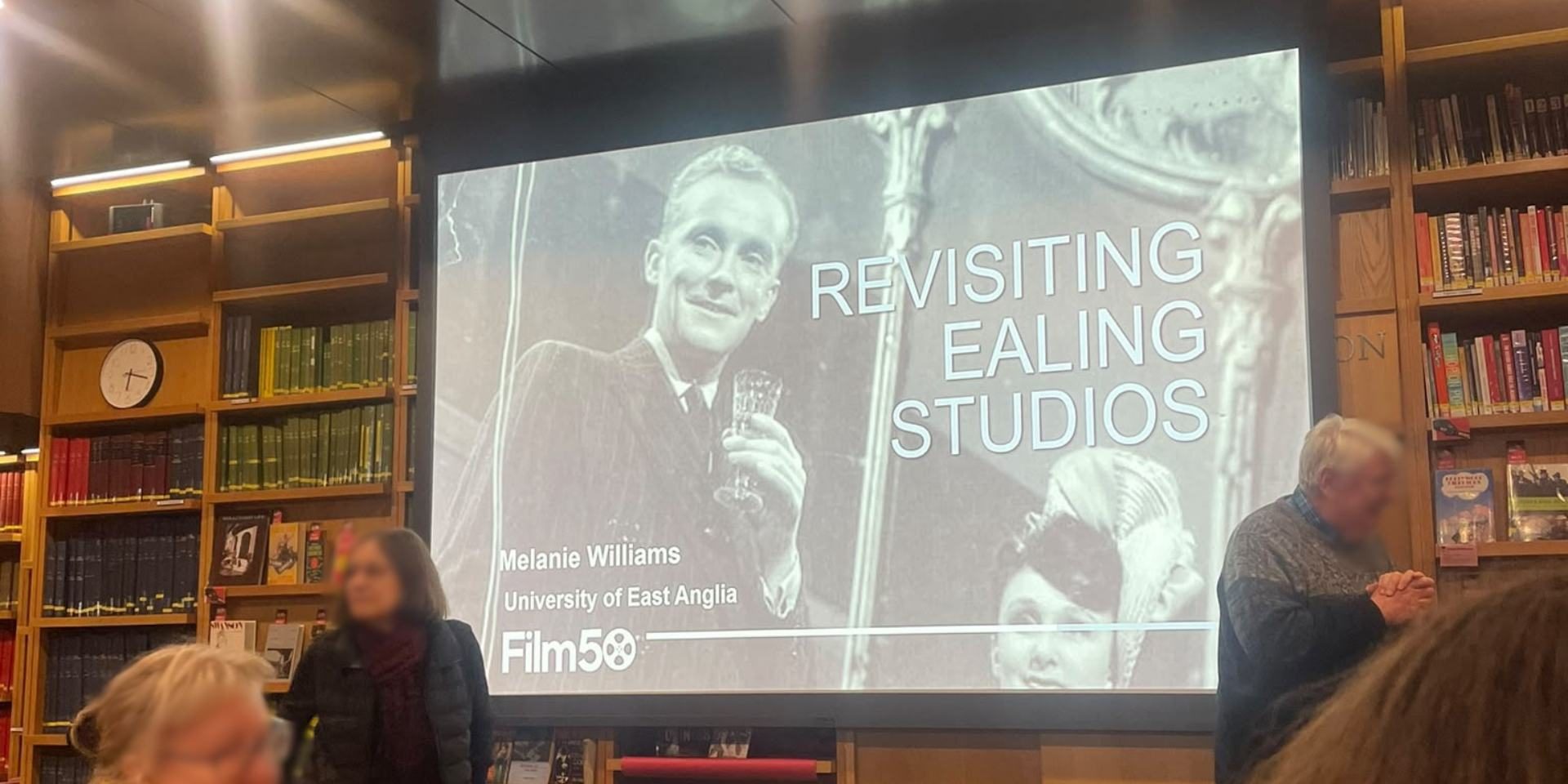
Film50 at the BFI: A reflection on Ealing Studios and British cinema
Last week I had the pleasure of attending ‘Revisiting Ealing Studios’, an event held at the BFI Reuben Library in London’s Southbank. Organised by the University of East Anglia and presented by Professor Melanie Williams (UEA), the talk was a chance to revisit Charles Barr’s foundational book, Ealing Studios.
Professor Williams specialises in film and television studies, as well as feminist media studies. Concerning this lecture, one of her most intriguing works would be one of the texts she worked on (alongside other scholars): Ealing Revisited (2012). Her speciality in the area was nevertheless demonstrated by her utmost passion for the lecture she was presenting. Within a quaint room we were given an intimate opportunity to reflect upon Barr’s work and discuss thoughts and feelings on it.
“Barr held up a mirror for England”, and the studio became “a catalyst for taking British cinema seriously”
It is claimed that the golden era of Ealing Studios lasted from 1939 to 1951; Professor Williams claimed that “Barr held up a mirror for England”, and the studios became “a catalyst for taking British cinema seriously.” Barr’s book studies this era in immense detail, analysing the inner workings of the studios, and reflecting on its importance as a staple in film studies.
What I personally found the most interesting within the talk was the discussion of ‘Britishness’ in British Cinema. Professor Williams humorously pointed out how much the infamous English breakfast tea was a staple in the old Ealing Studios films, a representation of British culture within itself.
Earlier on in the talk, Williams had discussed how Ealing Studios “never moved too far from its cosy burrow”. Yet there was still a dynamic separation from “The establishment and the radical”.
Studio head Michael Balcon, writer T.E.B. Clarke, and others represented this ‘establishment’, as Professor Williams called it, with Directors Robert Hamer and Alexander Mackendrick representing the ‘radical wing’. So, whilst there were stereotypical and perhaps shallow representations of ‘Britishness’, like the cup of tea, there was still this radical element within the studios. For example, Professor Williams describes the 1955 film The Ladykillers as a “post-war labour government” film, representing “a façade of respect to be radical”.
This discussion of the contrast between conservatism and radicalism within British cinema and its definition of ‘Britishness’ is interesting to apply to British cinema today, and led me to wonder: what is ‘Britishness’ in British cinema now?
In our ever-changing cultural sphere, what exactly would a film about ‘Britishness’ and national culture feature today?
We live in an era of mass political and cultural change, something I asked Professor Williams about: “In our ever-changing cultural sphere, what exactly would a film about ‘Britishness’ and national culture feature today?”
Professor Williams answered that, of course, today’s world is much wider, especially due to the sharing of culture and access to media. But what it boils down to, according to Williams, is the “broader appeal” of these elements in cinema.
It is what the audience wants to see, a concept addressed in Barr’s book: “They stand as evidence of what the producers thought would mean something to the audience”.
Whilst I was the youngest in the room, this did not stop me from feeling somewhat connected to Professor Williams’ lecture. In fact, one of the most memorable moments was when Professor Williams displayed a photo (which was not allowed to be photographed) of Charles Barr waiting at a train station alongside a co-worker, a photo taken by Laura Mulvey herself.
The chance to see such an intimate and almost vulnerable photo as someone who has studied these figures was such an amazing experience. It brought me back to when I would sit in my A-Level Film Studies classroom, discussing figures from Laura Mulvey to Alfred Hitchcock.
Whilst revisiting Ealing Studios was a pleasure within itself, what I still question as I look back on the evening is what we can take from it when thinking of film today?
As Professor Williams previously mentioned, the “broader appeal” to audiences is one of the key measures of how to represent Britishness in film. However, in attending this talk as a university student, I considered how we can watch and analyse modern films with the rich history of Ealing Studios in mind.
Just like Barr with his ever-changing perspectives on media, we all go through the same process of continuous change
Professor Williams discussed Barr’s experience of writing the book and how we can see this when we read his works. She described the text as a “rewarding read” and explained that “active and agile reflection on film was not always the case in this period.” This intense level of analysis is ever present within Barr’s book, and Professor Williams highlighted how Barr was continuously in a process of editing, changing the book as his views on films constantly evolved.
The concept of the film studio is something that always stands to be challenged and questioned. Ealing Studios saw a vast majority of comedy films release within its ‘golden era’, films which, despite the studios’ reputation for rarely moving “too far from its cosy burrow”, have rich layers to them that can be unpacked.
If there was one thing I learnt from my A-Level Film Studies course, it is that, just like Barr with his ever-changing perspectives on media, we all go through the same process of continuous change. Hence, it is on nights like this, in buildings like the BFI, that we revisit the monuments of the film world, like Ealing Studios, as well as the books written on them, as each time we consider them we may discover something new.
Comments