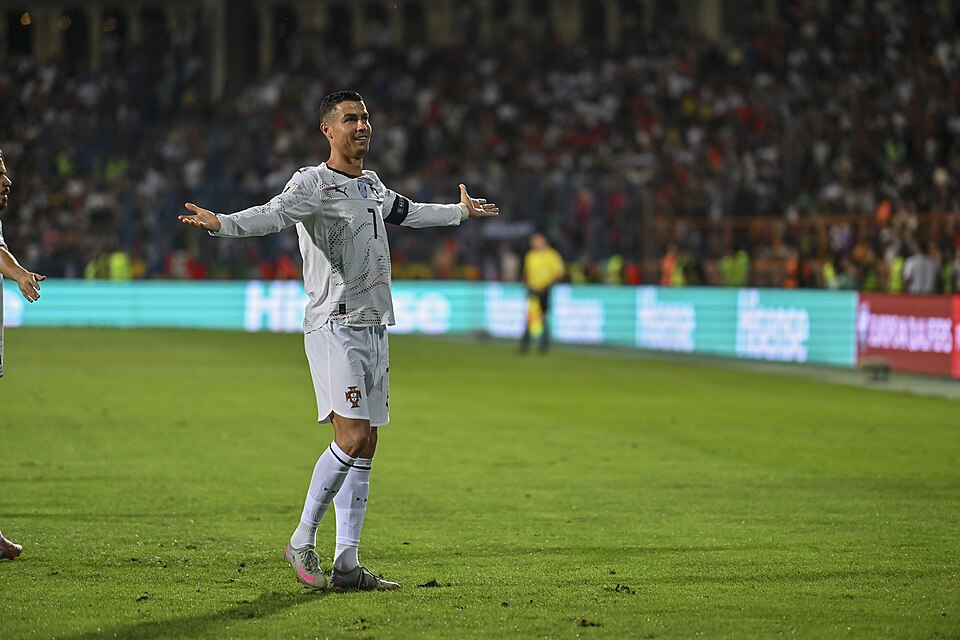
Looking back on Cristiano Ronaldo’s Portugal legacy as he says goodbye to international football
After almost 23 years, 234 caps and 146 goals, Cristiano Ronaldo has confirmed his retirement from Portugal’s international football team. As the greatest Portuguese player of all time and arguably one of the greatest footballers in the history of the sport, his legacy is immortalised in three senior international titles.
The 41-year-old, who confirmed this news on Instagram, has left international football after becoming the leading goalscorer and highest-capped player in Portuguese football history. The forward has defined this era of international football, becoming a dominant figure on the Portuguese team across five World Cups and six European Championships.
If I could, I’d play football only for the National Team, I wouldn’t play for any other club because it’s the culmination and the peak of a football player.
Ronaldo made his debut for Portugal at just 18 years old in 2003, as a substitute against Kazakhstan. In the 2006 FIFA World Cup, at 21 years old, Ronaldo became the youngest ever goal scorer for Portugal at a World Cup finals. At the 2012 UEFA Euros, Ronaldo was the joint top goal scorer and was included in the team of the tournament. He led Portugal to their first major international trophy at the UEFA Euro 2016, finishing as the tournament’s second-highest goal scorer and receiving the Silver boot, achievements that assisted him in securing his fourth Ballon d’Or. Additionally, Ronaldo led Portugal to victory at the 2019 UEFA Nations League and received the Golden Boot at the 2020 Euros. Speaking of his loyalty to the Portuguese team, Ronaldo said: “If I could, I’d play football only for the National Team, I wouldn’t play for any other club because it’s the culmination and the peak of a football player.”
“On his sixth World Cup appearance, the outcome for the Madeira legend was as discouraging as the previous ones. Good players, good intentions, a great reputation…and very little to show for it”
However, at the 2022 World Cup, despite becoming the first male player to score in five World Cups, Ronaldo was involved in a dispute with the then Portugal manager, Fernando Santos and was subsequently dropped before the last 16 match. By the 2024 Euros, Ronaldo had become the player with the most international victories in men’s football history, recording 132 wins, before helping Portugal secure a second UEFA Nations League title in 2025. Ronaldo later received a red card and was temporarily banned in the 2026 World Cup qualifiers for elbowing an Irish defender. This was subsequently cancelled by FIFA to ensure his availability, allowing him to rejoin the international squad and break the previous Portuguese record of most goals scored at a World Cup. Portugal were later eliminated by Spain in the round of sixteen. This prompted significant criticism over whether Ronaldo’s performance was ineffective and underwhelming, leading to questions over whether it would be his last international competition. Spanish publication AS said that: “On his sixth World Cup appearance, the outcome for the Madeira legend was as discouraging as the previous ones. Good players, good intentions, a great reputation…and very little to show for it.”
After the 2026 World Cup, Ronaldo was convinced by the Portuguese Football Federations (FPF) President to delay his retirement. He was later called up for the 2026 Nations League, where he would play his final match against Wales, subbed off at the 67th minute with no goal contributions. Tensions continued between him and the manager Jorge Jesus, who kept him on the bench against Norway and said he didn’t plan to start him for the next match. This prompted Ronaldo to leave the team’s training camp on September 30.
Ronaldo publicly accused Jesus of reneging on a promise to start at home, an allegation that Jesus denied. This led to Ronaldo receiving a fine and a 30 day suspension in October. By November 5, he announced his retirement from international football.
Some have viewed Ronaldo’s retirement as a demonstration of Jesus’ commitment to focusing less on individual international superstars and more on the cohesiveness of the team. With Portugal co-hosting the upcoming 2030 World Cup, the empty center forward role allows focus to return to younger forwards and the next cycle of national players. However, Ronaldo’s retirement has also intensified scrutiny of Jesus, particularly following Portugal’s heavy home loss where they fell short to Denmark 4-1 – a performance which has been described as lackluster by both the team and the coach.
It is without a doubt that Ronaldo has left an enormous shadow and legacy on the Portuguese international football team. The question now is, can Portugal truly thrive without its national superstar?
Comments