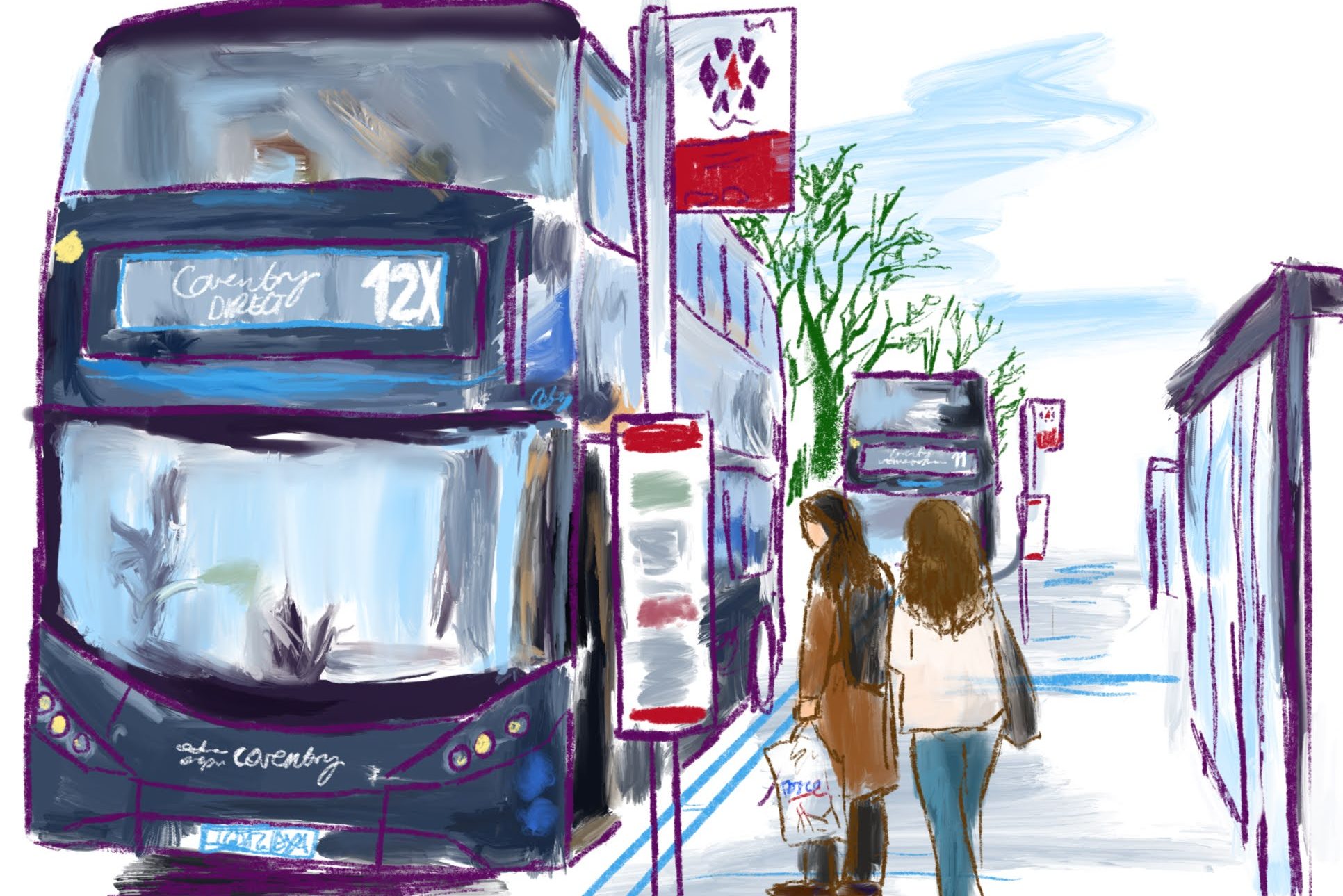
Can Britain build a public transport system people actually want to use?
Anyone across the United Kingdom is nearly guaranteed to have their own personal vendetta of how the public transport system has wronged them. As a Leamington based student, I know many Warwick students have felt vengeful towards the U1, U1A and lack of U2. I wish anyone trying to queue at Parish Church to get in for a 9 AM strength, as they may have been personally victimised.
Public transport across the United Kingdom is not known as one of its strengths, quite the opposite. So, when the government announced that England’s bus fares will be capped at £2 from January 2027, it raised the question: can Britain build a public transport system people actually want to use?
If the demand for public transport exists, why is it so unreliable?
In the year ending March 2025, a total of seven billion kilometer public transport passenger journeys were undertaken across Great Britain. In 2024, TfL (Transport for London) estimated 26.6 million passengers used their public transport every day across London. Therefore, if the demand for public transport exists, why is it so unreliable?
It is realistic to argue that the British people are not asking for much in terms of transport. We want on-time, affordable, preferably air-conditioned in the summer, transport which can ferry you from point A to point B. The Labour governments of both Andy Burnham and Keir Starmer have made it a key point to develop public transport infrastructure, between the aforementioned bus fare cap and the nationalisation of all train companies across England, this is a process that should be completed by the end of 2027.
Speaking from personal experience, being stranded at midnight in London Waterloo on a random day in July, as a direct result of train cancellations, I would be inclined to agree that South Western Railways have not been up to the job for many years.
Prime Minister Andy Burnham recognises the importance of public transport in day-to-day life, stating, in a government press release, that he is undertaking this mission to “give people the breathing space they need”. Breathing space would be well-received by the majority of the British population, but only if these bus services actually function in a timely manner.
Government policy on transport has already re-nationalised most rail companies who work with the Department for Transport across the United Kingdom, excluding a few, such as Great Western Railway and Avanti West Coast. The re-nationalisation of these train services was an action that claimed to “create a more joined-up system that puts passengers first, delivers better and more reliable services and leaves the fragmentation of the past behind,” according to the Department for Transport. However, this has not improved the quality or cost of the rail service. Transport Secretary, Heidi Alexander, willingly admitted to the BBC that “services had not been good enough just over a year on” regarding the nationalisation of SWR (South Western Railway), and that she could not guarantee that train tickets would get any cheaper.
This summons a further question that must be answered. Can Britain build a public transport system that can withstand the number of people that need to use it? Historically, that answer has been yes. The London Underground, beginning operation in 1863, is usually, an incredibly reliable service that covers the vast majority of central London. While it faces its own issues regarding older infrastructure and systems, it remains an integral, fairly reliable piece of London’s transportation system, reaching heights of 81% reliability during rush hour.
Burnham’s Bee Network created an integrated public transport system across Greater Manchester, bringing local buses, trams, and commuter rail lines under public control
More recently, it has been proved that transport can be improved, demonstrated by Andy Burnham in his time as Mayor of Greater Manchester. Burnham’s Bee Network created an integrated public transport system across Greater Manchester, bringing local buses, trams, and commuter rail lines under public control. Though, admittedly, it is not a perfect system, reports have shown an increase from 14% to 24% of bus patronage and an increase from 66% to 88% for bus punctuality.
Under Andy Burnham, with the installation of his ‘Number 10 North’ in Manchester, the government intends to reiterate a system of devolutionary transport powers across the country. That isn’t to say that all places are as well-connected as Manchester, meaning the capabilities for reliable public transport are considerably smaller. Furthermore, the costs of instating and servicing such a system range from £134.5 million for franchising setup fees to £414.8 million for a single year to maintain the entire network (based on the 2026/27 year). It is an understatement to say that the majority of the UK does not have the same financial capability as the UK’s third largest city.
While only time can tell whether public transport will become more reliable and used, there is also a wider question of whether Britain is even capable of making public transport simultaneously affordable, reliable, and sustainable? As of March 2025, roughly 70% of the UK’s buses still run on diesel, so while it may be better to take the bus than a personal car, the majority of their effects are not zero. Similarly, many trains, namely SWR trains, have struggled in recent years due to the rising temperatures of our summers. As it functions currently, the UK’s public transport system is far from being both reliable or sustainable.
In the following years, the use of air-conditioning and cooling systems will become imperative to the continued functioning of many modes of transport throughout the United Kingdom. This past summer, with temperatures consistently reaching 30°C and a height of 38.2° C, trains, and the infrastructure that upholds them, will swiftly need to upgrade to keep up with the ever-changing climate.
It is possible for Britain to create a public transport network that people want to use, but it requires serious time, effort, and overcoming deep-rooted structural, financial, and planning hurdles
It is possible for Britain to create a public transport network that people want to use, but it requires serious time, effort, and overcoming deep-rooted structural, financial, and planning hurdles. Attempting to better connect the train network under the umbrella of Great British Railways is a good start, but it must be accompanied by devolution of transport powers (as seen in Greater Manchester). Integration of differing modes of transport into one amalgamated system and ensuring it can safely transport people across the country in times of extreme heat is also imperative.
While many factors appear to be fighting against the improvement of the UK’s transport network, as evidenced by Manchester, it is not an unattainable goal. It will require continual work and effort to create a solid foundation for public transport across the United Kingdom which can be maintained.
Comments