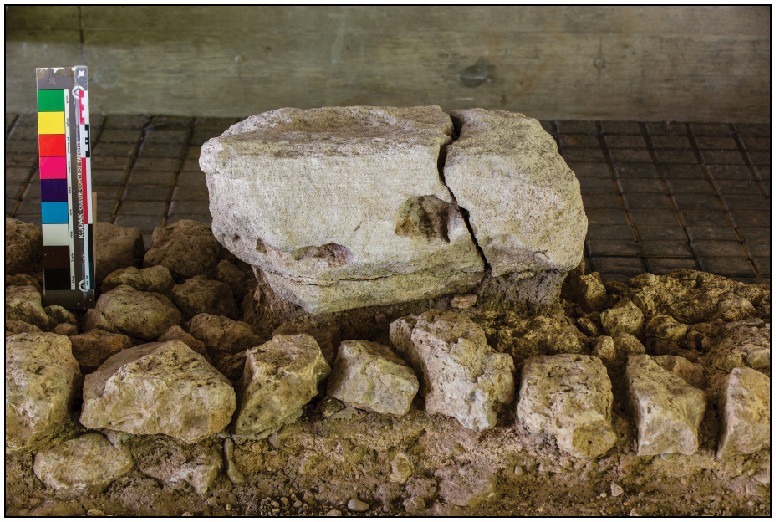
Can artificial intelligence help us to understand the gaming habits of past civilisations?
While we’re all familiar with the modern board games that we love, and sometimes hate, the concept of the board game itself dates back thousands of years.
Many games from ancient civilisations have been unearthed by archaeologists, but while their physical forms have been discovered, often their rules are tragically lost to time. Yet ancient board games expert and archaeologist Walter Crist’s recent breakthroughs have proven that these losses might only be temporary.
In 2020, during a trip to the Het Romeins Museum in Heerlen, Holland, Crist discovered a slab of limestone excavated from the ancient Roman settlement of Coriovallum. The deliberate patterns etched upon it indicated its purpose as a board game, yet its ruleset and name had been an enigma since its discovery over 100 years prior.
Crist, speaking to ZME Science, stated that his interest was piqued because the pattern was unlike any other game that he was aware of. Fascinated, Crist set out to understand the rules of this mysterious ludic anomaly.
After extensive research, utilising AI as part of their process, Crist and his team believe they have successfully deciphered the ruleset of the game, now called Ludus Coriovalli (Game from Coriovallum).
His interest was piqued because the pattern was unlike any other game that he was aware of. Fascinated, Crist set out to understand the rules of this mysterious ludic anomaly.
Crist and his team quickly deduced that the key to their future discovery lay in the etched lines on the tablet, each of which had seen varying degrees of abrasion. This kind of localised damage matched that of other Roman-era games that Crist was familiar with. These lines, carved by years of sliding counters across them, formed the basis for the investigative process.
This is where the power of AI came in. Crist, using a system called Ludii, programmed a set of AI agents to play hundreds of rounds of different rulesets pulled from traditional European board games which matched the size of Ludus Coriovalli’s board. With the idea being to eliminate rulesets which did not produce the wear patterns corresponding to the tablet’s lines, what unfolded was effectively a colossal trial-and-error approach. The AI worked through thousands of rounds, discarding game-types from the list until only nine remained. Results of the AI testing demonstrating the nine possible options for board layouts. Crist et al./Antiquity
Now certain that the mystery ruleset revolved around being a “blocking game”, the team continued to refine the rules until the final product of Ludus Coriovalli was finally formed – or rather, rediscovered.
A blocking game involves two players: one with more counters than the other. The player with more counters must work to entrap their opponent, blocking them from making any other moves. The player who survives the longest as the ‘escapee’ is the victor.
The game is fully playable on the Ludii website under Ludus Coriovalli.
Such a discovery represents a significant breakthrough in the field, not just through progression in methodology but also through historical understanding. Blocking games were believed to have existed only as far back as medieval Europe, yet Crist’s research has now shown that such games were present even in ancient Rome, marking a significant leap in the understanding of ludic history.
So, what does this mean for future research? Can we continue using AI to simulate human interaction to better understand such artefacts? Yes and no.
Such a discovery would have been rendered a logistical nightmare without the aid of AI agents. In his published research, Crist discusses how these agents played 1000 games of over 100 different rulesets: a challenge even before taking measurement data into account. In this way, AI has shown its potential to be an incredible tool in the archaeological process.
However, Crist has acknowledged the limitations of such methods. While the use of AI agents in this manner has worked for Ludus Coriovalli, the game itself is one of low complexity with a small catalogue of moves, and consequently, the gap between human decision-making and that of the AI playing ‘optimally’ is on the lower end.
Comparatively, larger games with a greater number of variables would complicate this method of reverse engineering. The higher the level of complexity, the greater the gap between AI-simulated and human play. When the human variables of playing for fun, rather than optimisation, as well as social and physiological pressures are considered, it becomes clear that this type of analysis is not widely applicable yet.
Furthermore, one thing to consider is that games themselves are cultural objects: experiences in their own right. While rulesets might be rediscovered, is the value of understanding the logic enough if the human experience of playing the game can never be truly captured? Does a greater dependency on such methods, where research becomes increasingly algorithmic, forgo that which is gained from distinctly human approaches?
games themselves are cultural objects: experiences in their own right. While rulesets might be rediscovered, is the value of understanding the logic enough if the human experience of playing the game can never be truly captured?
This groundbreaking research has certainly demonstrated AI’s potential to uncover the distant past, with Crist and his team bringing the leisurely habits of ancient Rome into the present day. Yet, with the field of archaeology increasingly employing AI to further historical research, will the past become less human when viewed through the lens of artificial intelligence?
The original academic article can be found here for reference.
Comments