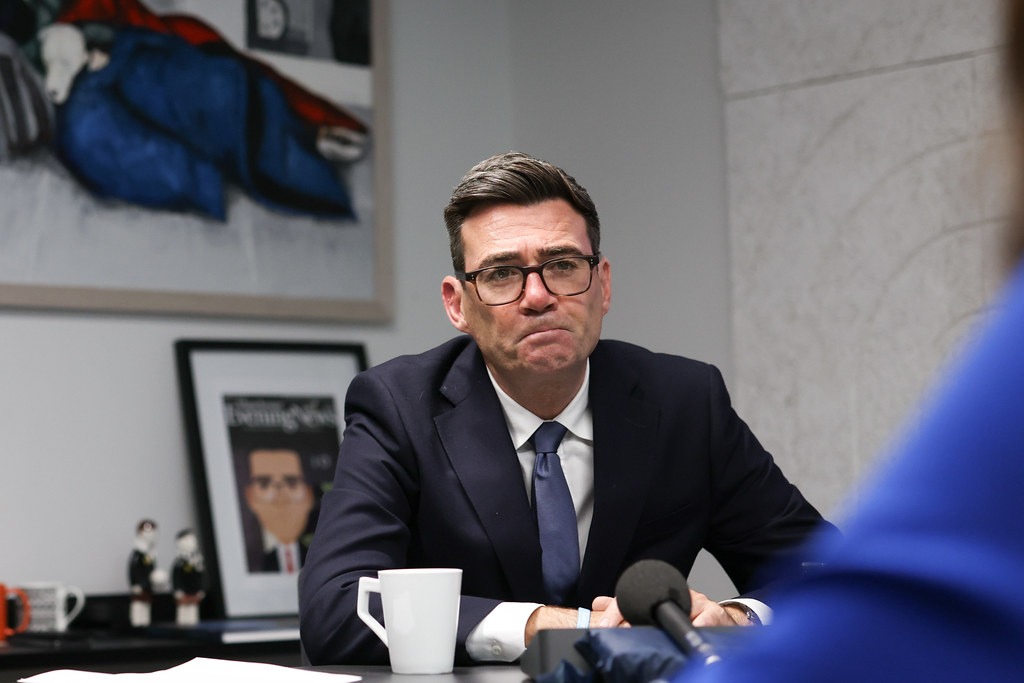
What does Andy Burnham’s new programme mean for the UK? Is it for the people or their votes?
Andy Burnham became the Prime Minister of the United Kingdom on 20 July 2026 with promises of a new kind of politics. Since then, Labour has overtaken the Conservatives, Reform, and the Greens to lead the polls by a substantial margin. It seems that Burnham’s leadership has ushered a sentiment of hope, renewal, and faith into UK politics. The real question is whether this positivity reflects a promising policy agenda, or merely political showmanship. In other words, is Burnham really for the people, or just trying to grab their votes?
At the recent Labour Party conference Burnham restated his desires for electoral reform, a closer relationship with the EU, a National Care Service, greater public ownership – solutions which could do our country a lot of good.
Although Burnham’s speech was praised by commentators across the political spectrum, when you look past his ‘regular guy’ charade, it was somewhat questionable. Burnham says he wants a National Care Service so that we can all have a comfortable end to our lives, but the service will be funded by cutting real pensions. Burnham says he wants electoral reform which would ensure that our leaders cannot be elected with only 20% of the country’s support, but he’ll only do it after the next election.
Burnham says he wants greater public control of water companies, but he’ll only repeal a ban on government ownership, not actually nationalise anything. If Burnham truly recognised the struggle and suffering of his citizens, why wait until the next parliament – in four years’ time – to act?
If Burnham won’t enact any major policy change until the next parliament, let’s take a look at what he has done so far to see if Burnham is really for the people. He was hailed for his decisive action as soon as he took office by reducing VAT on household energy bills to alleviate pressure from the cost-of-living crisis. In reality though, the reduction will only save an estimated £45 per year. To put that in perspective, the average weekly cost of groceries for a family of four is £174. For a family of four having to choose between feeding their children or heating their homes, it is frankly insulting for Burnham to claim that his decision has materially helped them. Not to mention Burnham stating that the cut would be funded by scrapping the Digital ID scheme, even though no funding was actually allocated to the scheme according to Starmer’s Chief Secretary Darren Jones. To add insult to injury, he is praised for his actions.
Burnham’s policies on pubs have similar effects, with the £1,100 saving only decreasing average annual costs by 0.5%.
But hey, finances are tight right? Wrong. There is in fact a lot that could be done without having to spend any more money. Economist Henry Fudge explains that our housing is incredibly overpriced because our legislation and financial systems incentivise investing in land and housing rather than the productive economy. Simply, there’s too much money chasing property. Andy Burnham’s solution? He’s giving young people more money to chase property. The effect? Housing prices will increase further, they will take up a bigger proportion of the average person’s income, and the cost-of-living crisis will be exacerbated because disposable income will decrease. The cost-of-living crisis and the UK’s stagnating economy could be significantly improved by deregulating the construction industry and reforming planning permission. But dear old Andy’s plan is to make the situation worse. Cheers pal!
Given his ineffective policy decisions and promises, Burnham’s popularity is puzzling. However, his reputation as an anti-establishment, anti-Whitehall, ‘regular bloke’ is even more confusing given his time under Blair. Burnham served in Blair’s parliament from 2001 to 2007 where he pushed for the illegal invasion of Iraq, an invasion which killed 1 million people, starved 4 million, displaced 9 million others, and destroyed an entire region’s history, culture, museums, and society. That was us, our military, our RAF, our navy. As a country, we held Blair socially accountable, shunning him from public office. How then, do we allow a Blairite, Iraq war confederate, Oxbridge graduate, politician for over a quarter of a century, to convince us that he is a man of the people?
You might think that he has turned over a new leaf and that we shouldn’t judge him on his actions 20 years ago. You may want to think again. First of all, it’s fair to say that the war on Iraq was at least partly caused by the pressure from oil and gas giants. Well, it seems that Burnham is sticking to his roots as he is set to approve new oil and gas drilling in the North Sea despite warnings from climate experts. His catchphrase of ‘a pragmatic approach’ on the topic also seems like another phony buzzword as the drilling will not have any effect on UK energy prices. By selling the contract to a private investor, we would have to buy back the energy at market prices, we would not get the energy ourselves. The addition to global supply is so negligible, +0.069%, that it is almost mathematically impossible for the oil to have any impact on bills. But hey, at least we get to keep destroying the environment!
So, as much as I truly hope for his success for my own sake and the sake of our country, it seems that Burnham may not be a man for the people but rather for their votes. Although, with some luck Andy will change my mind on 28 October with the Autumn Budget. But if he defers action again, we’ll have our answer.
Comments