The Original: An interview with Nell Stevens
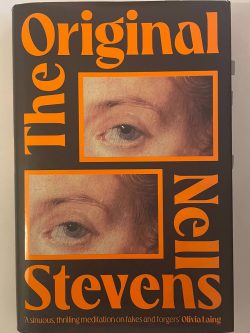
Nell Stevens’ novel, The Original, is an enthralling read full of secrets, questions of authenticity, art, and love. I had the opportunity to interview Stevens and ask about the core themes of her novel, the beauty and cheekiness behind imitation, and what she learned while writing this book and seeing readers engage with her work. I encourage readers to dive into this novel, and look forward to meeting its gripping complex characters (with a master class in characterisation, through immersion in setting).
Sophia Hadjioannou/The Boar
As art is a key theme in this novel, why do you think it is so important that art and literature can inspire one another?
“I’m sort of quite interested in the impossibility of writing about other forms of art. I’ve tried really hard to write about music. There’s this quote by Frank Zappa: ‘Writing about music is like dancing about architecture’. As in, [these art forms] are so distinct, and I feel the same about writing about painting. I can’t reach it, because all of the things a painting is – dimensional, solid, and full of colour – are not available to me when I write prose. But there is still something so seductive about trying!
When we write fiction we can access interiority, and that’s only really available to writers
Maybe it’s because we can’t do it that we keep trying and I think there’s quite a lot of contemporary novelists at the moment working on writing about art. There’s something expansive about it because when we write fiction we can access interiority and that’s only really available to writers. Film can’t do it, painting can’t do it – but we can get inside as writers. And the idea of looking at a painting and being able to inhabit it or get behind it. This is a lot of what is going on in the novel because, as Grace copies the paintings, she is sort of getting inside them. That’s very interesting and exhilarating to be able to do that.”
Charles’ authenticity is a mystery. Even so, there is an inclination to root for him! Did your opinion of dupes and fakes change before and after you began writing the book?
“I suppose it did. Or maybe it changed even more after because I started talking to people about it in a way I wasn’t as aware of when I was writing it. There’s a huge appreciation for copying in the novel as an act of devotion. I do sort of think that’s beautiful! There’s a moment in the novel when Grace is having this kind of entanglement with another woman and she starts just tying her scarf like the other woman and I was thinking that so many queer people describe their burgeoning awareness of their queerness as not knowing if they wanted to be with someone or be someone. It’s that phrase that people grapple with and that’s everywhere in this book. These queer characters who are copying, and it’s not copying necessarily to usurp – although in some cases a little bit – but really as an act of love and devotion, and an act of trying to get close to someone.
There’s something moving to me about the way that even when we don’t mean to copy people, familiarity and love makes people [copy others]
It’s the same way with Grace – she’s a really devoted artist and sees the copies she’s making as a chance to honour these original paintings. So there’s something really moving to me about that and the way that even when we don’t mean to copy people, familiarity and love makes people [copy others]. And after a while if you’re in a really long-term relationship or a marriage people start sounding like each other, the same phrases or gestures. People do sort of morph into a closer version of each other. And that’s so wonderful – I think it’s so beautiful that we do that and that we want to exhibit closeness like that! There is a sort of love in copying in the book – I think that’s a huge part of the book. And it’s generous. I think that’s part of it. I think Grace is a utopian thinker and there are various moments in the novel where you meet people who think they have an original painting and they don’t. Isn’t that great? Who cares? At one point she makes comments that some of her copies are better than the originals – she’s modest in other ways! She knows she’s good!
How brilliant that you can kind of propagate this work in this way and it’s not the same as mechanical reproduction because there is a kind of soul in the copy! And there’s Grace, there’s an artist – in fact, two artists – magnifying distribution, I suppose! One more point to do with reproduction – it’s to do with inheritance. It follows some of the tropes of Victorian lineage and who gets to inherit and queer characters in that context were quite disruptive because they don’t reproduce. There are all these other forms of reproduction these queer characters are engaging in: they reproduce each other, they reproduce art – so there’s a kind of generative capacity and creativity there that offsets this other question about reproduction.”
In a setting filled with mystery, much is open to interpretation – have any readings of your work surprised you, whether from editors or agents while you were still writing or even afterwards, that you hadn’t thought about before?
“That’s such a good question. I think one thing that has been really nice is that people have loved Grace and I didn’t know that she was particularly loveable. She’s prickly and sort of awkward and she acts against her own interests all the time. One of the measures in the book is that she is trying to make money, really concerned about money, and thinks about money all the time. And she’s awkward around money – really wants it! She wants all the things she could achieve with it – not just sort of basic needs like freedom, which is the big one for her, but she also thinks more frivolously, she thinks about parties and is interested in money but ultimately just cannot bring herself to keep it when there are people who need it more than she does. So I had a rule for her: anytime she gets money in the book she has to immediately get rid of it. It kind of operates all the way through – she makes money, she loses it. I won’t say anymore because of spoilers!
I suppose I thought that she was a little more awkward and prickly than most people would want to embrace and it’s been so lovely seeing people love her, because I love her. So that’s been one really beautiful thing and then there’s been some surprising interpretations around her copying that really threw me. That some people think she’s engaging in deception, selling copies pretending to be real and some people think she’s selling copies announcing that they’re copies – which I didn’t mean! I thought of her as engaging all the way through in her own kind of deception with the copies and if people think she’s selling deliberate copies that was kind of fascinating to me because that slightly undermines some of the ways that I was thinking about deception! But that was a kind of interesting one! But mostly, just Grace as a character has been really surprising in a good way.”
Grace has a great talent for painting – if you had to associate her character with any famous artwork, what would it be and why?
“She has face blindness so she doesn’t recognise people easily, she can’t hold on to the idea of faces, so she talks about the people she loves and people she knows in terms of paintings. Right at the end she does a copy of Velázquez’s Venus called ‘The Rokeby Venus’, which is the back of a nude woman and then a mirror and you can see the face in the mirror but it’s a slightly blurry face. The weird thing about the painting is that you sort of assume that’s the face of the woman because of the way it’s structured and then when you sit with it and look at it more closely, you think well that mirror isn’t angled right and wouldn’t be showing her face so it seems like a completely different person’s face. Grace is interested in this because one, she can’t really see faces and two, she’s sort of a funny combination of she really knows herself and still really mysterious to herself all the way through, so she talks about that as a kind of way of understanding herself. So that’s one answer. There’s also another one of my favorites. ‘Venus as a boy’ by Wen Wu. I love this painting. I saw it many years ago and I’ve had it on my wall (a print) ever since, I adore it. I think that’s also Grace. It’s brilliant. Some of her energy there.”
You have said in another interview that you hope this book enables readers to ‘confront some parts of the world we live in now’. At a time where books are being banned and restricted across the world, why do you think it is so important that readers can use literature and fiction to understand their own feelings and societies?
“Spending time with literature, with books, is valuable and not everyone feels that or knows that or agrees with that. I think books and writing are the most extraordinary technology – you know we talk about technology all the time and the way it’s changing us and AI… I don’t think even the most extravagant technological advances of our century compare to the existence of writing and texts and printing presses. We can access the brain and thoughts of another person who is not there – it’s magic, it’s magic. I can read George Eliot and can be with George Eliot’s brain – someone who is long, long gone – that is an extraordinarily precious and transformative technology.
When we read we go inside someone else’s brain and that’s an unfathomable gift to be able to do that
We risk not noticing it anymore because it seems ‘low-tech’ and it’s not set up to scratch the itches our brains have for novelty and bright lights and all of those things. It feels sort of old-fashioned now to just sit and read, and children are not reading anymore and that’s sad and scary because when we read we go inside someone else’s brain and that’s an unfathomable gift to be able to do that. And when you do that, especially when we’re looking at minoritised or marginalised experiences, our world gets bigger and that’s part of what this book is trying to be.”
Finally, is there any writing advice or particular lesson you learnt from writing The Original that you can share with the readers of this article?
“Well, there’s so many! I think it’s a really surprising novel for me because to an extent I think every book I’ve written has been a reaction to one bit of criticism to the previous book. So, I wrote a book called Briefly, A Delicious Life – I had such a lovely reaction from readers to that book but one thing that really surprised me was that people thought it wasn’t plot driven. Really character driven – a deep character study essentially. And I had worked quite hard, I thought, to put some plot points in there but it was difficult because I was working with real events and sticking to certain historical facts but I was like oh it’s… that’s not what plot is! So, I wanted to write a plotty book! And it surprised me that it’s the first book I’ve ever written with a spreadsheet to try and keep track – because it’s quite intricate at times and plot driven. So there’s something there about being much more expansive about what you think you’re capable of writing. It’s so tempting to limit ourselves so maybe that’s it: the whole time as a writer I have gone through this process of expanding what I think I can do. And the novels teach you, you don’t teach the novel. The novel shows you what you’re capable of, bit by bit. And listening to that and letting that teach you is such a useful thing as a writer. We think we’re the ones in charge – we’re not!”
Comments