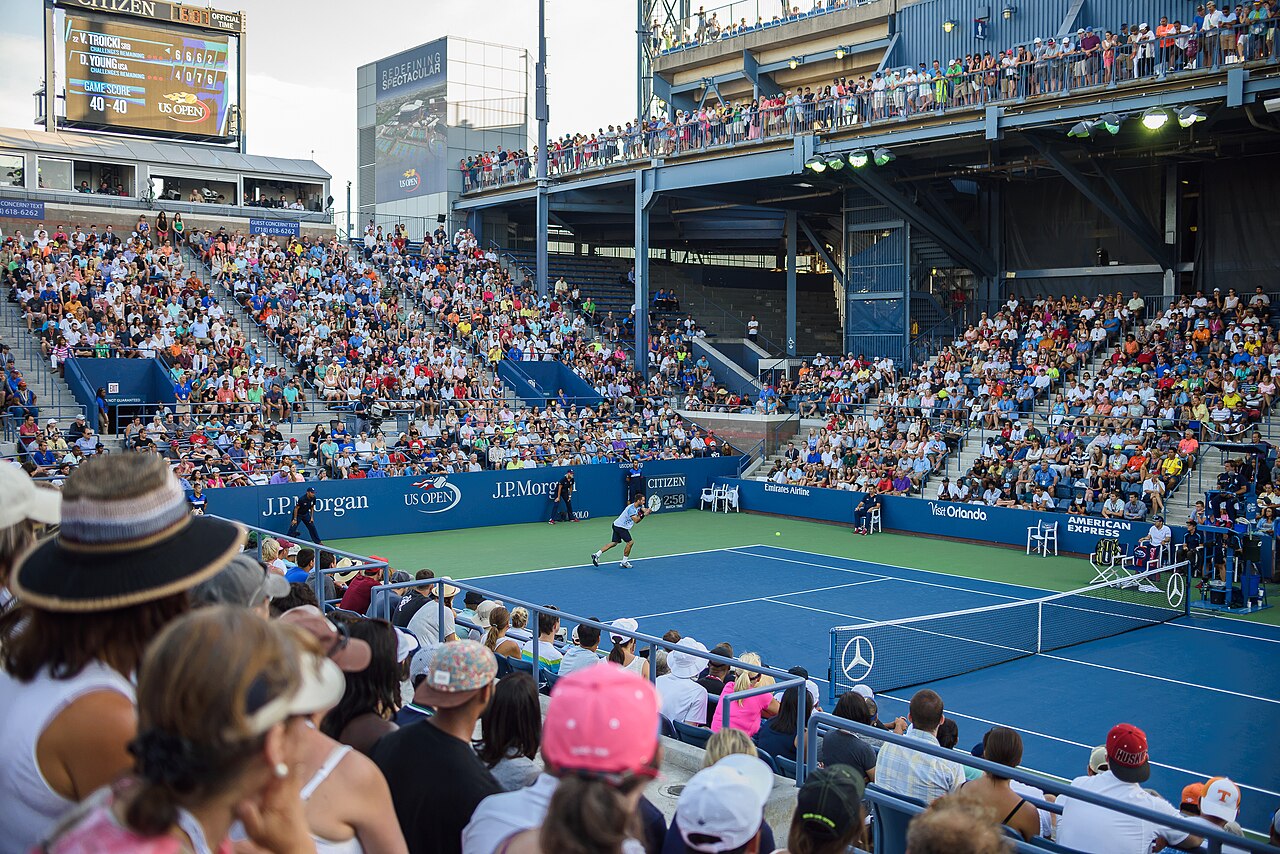
The growing problem of the courtside influencer intrusion
Each Grand Slam in tennis boasts an acute individuality. First, there is the sun-soaked season opener, the Australian Open, dubbed the “Happy Slam” by Roger Federer. Then comes the striking red clay and Rolexes galore at Roland Garros… only for it to be trumped by the timeless prestige of Wimbledon every spring, the sport’s oldest and arguably most illustrious tournament. Finally, there’s the brash and noisy US Open to round off the Grand Slam portion of the tennis calendar.
This year it was more brash than ever.
New York is known for its hustle and bustle. The tournament’s stadium complex is surrounded by some of the city’s noisiest roads, including the Grand Central Parkway and the Long Island Expressway – not to mention the constant rumble of aircrafts taking off from nearby La Guardia Airport, which handles over 28 million passengers per year. It was not the commotion of Flushing Meadows’ surroundings that ruffled feathers this year, but those watching from inside the stands.
The truth is it’s turning into a bit of a zoo
Adrian Mannarino
It was stoppages galore across the fortnight. Naomi Osaka’s first-round match was interrupted by a group loudly recording themselves in the stands, and then later by a creator using a bright ring light to take photos of herself mid-match. Women’s world number one Aryna Sabalenka even had to pause her match against Kamilla Rakhimova to complain about the smell of weed.
French player Adrian Mannarino later spoke out about the disruption, saying: “The tournament puts up with it, [but] I don’t know if it’s the best thing for tennis in general. There’s a smell of marijuana on the court, noise everywhere. The truth is it’s turning into a bit of a zoo.”
The United States Tennis Association (USTA) has credentialed content creators as official media since 2025, and, this year, they invited over 100 influencers in efforts to increase the viewership and conversation around professional tennis. Accreditation is the system responsible for influencers gaining access to press conferences, media centres, and player Q&As. This unlimited access is largely what is being blamed for the disruption this year.
It comes as no surprise that Wimbledon, the crème-de-la-crème of the tennis calendar, wishes to avoid a similar fate. Even before the US Open finished, the All England Lawn Tennis Club (AELTC) announced to the Press Association that they would not be providing an accreditation category for influencers wishing to attend the tournament in 2027. The AELTC will also be banning any equipment deemed ‘distracting’, which includes – you guessed it – ring lights and flash cameras.
Tennis is one of the only professional sports that still expects a respectful silence while a match is ongoing
While Wimbledon will not ban influencers from attending the Championship, it will not grant creators the same access-all-areas that caused a stir in New York this autumn. It is hardly shocking that tradition-heavy Wimbledon wants to avoid the same disastrous fate. It has long simply relied on the appearances of celebrities, royals, and public figures, there by their own interest or invitation, to generate talking points around the tournament – that is, if the tennis itself is not interesting enough.
Tennis is one of the only professional sports that still expects a respectful silence while a match is ongoing. It offers a sophistication that other, more raucous sports – such as football – cannot replicate by nature. The sport itself is graceful, and its players are held to elaborate standards regarding playing style and conduct. Wimbledon is leveraging this media tumult to preserve the high-brow nature of the sport.
Comments