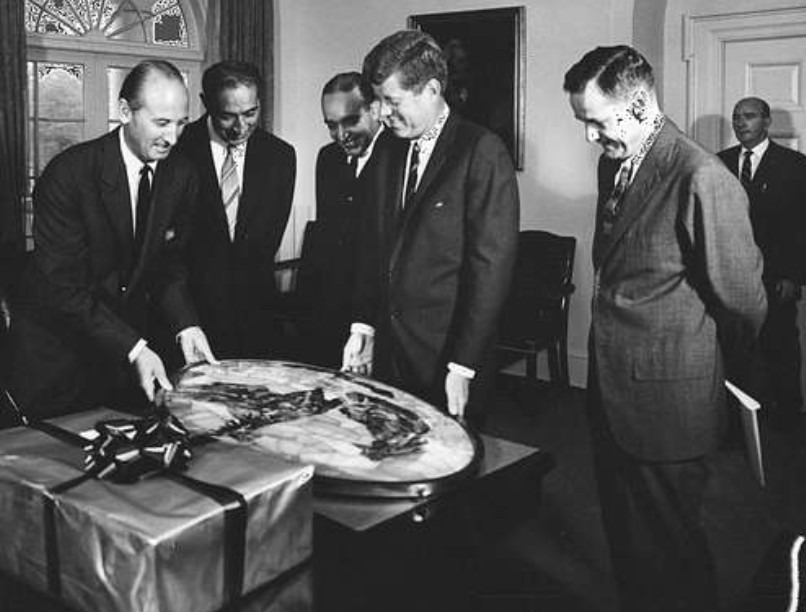
The Art of the Diplomatic Gift
Don’t look at the title of this article; tell me what the items on this list have in common. Pandas, the Statue of Liberty, a camel, 20,000 tulip bulbs, 300 pounds of raw lamb, the Trojan Horse, and a jewelry set worth nearly $190,000. While these may appear a rather abstract array of objects, their significance in regards to international diplomacy is far greater than one may expect.
One of the most famous diplomatic gifts of all time, as mentioned above, is the Statue of Liberty. Gifted to commemorate 100 years of American independence from the British Empire, the Statue of Liberty solidified the relationship between France and the United States of America, acting as a symbol indicating the strength of the friendship between the two nations.
On such a monumental anniversary as 100 years, it was of great strategic importance for the French to emphasise the role they played in liberating America from the British Empire, even at significant cost to their own economy. The Statue of Liberty was used to demonstrate both the USA’s status as a refuge of freedom, but more importantly, the French wanted to ensure that their role in obtaining America’s freedom would not be forgotten.
You can’t pick up a diplomatic gift last minute online, hoping and praying that it will arrive on time; it requires a certain pomp and circumstance
This manipulation of diplomatic gifts is an art that dates back as far as the Ancient Egyptians, historically being used to convey meanings as wide ranging as friendship, power, apology, cultural identity, and political intent. Even today the Diplomatic Gifts Unit exists within the U.S. Department of State, advising the President, Vice President, and Secretary of State, ensuring culturally appropriate and mindful gifts are chosen for foreign leaders.
Peter Ricketts, who spent 40 years in diplomatic service between the UK and France, stated in The Guardian that diplomatic gifts must “be clever and really stand out as something special to make any difference.” You can’t pick up a diplomatic gift last minute online, hoping and praying that it will arrive on time; it requires a certain pomp and circumstance.
In the past, these gifts were able to fundamentally change the shape of diplomatic relationships. However, nowadays, international politics is so multifaceted, it is difficult to alter a relationship by way of a simple gift. In many Western cultures, they have come to act as a formality within the structure of a foreign visit, yet the ceremony has lost its gravity, especially in Europe. The relationship is more important than the gift that accompanies it.
Nonetheless, some countries, namely Japan, still focus on the importance and cultural significance of a diplomatic gift. The Japanese are specific in their customs, giving and receiving gifts in a highly structured, symbolic practice. Despite the shifts in Europe, where diplomatic gifts have been neglected in favour of hard power, gift-giving in Japan remains a key tool for building relationships and maintaining soft power. This process cannot be undermined or negated. The Japanese are superstitious – avoiding gifts in quantities of four or nine, sharp objects, or white elements. Gifts are never to be presented during tense negotiations, instead at the very end of an official first meeting, or during state dinners. They are to be given and received with two hands and a slight bow, offering deep respect and the representative’s undivided attention.
China have certainly fashioned themselves a niche with their ‘Panda Diplomacy’. While accounts suggest the Tang Dynasty gifted pandas to Japan in 685 AD, the modern practice of ‘Panda Diplomacy’ dates back to 1941, when the Republic of China sent two pandas (named Pan-Dee and Pan-Dah) to the Bronx Zoo in New York as a thank you for American aid during the war with Japan. This success lead to something of a diplomatic breakthrough for China, gifting pandas to the United States, Japan, and the Soviet Union between 1941 and 1984.
After 1984, however, China has been far more strategic with the manner in which these pandas are doled out. It has since rolled back its gifting, instead choosing to loan pandas for ten years at a time, allowing them to retain a greater control and agency over their diplomatic relations. Panda diplomacy is ongoing, and provides China with an unusual angle of soft power among nations perhaps not traditionally perceived as close allies.
Other diplomatic gifts are continual, representing an ongoing gratitude from one nation to another. Two such examples emerged following the end of the Second World War. Firstly, Norway sends a Christmas tree to the United Kingdom every year, representing their gratitude for shielding their exiled Government when Norway fell to the Nazis. Similarly, Canada receives 20,000 tulip bulbs from the Netherlands each year showing appreciation for sheltering their royal family during the Second World War. While few people were alive at the time of these actions, their significance has shaped a diplomatic bond between these nations lasting beyond generations.
Nevertheless, these diplomatic gifts aren’t always quite as effective as intended. In 2003, the Argentine President Néstor Kirchner gave United States President George W. Bush 300 pounds of raw Patagonian lamb as a diplomatic gift. The gift was accepted, however it was turned over and, quite possibly, destroyed by the Secret Service due to rules regarding foreign food and drink. It was not the ideal scenario.
As per the GSA Foreign Gifts Policy, gifts valued below $525 are allowed to be kept by officials, though they still have to consult agency ethics advisors
The incredibly specific procedures enforced upon the receipt of diplomatic gifts in the United States mean, more often than not, these well thought out gifts only ever act as props, as opposed to genuine gifts. As per the GSA Foreign Gifts Policy, gifts valued below $525 are allowed to be kept by officials, though they still have to consult agency ethics advisors. Taking this into consideration, even without the Secret Service’s rules, George W. Bush would never have been able to taste the Patagonian lamb, valued to be worth nearly $1500. Many countries choose to ignore this fact, gifting lavish items nonetheless, as a show of wealth, knowing that they will never reach their intended recipient.
Similarly, in 2013, the government of Mali gave French President François Hollande a camel as a token of gratitude. Given the fact the President wasn’t prepared for a camel to fit in his suitcase home, he left it with a local family. Subsequently, the family slaughtered the camel, fashioning a traditional tagine out of the French President’s gift. Not to worry – the Malian authorities promised to provide Hollande with a “bigger and better-looking” replacement camel. Perhaps a small misstep in the eyes of the Malian government.
As Paul Brummell, author of the book Diplomatic Gifts: A History in Fifty Presents, and former British ambassador to Latvia, stated the act of gifting and receiving diplomatic gifts is “a highly complex political art – an exercise in brand-building for the giver, via an item that must suit the recipient’s own interests and character.” These aforementioned examples demonstrate the continuing influence that a well thought out present is still able to carry; even in a modern world so encumbered by threats of violence and war.
But diplomatic gifts are a finicky business, proving once again that there is much more to international politics than we may care to understand.
Comments