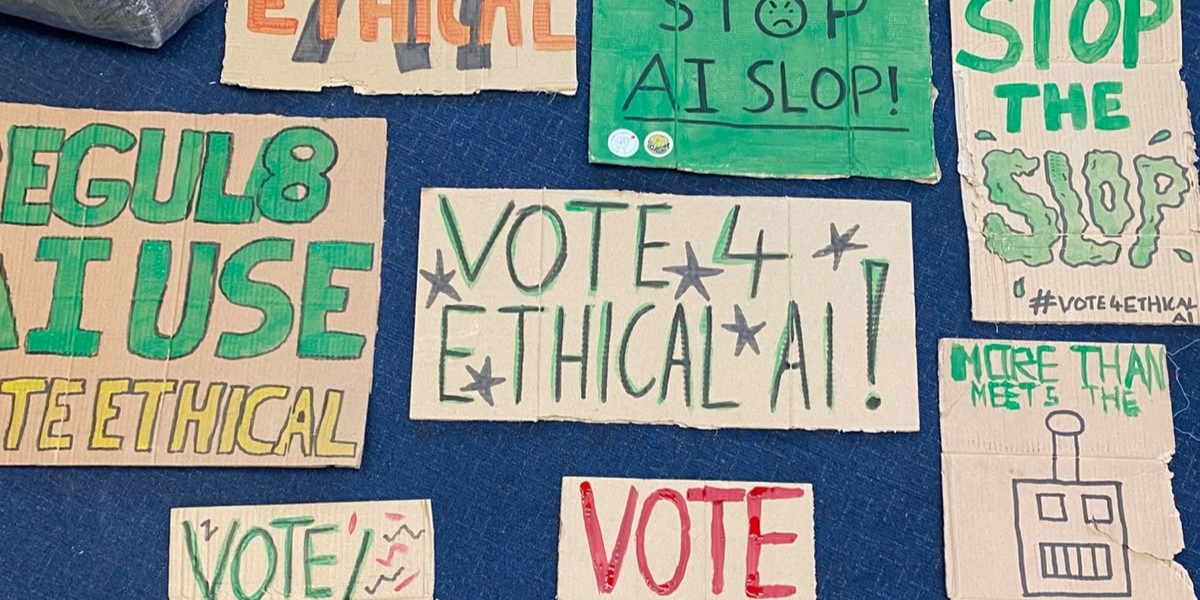
Students are lobbying for a university-wide ethical AI stance: Here’s what they’re saying
Throughout Week 5, students will have the chance to take a stand against AI’s increasingly harmful impact on academia and university life. Student activists have come together to propose a new landmark policy that urges a firm commitment to restricting AI use, and it is now in the hands of all students to decide what happens next.
If it passes, the motion will set in stone the Student Union’s commitment to lobbying the University for an ethical stance on AI via a list of proposed goals and regulations. It aims to encourage the University to limit promoting AI and large language models (LLMs) across teaching, assessment, governance, and marketing, and would ask all departments to publicise clear guidance on how students can use AI in their work.
The motion also sets out a proposed ‘opt-in’ policy, whereby staff must deliberately declare the use of any AI tools in their work. It would ask the University to confirm that students could complete all modules and courses without AI and ensure that AI tools are never used to grade student assessments.
The campaign for ethical AI is the result of growing discontent among students with how AI use is negatively influencing their university experience and responds to widespread concerns that unrestrained AI use will have disastrous consequences for the quality and reliability of teaching and learning.
As AI tools rapidly develop, student feedback shows that the changing academic landscape is becoming increasingly difficult to navigate, and advice for students is vague and uneven across university departments. Students are demanding that staff take an ethical and sustainable approach that recognises AI’s role in undermining academic integrity, freedom of thought, originality of ideas, and acknowledges its active contribution to global inequality and ecological breakdown.
One student said: “I think that AI use has the capability of hijacking the education system here at Warwick, where people will no longer be making the best use of work to develop skills like critical thinking, instead focusing solely on an easy grade.”
“AI threatens to streamline thinking, breaking the variety that universities foster,” another student told campaigners. “A degree is devalued without that [variety], and the progress we make as students in the university environment is lost. With unregulated AI, our degrees become nothing more than a tool for LinkedIn.”
Students are similarly concerned with how student work might itself be misused to exacerbate the rapid acceleration of AI development. Recent months have seen extreme backlash to plagiarism software Turnitin’s proposal to use student work to train AI tools, with the universities of Newcastle, Westminster, and Southampton ending or modifying their contracts with the service, and many Students’ Unions and activists encouraging their universities to do the same.
As well as compelling the University not to continue working with companies that “exploit student’s academic work in the training of AI”, the motion recognises how AI developers often illegally steal literature, visual arts, and other cultural artifacts to programme AI and profit as a result. Campaigners are urging the University to clarify how work will remain the intellectual property of students, and will not be monitored or appropriated for the wider aims and benefits of tech giants.
Key to many student concerns is the role of AI in intensifying environmental degradation and social inequality. The motion states how AI is “increasingly used to replace the work of humans … in the name of efficiency and productivity” and requires staggering amounts of energy, resources, and land to power data centres. As a result, campaigners are demanding an assessment of how the University will mitigate AI’s environmental impact.
“We know AI models inherit biases from their training, and those biases could unfairly exacerbate existing disadvantages and inequalities”, one student said.
Another added: “In the meantime, the data centres rumble on and drain communities of their clean water, whilst stealing intellectual property.”
Though some have raised concerns with the idea that AI can ever be deemed ‘ethical’, the policy intends to be pragmatic about the realities of AI use and its increased prevalence in both everyday and professional life.
Campaign leader Helena Ratcliffe explained: “Our Ethical AI policy maintains full student choice. An outright ban would not be conducive to equipping students to enter into a society where AI exists, and could disadvantage particular groups such as disabled students, who may have legitimate requirements for AI use, or Widening Participation students who will lose out to those able to pay for new premium AI models.”
There is significant ongoing collaboration between ethical AI student campaigners and members of staff who are also keen to stress the dangerous consequences of unrestricted AI usage at university. Campaigners are currently interviewing tutors to discuss their views, intending to make clear to the university that many staff are outspoken in their concerns about unregulated AI, and will not let it undermine academic integrity.
Honest conversations between concerned staff are already leading to meaningful action. As the University has so far failed to provide enough clarity on AI to departments, the Liberal Arts department became the first to create its own policy that formally bans the use of generative AI in assessed work, and campaigners hope that many others will follow their example.
Student advocates are also drafting a no-AI pledge that individual tutors can adopt, which confirms to students that they will not use AI to generate any of their teaching materials and will not encourage students to use AI at any stage of their learning process.
One student stated that their tutor shockingly declared AI “the best thing to happen”, motivating them to use it for their reading “if it gets boring” and to generate a percentage of their assessed work. The student continued: “I find it embarrassing that some of our tutors have been actively encouraging us to turn off our brains … I believe in us to resist the easy option and do things ourselves.”
The message of ethical AI advocates is clear: we need to provide practical and unambiguous guidelines and restrictions for AI use in academia, before it spins out of control. These regulations must stand firm on their commitment to preserve academic integrity and must always acknowledge the wider social and ethical consequences of new technological developments. If the motion passes, all eyes will be on the University to see how it responds to these demands and whether it truly listens to student voices encouraging meaningful change.
Voting for the Ethical AI All Student Vote opens 9am on Monday 2nd November and closes 12pm on Friday 6th November. To vote and read the full policy document, visit the SU website.
Comments