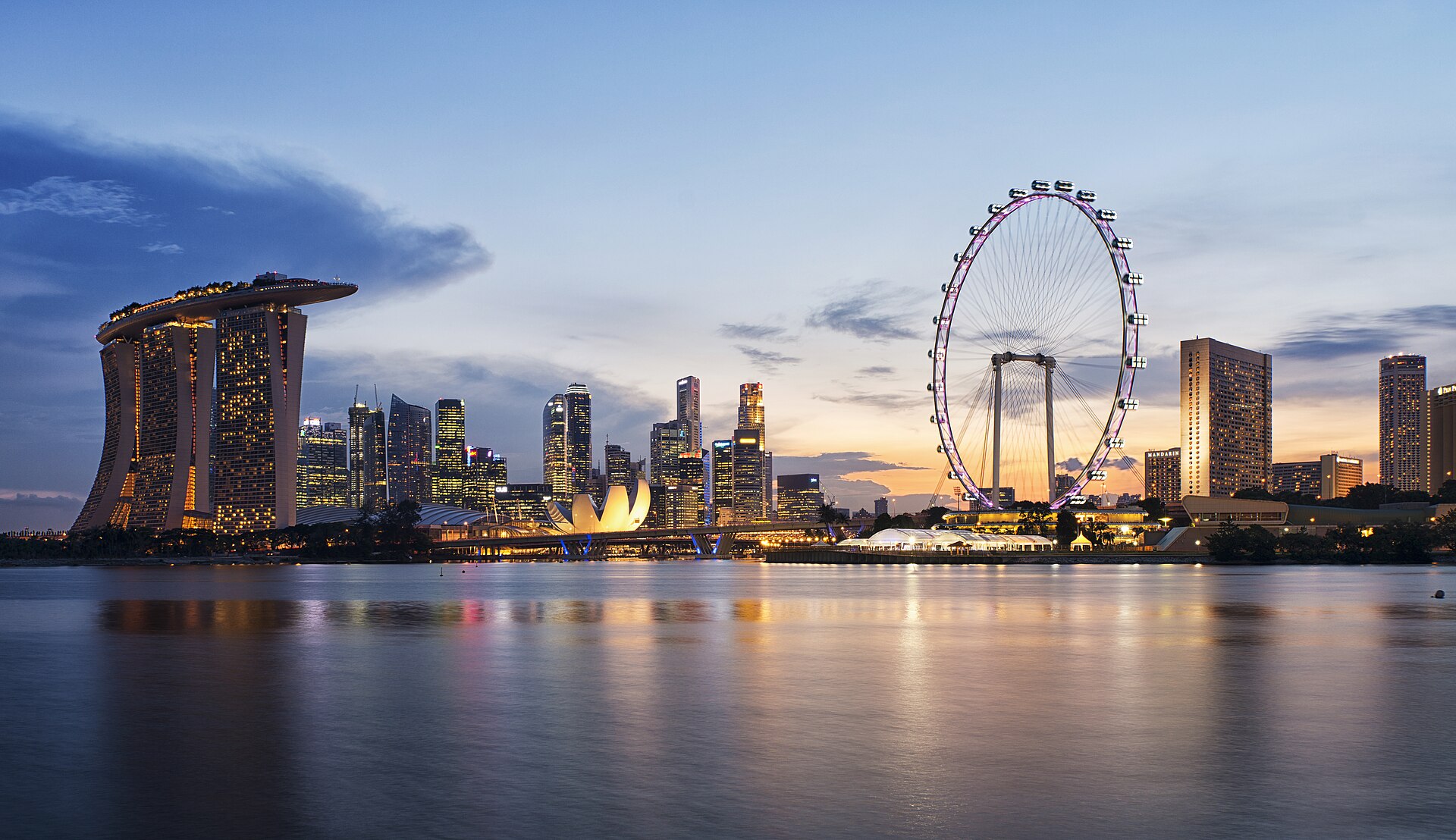
Singapore’s financial success
Historically, size has mattered when it came to a nation’s fortunes. After all, it is logical to assume that the larger your territory, the more natural resources and domestic markets you have access to. Described as a ‘city-state’, you’d be correct to assume that Singapore lacks in these departments. But despite having less land area than NYC, this former colony has still managed to flourish into a global financial centre and formidable military power. How?
Singapore’s most obvious advantage is its geography. If you’ve ever watched Location, Location, Location on Channel 4, you’d understand that sitting at the mouth of the world’s busiest shipping lane would naturally increase your property’s value. The Strait of Malacca handles over 80 thousand ships and, by extension, 30% of global trade annually. For comparison, around 12% of global trade normally passes through the Suez Canal, whose blockage by the Ever Given demonstrated just how vulnerable global commerce is to these chokepoints. It is only natural that Singapore’s economy has greatly benefited from the resulting trade.
The Port of Singapore has become a vital organ of global shipping and is renowned for its efficiency and automation. Its facilities allow it to deal with ultra-large container ships at great speeds, and the Tuas terminal is the largest fully automated shipping terminal. Sitting astride a strategic chokepoint does not guarantee wealth: managing it well and investing heavily in its infrastructure probably does. With its port quality a major factor, Singapore boasts one of the highest trade-openness scores (imports plus exports as a percentage of GDP) on the planet, ranking 4th at 320% (of its GDP). For the same comparison, Egypt and its Suez Canal come in at a whopping 178th with 51%.
Evidently, controlling a port and having great geography aren’t the full story of Singapore’s success. As the adage says, ‘it is not about the size of the sword, but the knight who wields it’. That’s not to liken the leadership of Singapore to a knight; however, how they have wielded their circumstances has brought unparalleled success over the last 60 years since expulsion from Malaysia. Lee Kuan Yew was Prime Minister for 31 of those years, and his People’s Action Party (PAP) has governed continuously for all of them. Singapore’s political system is neither a conventional liberal democracy nor a straightforward dictatorship. PAP has governed continuously since independence, creating an unusually stable policy environment. The stability of this political structure engineered Singapore into a corporation-friendly state.
Singapore has been consistent, and consistency is currency.
Whilst democracies shift dramatically every election cycle and firms constantly must evaluate their global resource allocations, Singapore has been consistent, and consistency is currency. Similar countries like Egypt, Djibouti, or even Malaysia’s own Port Klang have seen nowhere near the riches and influence that Singapore has mustered, and we can owe this to its political climate. Egypt collects substantial tolls from the Suez Canal but allocates it poorly in a bloated public sector and inflationary economy. Djibouti doesn’t have enough money to invest in the surrounding infrastructure that Singapore prides itself on, instead opting for military leases to Western powers to make cheap change and protect itself. Port Klang could reach the heights of Singapore’s ports, but Malaysia simply has more of a country to share its budget with.
The lessons of politics and corpo-state development can be illustrated with Hong Kong, which boasts a shared British colonial past with Singapore and reaped the same benefits of stability, but has seen some of these advantages erode since transitioning to China. Singapore has since briefly overtaken Hong Kong as Asia’s top wealth-management hub due to capital flight from Hong Kong amid political pressures from Beijing.
Singapore instead places its own pressure on government officials, possessing a complete zero-tolerance anti-corruption regime. Punishments are harsh for corrupt politicians and criminals in general, with capital punishment rates being some of the highest in the world. Additionally, Singapore has strong investigative institutions, severe penalties, bureaucratic professionalism, political incentives, and relatively strong enforcement to ensure that there is low corruption. But Singapore doesn’t just wield an iron fist to ensure a fair and competitive business environment; it hangs a very juicy carrot for government officials in the form of some of the highest public sector wages on Earth. There’s little a briber could offer that would be worth risking a salary already among the highest in public service.
Most low-corruption states are either wealthy democracies with checks and balances from a free press and institutions or poor with nothing to steal. Singapore is neither, being low corruption with high predictability and wealth, making the country a great place to send capital and do business.
The financial engineering doesn’t halt at attracting Foreign Direct Investment; Singapore is exceptional at raising internal capital as well. The Central Provident Fund forces every worker and employer to save for the state’s benefit alongside their own, up to a 17% employer contribution per salary. This has helped Singapore build an enormous pool of domestic capital, while sovereign wealth funds like GIC and Temasek invest state capital globally, multiplying returns for the country.
Yet, as with any situation, there are trade-offs. The very smallness that made Singapore’s strategy possible leaves it with nowhere to hide. Its wealth-management edge rests on US capital and dollar access; its trade volume rests on China’s energy and goods passing through the Malacca chokepoint, alongside which it sits. A US-China rupture over Taiwan wouldn’t just test Singapore’s neutrality: it would force it to make a pivotal choice.
Comments