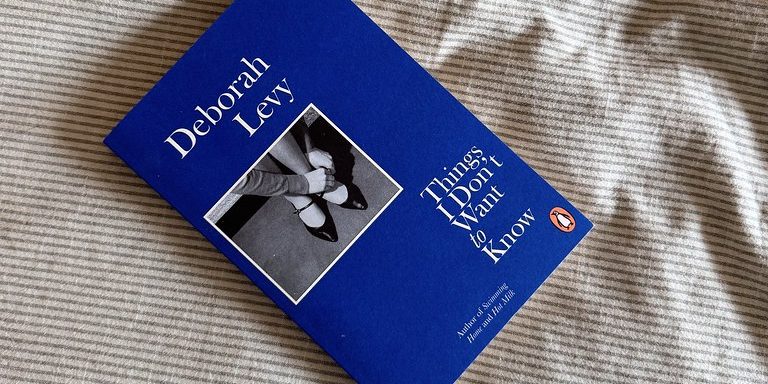
Deborah Levy’s Things I Don’t Want To Know: On teleological disobedience
A symptom of a modern world ruled by efficiency is that we judge writing by its object; stories are only as good as the events that they represent. We don’t care for writing outside of its ability to tell us things – if it takes too long to tell us things, or does so in words we don’t understand, then we consider it bad writing. Modern writing is teleological, oriented around one purpose – to inform. It’s transactional writing, bred by mark schemes and exam boards, designed to sacrifice style for substance. The sentence, once the unit of thought, has been demoted to a vehicle; what matters is the cargo, not the craft.
It forces you to keep up with a narrative, the primary aim of which is not the utilisation of language, but its celebration
Things I Don’t Want To Know by Deborah Levy is an exception to this ever-strengthening rule. It’s whirlwind writing, spinning you down a yellow-brick road, gathering evidence for something you could not fathom. It forces you to keep up with a narrative, the primary aim of which is not the utilisation of language, but its celebration. Ian McEwan said, “The mounted horse did not kill athletics. We run for joy.” Levy’s novel picks up on this beautiful futility, of writing for writing’s sake, writing with pretty words and every intention of making the story pleasant to read. You don’t read it to find out what happens. You read it to feel the particular texture of the writing, deliberate and light and sweet.
A portmanteau novel of the lyrical detail of Joyce, the deliberate simplicity of Hemingway, and Orwell’s robust structure, Things I Don’t Want To Know is primarily a response to Orwell’s ‘Why I Write’, but most effectively an explanation of why we write, and what it is we want to say to each other. It is style and substance, proving the sacrifice that we continue to make is useless. Where Orwell laid out the grammar of literary motivation — political purpose, historical impulse, aesthetic enthusiasm — Levy dismantles the hierarchy. None of his four reasons are more urgent than the others; they collapse into a single, humane act of attention.
Levy’s revolving, joyous prose raises Orwell’s stakes, adhering to the rules of his original essay and at the same time flaunting how far we’ve come: “That spring when my life was very hard and I was at war with my lot and simply couldn’t see where there was to get to, I seemed to cry most on escalators at train stations.” It’s tragic, powerful, deliberate, light, and graceful. The sentence earns all five adjectives without straining for any of them.
Levy is not interested in the chronology of events so much as what they leave behind: the residue of experience that eventually becomes the reason to sit down and write
The bulk of the novel is spent recounting transformational events in Levy’s childhood, travels, and writing career. Levy takes us through her family’s emigration from apartheid South Africa, her teenage years in the UK scribbling in cheap diners among builders and bus drivers, and her theatre-writing days touring Poland during Eastern Europe’s economic collapse — each episode orbiting Orwell’s four motivations without ever being reducible to them.
Levy is not interested in the chronology of events so much as what they leave behind: the residue of experience that eventually becomes the reason to sit down and write. Her South Africa is not just a historical backdrop; it’s the source of her political urgency. Her cheap diners are not merely anecdotal; they’re where she was taught that writing was an act of will, not talent. The episodes don’t build toward a conclusion, but toward a complete, coherent voice.
It’s an emotionally charged response to Orwell’s philosophy. Aptly, it’s telling us something we don’t want to know: that our recent technological forays with words won’t kill literature, and that robots may use words like we do, but they don’t – and they won’t – write like us. A language model can approximate tone and accumulate syntax, but it has no escalator, no war with its lot, no spring of genuine difficulty. The distinction matters – we write down, literally or not, the things that we go through. It’s distinctly human, and no robot, however syntactically competent, goes through what we do.
Comments