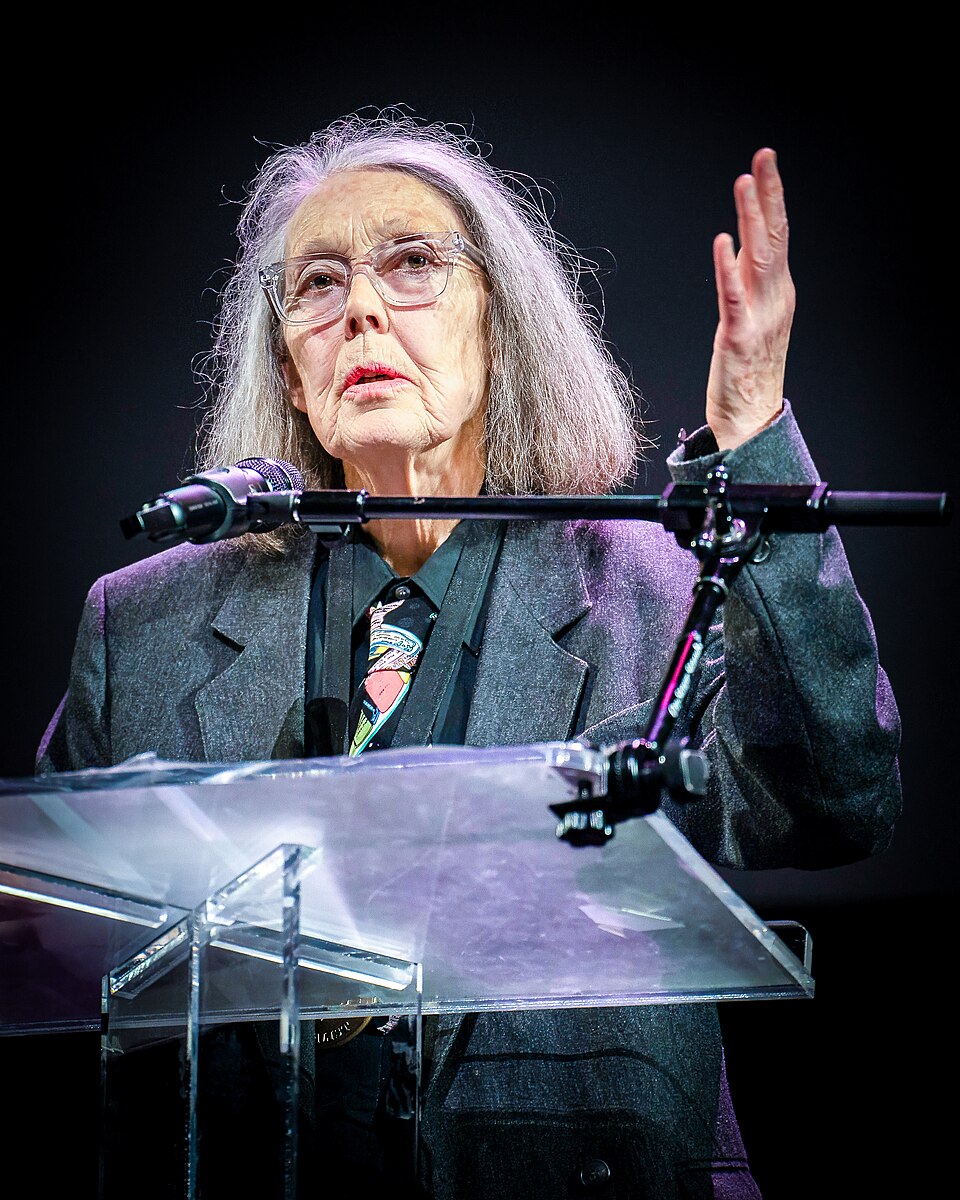
Anne Carson becomes the 19th female winner of the Nobel Prize for Literature
This year Anne Carson has joined the ranks of Harold Pinter and Bob Dylan as she becomes this year’s winner of the Nobel Literature Prize. Carson is known for her creative and playful use of ancient Greek literature in her prose, poetry, and essays. Her work includes The Glass Essay, Autobiography of Red: A Novel in Verse, Nox, and The Trojan Women: A Comic. Other winners of the 2026 Nobel Prizes include physicist Francis Halzen for his work on neutrinos, and Navanethem “Navi” Pillay who won the peace prize “for her efforts to promote peace and international law”.
Born in Toronto in 1950, Carson’s body of work flows easily between poetry, prose, and translation, having an impressive grasp of all its forms. She draws heavily on mythology and ancient Greek literature, and has been a professor of classics at many colleges, including: Princeton, New York University, and McGill University in Montreal. She is the 19th woman to win out of 123 literature laureates; a saddening statistic.
Her work has been praised by many, including the Canadian Prime Minister, with people describing it as broad, intoxicating, smart, and humane
Her work has been praised by many, including the Canadian Prime Minister, with people describing it as broad, intoxicating, smart, and humane. The Academy has stated that she has been given the prize for her “bold and inventive oeuvre that, in playful dialogue with the classical tradition, has created new forms for contemporary literature”.
As well as the Canadian Prime Minister, Anders Olsson, the chair of the Swedish Academy’s Nobel Committee for Literature, praised Carson, saying she has “broken away from lyrical poetry bound to the narrative self and inspired new forms of contemporary literature”. She also received acknowledgement from her long-term editors Robin Robertson and Declan Ryan from Jonathan Cape; both of whom called her work unclassifiable, innovative, and praised her manipulation of language.
Her most famous work, Autobiography of Red, a novel from 1998, pulls on fragments of the ancient Greek poet Stesichorus. She retells the myth of Geryon as the story of a teenage boy navigating heartbreak and desire in the modern day. This book was renowned for its wit and powerful prose.
Carson often bends the rules of genre and form, including many different examples of different forms in most of her work. Her 2021 comic, The Trojan Women: A Comic, bends the rules of poetry, adaptation, and graphic novels to become a fresh new look at The Trojan Women, allowing their story to be brought to life in the 21st Century in a way that no other author is currently doing. With the help of visual artist Rosanna Bruno, she has explored how human beings are affected by warfare on a personal level through reimagining Euripides’s The Trojan Women.
Nox is another genre-bending work of Carson’s, which doubles as a poetry collection and a stunning elegy for her brother. The collection takes the form of a fold-out concertina, which includes: quotes, letter fragments, poetry, photographs, paintings, and drawings which all build up the life of her brother for the reader. It is more than simply a work of literature, it is an art piece highlighting Carson’s ingenuity and uniqueness as an author and artist.
Authors who were also up for the prize included Chinese experimental author Can Xue, who was named as a favourite to win alongside Carson. Xue has been a favourite for a few years now and has been longlisted for the International Booker Prize twice. Others who were in the running included Haruki Murakami, Gerald Murnane, and Margaret Atwood, all of whom have had hugely impactful careers. Competition for this year’s Nobel Prize was harsh, and it appears we have plenty of phenomenal authors to choose from in the next few years already.
Anne Carson plays with the work of the ancient Greeks in much of her writing, creating a fresh take on old tales
Often, writers play with form and call on the literary canon to influence their own work. Anne Carson plays with the work of the ancient Greeks in much of her writing, creating a fresh take on old tales and bringing them to the forefront of her readers’ minds. The 2025 winner, László Krasznahorkai, was heavily influenced by Kafka, and many recent winners have taken a heavily politicised stance, often gunning for equality, feminism, and freedom. All winners have been regarded as genre-defining.
Comments