A masterclass in visual politics: Re-entering Pan’s Labyrinth 20 years later
A black screen, the sound of a young girl’s shallow breathing, blood trickling from her nose as time appears to run backwards. Sitting in my year-twelve film studies classroom, I had no idea I was about to discover one of the greatest films I believe I will ever watch. Twenty years after its release, Guillermo del Toro’s Pan’s Labyrinth (2006) remains a masterpiece of cinema that’s legacy extends far beyond its three Academy Awards and lies in its ability to expose historical cruelty through childhood innocence.
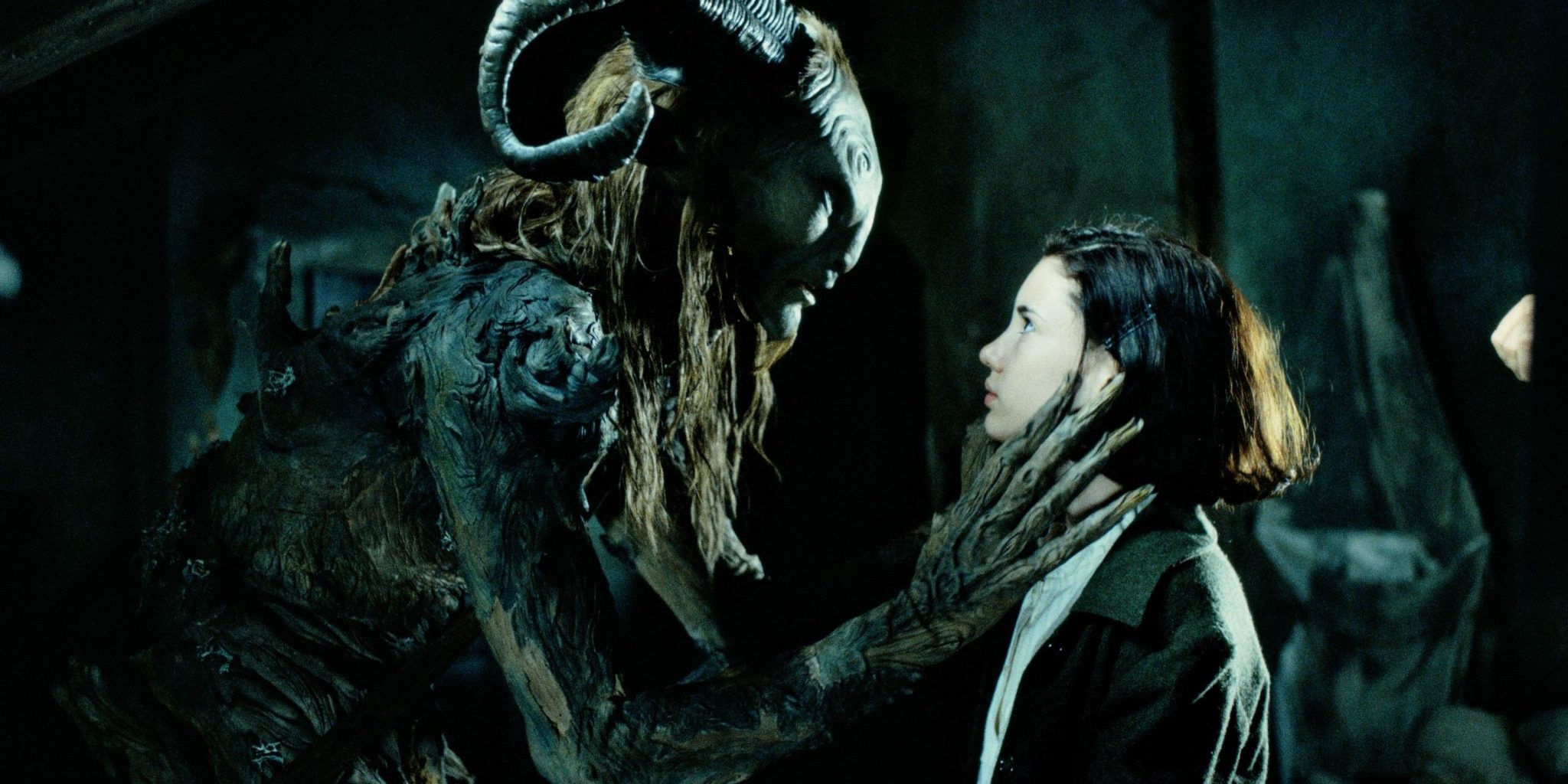
Set in post-civil-war Spain in 1944, Pan’s Labyrinth follows eleven-year-old Ofelia as she arrives at a military outpost commanded by her authoritarian stepfather, Captain Vidal. While he attempts to eliminate republican guerrillas resisting Franco’s dictatorship, Ofelia falls into a fantastical world where – to her surprise – she is told she is the reincarnation of an underground princess. Del Toro intertwines these narratives to explore the relationship between imagination and oppression.
Ofelia’s imaginative world offers a warmth and possibility which is absent from the brutality of Francoist Spain
From its opening sequence, the film demonstrates how cinematography and mise-en-scene can communicate meaning beyond simple dialogue. An extreme close-up of Ofelia’s eye that zooms out in reverse immediately destabilises our understanding of the film’s reality, transitioning into a dreamlike tracking shot through a golden kingdom before jump-cutting to the cold, blue-toned military camp. This contrast instantly establishes the central visual dichotomy of the film: that Ofelia’s imaginative world offers a warmth and possibility which is absent from the brutality of Francoist Spain. Even if you know very little about cinematography, it is difficult to not be captivated by the film’s visuals almost immediately.
The film’s use of colour is particularly effective. Vidal’s oppressive world is dominated by harsh blues, with rigid compositions reflecting the regime’s obsessive order. Conversely, the labyrinth glows with golden light, using organic textures to create a warm, familiar and almost womb-like environment. The pagan imagery and subterranean spaces suggest protection and rebirth, positioning the fantasy realm as a refuge from a world intent on suppressing innocence and individuality. Although, the labyrinth is not entirely safe. Home to many outlandish creatures and the site of perilous trials, this setting complicates the idea that escapism offers complete freedom.
However, the film’s parallel narratives reveal that its most frightening monster may not be supernatural at all. Vidal embodies the cruelty of fascist authority. Del Toro pays close attention to the military man’s immaculate uniform and has Vidal constantly checking his watch, a reminder of his obsession over control. Against this rigid environment, Ofelia’s fairytale imagination represents a refusal to accept the world that Vidal expects her to.
Del Toro endeavours to expose the greed and self-preservation of those in power
This political argument is furthered by del Toro through the iconic ‘Pale Man’ sequence. The infamous creature sits before a banquet, surrounded by food while the wider world suffers deprivation, a scene which mirrors the exact layout of Vidal’s own lavish dinner party. With this, del Toro endeavours to expose the greed and self-preservation of those in power.
The Pale Man has often been associated with wilful blindness to suffering, his eyes embedded in his palms. Del Toro himself stated that the Pale Man “represents fascism and the church eating the children…there is almost a hunger to eat innocence. A hunger to eat purity.” Its grotesque imagery alongside allusions to wider European histories of fascism transforms a fantastical monster into a symbol of institutional cruelty. Furthermore, the sequence can be read as a critique of religious institutions, with religious iconography and imagery of abundance questioning the moral legitimacy of powers that turn away from suffering. This ensures that the fantasy elements of the film constantly refuse to distract from its politics, instead making del Toro’s messages of horror visible on screen and just as important today as ever before.
One of the most striking elements of the film is its presentation of femininity. A standout performance is Maribel Verdú’s portrayal of Mercedes, who conceals her support for the guerrillas beneath the appearance of a submissive housekeeper. Vidal, and perhaps the audience, underestimate her, yet her hidden knife transforms from an ordinary household object into a symbol of resistance. The kitchen becomes a site of political rebellion and her refusal to submit echoes the film’s wider message that unquestioning compliance is not a virtue when authority demands cruelty. Ten years before conversations about female representation became truly prominent in mainstream criticism, del Toro was already placing women at the centre of his story about political resistance.
The film’s message … transforms the fantasy genre into a platform where historical and otherworldly horrors can coexist and parallel one another
For me, the film’s significance extends beyond its cinematic achievements. Before watching Pan’s Labyrinth, Francoist Spain was not a subject I had learned about at school, so the film provides an essential spotlight on a section of history that often remains unexplored.
Del Toro’s decision to create a film focused on the aftermath of the Spanish Civil War and the effects of Franco’s regime came after decades of Spanish civilians following a ‘Pact of Forgetting’ which aimed to move the country on from the pains caused during the dictatorship. Yet the film’s message emphasises the need to stand up against fascism, and transforms the fantasy genre into a platform where historical and otherworldly horrors can coexist and parallel one another.
Twenty years on, Pan’s Labyrinth remains essential viewing, not just for film enthusiasts but for anyone interested in how cinema can change the way we understand the world. Its warnings about authoritarianism, blind obedience, and the cost of forgetting history remain important in 2026, when questions about political power and whose stories are made mainstream continue to matter. For anyone willing to embrace a world of fantastical creatures, del Toro’s film provides an invitation to discover an overlooked history, and question the authority figures we continue to encounter.
Pan’s Labyrinth returns to cinemas across the UK from 30 October, presented in a new 4K restoration.
Comments