Tony review: Bourdain before he was cool
I love Anthony Bourdain. Not in the way that someone finds a Bourdain quote on Instagram, puts it over a grainy picture of him smoking, and suddenly decides they have a profound understanding of the human condition. I mean, I grew up watching him on TLC on a 2010 television, watching a man wander through places I could barely imagine existing.
Before I had travelled much of anywhere, Bourdain gave me a way of looking at the world: curious, sceptical, irreverent, and always slightly hungry. In hindsight, that is probably a rather dangerous person to let near a developing frontal lobe.
Most people would recognise Bourdain from No Reservations and Parts Unknown. The premise was simple: travel somewhere, eat whatever was put in front of you, drink considerably more than any doctor would recommend, and try to understand the place through the people who lived there. The food was good. The destinations were good. The television was very good. But Bourdain himself was the point.
Most importantly, he was interested in people
He could make an opinion sound completely considered and slightly hungover at the same time. He was cynical without being entirely cynical, sentimental without becoming unbearably sentimental, and intelligent without seeming desperate to prove it. Most importantly, he was interested in people.
Which is why Tony, Matt Johnson’s new film about Bourdain’s early life, is such an interesting proposition. Because before there was Bourdain, there was Tony.
Tony, whom apparently only his mother was allowed to call Anthony, is 19, angry, directionless, pretentious, and not particularly pleasant company. He is also nowhere near as interesting as he thinks he is.
Bourdain himself was less forgiving. In Kitchen Confidential, he described his younger self as a “spoiled, miserable, narcissistic, self-destructive, and thoughtless young lout, badly in need of a good ass-kicking.” It is a pretty brutal way to describe yourself, but it gives Tony a very good place to start.
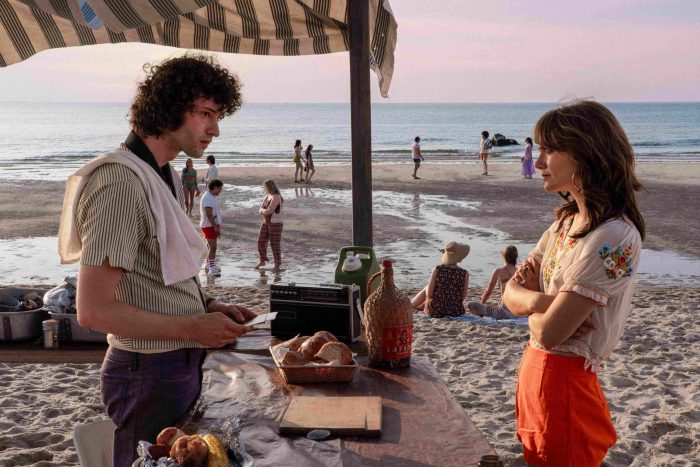
Image: Seacia Pavao / A24
After losing out on a writing fellowship at Vassar, Tony follows a girl to Provincetown, Massachusetts. In reality, Bourdain followed Nancy to Vassar, and the two later planned their Provincetown trip together. The film changes this into Tony impulsively following her there after learning he has lost the fellowship. He ends up working at The Flagship, a waterfront seafood restaurant that Bourdain later fictionalised as “The Dreadnaught” in Kitchen Confidential.
There is something almost perfectly funny about beginning a film about one of America’s great raconteurs with him doing the least glamorous job imaginable: washing dishes.
The camera feels like it has wandered into the room rather than been carefully placed there
It is also where Johnson’s film really starts to work. Following BlackBerry, Johnson brings the same loose, slightly chaotic energy to Tony. The camera feels like it has wandered into the room rather than been carefully placed there. People interrupt each other. Conversations overlap. Nobody seems particularly concerned with making themselves look good.
The colour grading adds to this. There is a warm, slightly hazy quality to Provincetown, which makes everything look sun-soaked, sweaty and vaguely sticky. It feels like summer, rather than a film trying to recreate summer. Even the kitchen looks hot enough to make you reconsider your career choices.
Then there is Dominic Sessa.
Fresh from The Holdovers, Sessa plays Tony without much of the mythology that has gathered around Bourdain since his death. This is not the deep-voiced, worldly traveller we remember. This is a 19-year-old who thinks being well-read is roughly the same thing as having experienced life. In other words, he is nineteen.
Sessa gets the combination of arrogance and insecurity exactly right
Sessa gets the combination of arrogance and insecurity exactly right. Tony wants to be a writer. He wants to be interesting. He wants Nancy to think he is interesting. Instead, he ends up at the bottom of a kitchen hierarchy, surrounded by people who couldn’t care less about his literary ambitions.
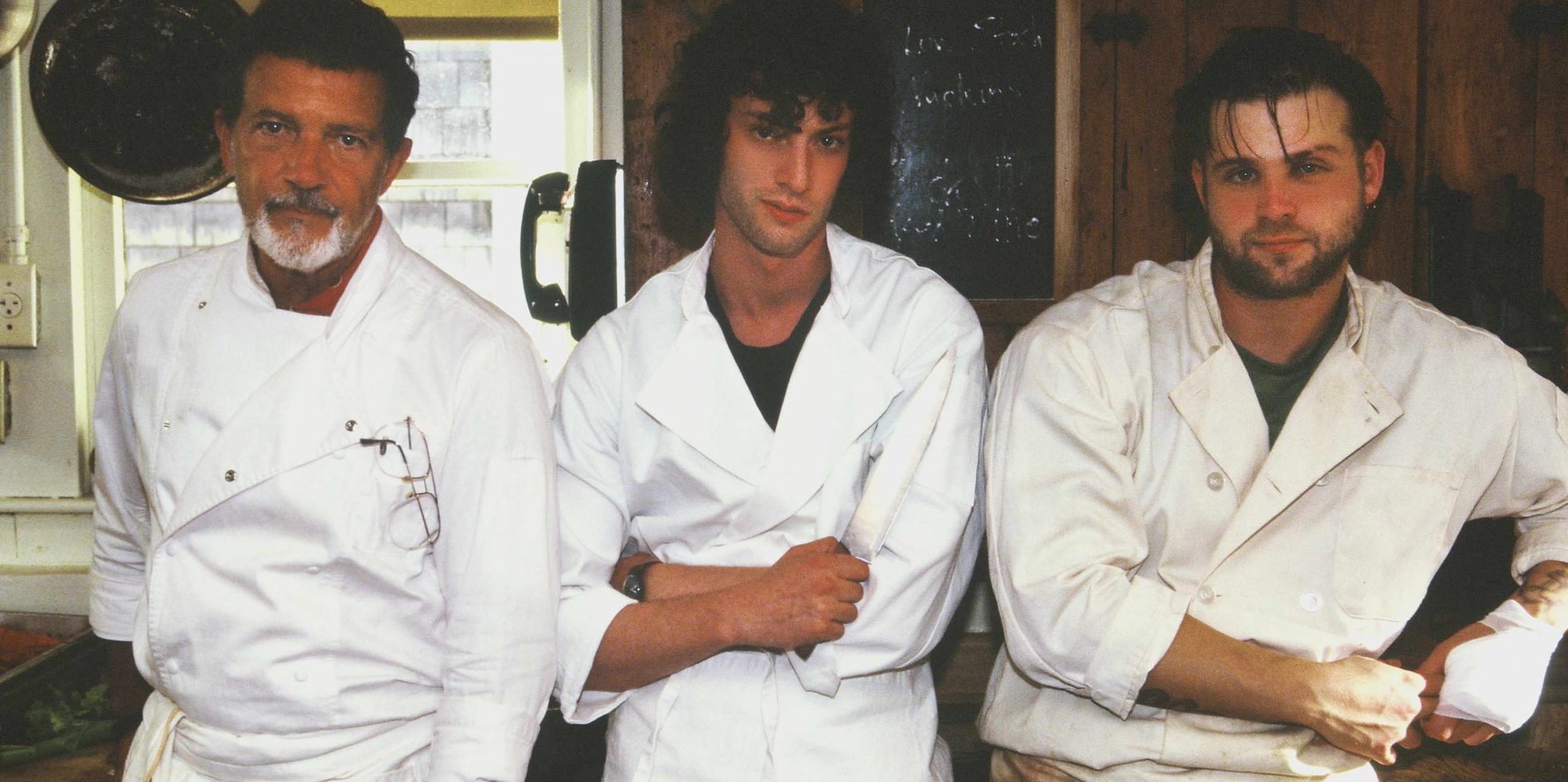
Antonio Banderas plays the chef running the kitchen. The character draws on Bourdain’s real mentor, known as “Bigfoot” in Kitchen Confidential, while also combining elements of other people from his early restaurant life. He does not see a misunderstood genius, rather a dishwasher who needs to learn how to work.
And then comes Leo Woodall’s Sal.
For the first part of the film, Sal is considerably more fun to watch than Tony. He is sweaty, flirtatious, unpredictable, and always about five minutes away from either starting a fight or doing something stupid. Woodall gives him enough charm that you immediately understand why Tony wants to follow him around.
But Sal is doing more than playing the kitchen’s resident bad influence. He is essentially a composite of the larger-than-life cooks Bourdain encountered throughout his early restaurant career, the ex-hippies, ex-cons, drifters, and general lunatics who would later fill the pages of Kitchen Confidential. Sessa has also described Tony and Sal as representing different sides of the Bourdain people eventually came to know.
Slowly, Tony finds something in this kitchen that he has been missing. Belonging
Slowly, Tony finds something in this kitchen that he has been missing. Belonging. Nobody cares that he failed at writing. Nobody cares what books he has read. They care whether he can keep up. For perhaps the first time, he has to earn his place.
That is where Tony becomes less of an origin story and more of a coming-of-age film. It is about a young man who has a vague idea of the person he wants to be, but absolutely no idea how to get there.
I left the cinema thinking about something else entirely: the small but remarkably loud corner of the internet insisting that Bourdain would have hated this film. And my question is: who asked him?

Image: Bob Gruen / A24
Laurie Woolever, Bourdain’s long-time assistant and collaborator, describes fans declaring “Tony would’ve hated this” with absolute certainty, “as if they’d just been ripping Marlboros and downing Negronis with the man himself.” And that is exactly what bothers me.
Much of what we know about Tony’s early life comes from Tony himself. Kitchen Confidential was based on his own experiences working in restaurants, although the book itself was already a heightened and fictionalised version of his memories. The filmmakers have used those stories as a starting point and then taken plenty of creative liberties of their own, as this breakdown of the film’s fact and fiction makes clear.
Maybe he would have loved the film. Maybe he would have hated it. Maybe he would have complained about it over a cigarette and then asked where everyone was going for dinner. We don’t know. And I think we have become far too comfortable pretending that we do.
There is a point where familiarity becomes intimacy by accident, and I think we have crossed it with Bourdain
We have read the books. We have watched the shows. We have heard the interviews. That does not mean we knew him. There is a point where familiarity becomes intimacy by accident, and I think we have crossed it with Bourdain.
The internet has turned him into a particularly strange kind of parasocial figure: someone people feel so attached to that they now seem determined to speak on his behalf. As if reading enough Kitchen Confidential qualifies you to explain what he would have thought.
Unless you were actually sitting there sipping Negronis with the man, perhaps we can calm down. And even people who actually knew him are not pretending they have the answer. Woolever asked Michael Steed, an Emmy-winning producer who worked with Bourdain for years, how Tony would have felt about Tony. His answer was: “Is there any biopic that the subject would actually like?”
What I like about Tony is that it does not ask us to worship Bourdain. It lets him be selfish, immature, obnoxious, and occasionally difficult to like. It lets him be wrong. More importantly, it lets him be unfinished.
People stayed through the end credits when I saw it. I left feeling strangely good. In an age where biopics can become so concerned with preserving a person’s legacy that they forget to make them feel like people, Tony does something much more refreshing: it lets Bourdain be young.
I went into the cinema loving Bourdain. I came out feeling like I understood him a little better, not because the film told me who he was, but because it reminded me that he was once someone who didn’t know yet.
★★★★ ½
Comments