Lady Thistledown: A toothed encounter
Dearest Wild Reader,
Today I was promenading beside Tocil Lakes, when I encountered a most fascinating sight!
Out on the water was a small gathering of birds, all sporting sharp, pointy, red bills, protruding from which were sets of needle-sharp teeth – enough to give those with such fragile dispositions as myself quite a fright!
After some brief research, it transpires that goosander teeth are used to grip slippery, aquatic prey, and are not true teeth, but rather ridges of keratin. This classifies goosanders as members of the sawbill family, due to the appearance of their beaks resembling that of the serrated blade of a saw. One must wonder, what sort of bird arrives at the lake dressed for dinner, with its own cutlery already attached?
Their sea duck characteristics include the ability to dive after fast-moving prey and tolerate exposure to salt water
This is not the only feature that distinguishes these birds from the regular duck. Though they can be easily mistaken as such by the untrained eye, they are in fact known as ‘sea ducks’. Their sea duck characteristics include the ability to dive after fast-moving prey and tolerate exposure to salt water. Goosanders have specialised “supraorbital glands” above the eyes, which excrete excess salt. These allow goosanders to inhabit both freshwater and saltwater environments – a most convenient arrangement for a bird with ambitions beyond the humble pond.
They are rather flamboyant birds too. The gentlemen present in this soiree were rather finely dressed in black and white, with dark green hoods – most distinguished. The ladies, however, decided subtlety was overrated, and instead sported rather eccentric rust-coloured mullets – a bold choice! Whether this is the height of fashion or a severe lapse in judgement, I shall leave you to decide!
So, dearest reader, keep watch for these scandalous creatures upon the water, and remember, the most intriguing characters are often those with the sharpest teeth…
Yours wildly,
Lady Thistledown
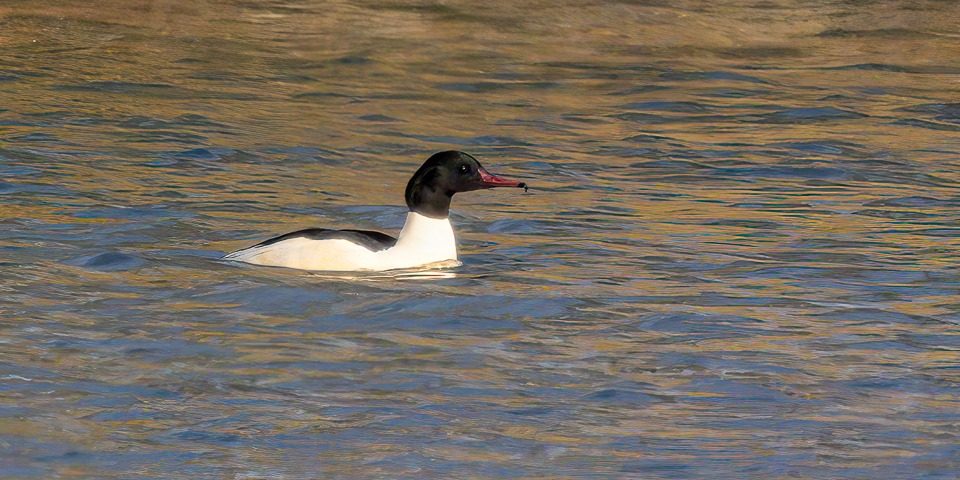
Image: Peter Hassett / RSPB
Comments (1)
Amazing writing