Jesus Christ Superstar with Sam Ryder — A Divine Debut!
Jesus Christ Superstar has long been one of the most notorious, famed and often controversial musicals – after the release of the concept album in 1970 and Broadway debut in 1971, the show written by Andrew Lloyd Webber and Tim Rice prompted both critical acclaim and social outrage, most notably from religious groups before gathering a rather ironic cult following and grew to an international phenomenon. Since then, it has gone through many incarnations and had many starred frontmen in the titular and leading roles, especially in recent history: a 2012 Arena Tour starring Tim Minchin (famously an outspoken atheist) in the role of Judas and Mel C from the Spice Girls as Mary Magladene; John Legend starred as Jesus alongside multiple Broadway icons in a 2018 Easter Sunday special; most recently a production at the Hollywood Bowl prompted outrage yet again from conservative women after the casting of theatre icon Cynthia Erivo as Jesus alongside the likes of Queen vocalist Adam Lambert and actor Josh Gad. All this goes to demonstrate that it is certainly not for the faint of heart to step into such a legendary musical with stellar casts in it’s past, making it all the more impressive that taking up the mantle of Jesus was Sam Ryder’s very first acting role and West End debut.
Ryder rose to prominence on social media before being catapulted into stardom following his Eurovision performance for the UK, coming in second place after Ukraine back in 2022. Since then, he has released albums, performed with Brian May of Queen and been nominated for a multitude of awards including ‘Best New Artist’ at the Brit Awards in 2023. He has cited Jesus as a dream role to play following in the footsteps of one of his idols (Ian Gillan from Deep Purple who sang on the original album), the question is whether or not his performance and the production as a whole lived up the hype?
There have been countless incarnations of JCS in its illustrious history, and this was no exception, choosing to characterise the characters through the music industry – Jesus appeared a budding musician who was susceptible to believing the hype around himself, Mary was a folk singer far more timidly present, and the Romans were presumably record label executives or industry members. Herein lies one of the criticisms of the production: whilst this is a potentially very intriguing decision, this particular choice felt slightly off and failed to reframe the story in a modern way or alter perceptions of the story, merely influencing certain staging and prop choices – Ryder and Peter playing guitar throughout, the Romans having ‘staffs’ which doubled as microphone stands etc.
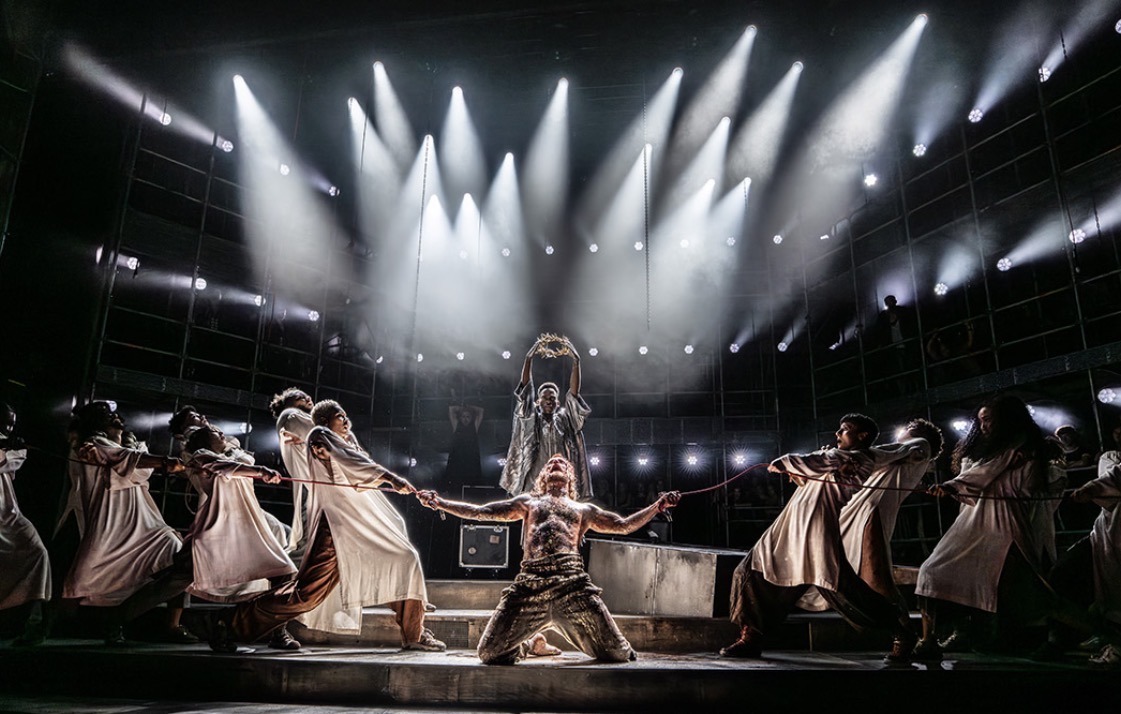
One aspect however which instantly catches the eye is the set design, notably the members of the audience on stage in amongst the scaffolded backdrops. This not only differentiates it from most performances where that is not the case, but it accentuates one of the main themes of the show; in the show, Jesus is depicted largely as a bewildered, tormented figure, burdened with responsibility and torn between doing what he believes he must do and having very human fears and desires. Therefore, having Jesus surrounded not only by other characters but members of the public ties into the celebrity it is implied Jesus has but also the claustrophobic feeling that Jesus experiences of too much being asked of him by too many. There is literally nowhere to turn to or way to escape for Jesus both physically and metaphorically.
By design, JCS is a show brimming with emotion which is imperative to be palpable to the audience, with every character having their own complexities and conflicts which must be navigated and portrayed.
The highlights of the show were undoubtedly the memorable spectacle moments which were brilliantly creative throughout: recreating the famous ‘Last Supper’ painting at the namesake’s song, Judas with silver blood on his hands after betraying Jesus in contrast to the wealth of gold used throughout the show, the restraining of Jesus with microphone cables to have the infamous crown of thorns placed upon his head whist being bathed in light, not to mention the very stage lifting to reveal they have been performing on a giant cross throughout in one of the final songs ‘Superstar’ to name a few examples. These striking visuals are spellbinding and accentuate emotions from amusement to astonishment and awe.
Another highlight of course was the long awaited performance of ‘Gethsemane’ by Sam Ryder. The song serves as arguably the emotional climax of the musical with Jesus reckoning with God, questioning and realising what fate awaits him in a raw, deeply human way, combined with vocal acrobatics and extraordinary high notes. Vocals were never going to be an issue for Ryder here and he absolutely does this tune justice with his delivery and acting choices – due to his range, he was able to hit the highest of notes with ease which allowed him not to compromise and choices he wanted to make, leaning into a rockier style vocal full of angst and frustration making it appear as a proper culmination and outburst of anguish with what he is being subjected to by his Father. Playing guitar throughout, Ryder absolutely nails it whilst being gradually overpowered by lights peering through the scaffolds at the back of the stage, prompting a standing ovation.
On top of Ryder’s individual outing, there was not a weak performance in the show. The vital role of Judas was reprised by Tyrone Huntley an award-winning portrayer of the character excellently captured Judas’ internal conflict and manic nature, opening the show with the angst driven ‘Heaven on their Minds’ and bringing Judas’ story to a close with a tortured, spine-tingling rendition of ‘Judas’ Death’. Huntley’s character could be seen throughout the show in the background observing ongoings with a look of sadness and desolation upon his face, developing his frustration to breaking point when he betrays Jesus, justifying his action to the audience as we have seen his concerns grow. Additionally, Richard Armitage’s King Herod provided great hilarity with its bombast and undeniable sense of fun, David Thaxton’s portrayal of Pilate was phenomenal and brought a brilliantly human element to the character who is undergoing his own moral conflict when deciding what to do with Jesus and Desmonda Cathabel’s gorgeously vulnerable vocals were spectacular in Mary’s two headlining songs.
By design, JCS is a show brimming with emotion which is imperative to be palpable to the audience, with every character having their own complexities and conflicts which must be navigated and portrayed. This production had an assortment of provoking moments and emotional decisions, two of which come towards the end of the show. One is the choice to humanise Jesus by placing him upon a smaller cross in front of a larger one to symbolise his humanity rather than his legend, followed soon after by Judas looking into the crowd in utter horror after the crucifixion which can be taken to mean a multitude of things including potentially breaking the fourth wall with Judas realising the consequences of his actions or what has come of the modern world since his times. Another symbolic move throughout is a golden microphone which is used by characters, potentially representative of the power that having a platform and authority comes with and also the dangers which partner it.
The singular criticism of the show would be attributed largely to contrasting tonal shifts which break the illusion often and detract from the overall emotional weight of the production. The story is quite literally as old as time and performances have been going for nearly 6 decades now meaning that as an audience member and fan of the show, you may be slightly disappointed by the lack of new emotions being brought out and different creative decisions in favour of archetypal characterisations. However, it must be recognised that JCS has an added dimension of difficulty in order to truly elicit the emotion it requires – following one of the most famous stories of all time means that acting choices are inevitably informed by the performers individual perceptions of the lyrics which will be greatly informed by their beliefs about the story of Christ. For example, someone who believes that Jesus is the son of God as a devout Christian would most likely play the character differently than an atheist who believes that Jesus was misguided and mistaken. Therefore also, the audience’s perceptions and what will truly move them is also inevitably swayed by their own views too, meaning that two audience members can come away with a completely different review of the show’s emotional weight.
Overall, whilst the production is deemed a rather typical production of the tale, that is by no means a negative! Sam Ryder delivers a performance to be admired for a West End debutant alongside a stellar cast, stunning visuals and vocal masterclasses. The current run at the London Palladium concluding on September 5th before moving over to Theatre Royal Drury Lane from October 16th – January 9th before touring around the country for the remainder of 2027 and is well worth checking out!
★★★★★
Jesus Christ Superstar begins their next run at the Theatre Royal Drury Lane from 16th October to 9 January 2027, followed by a UK-wide tour.
Comments