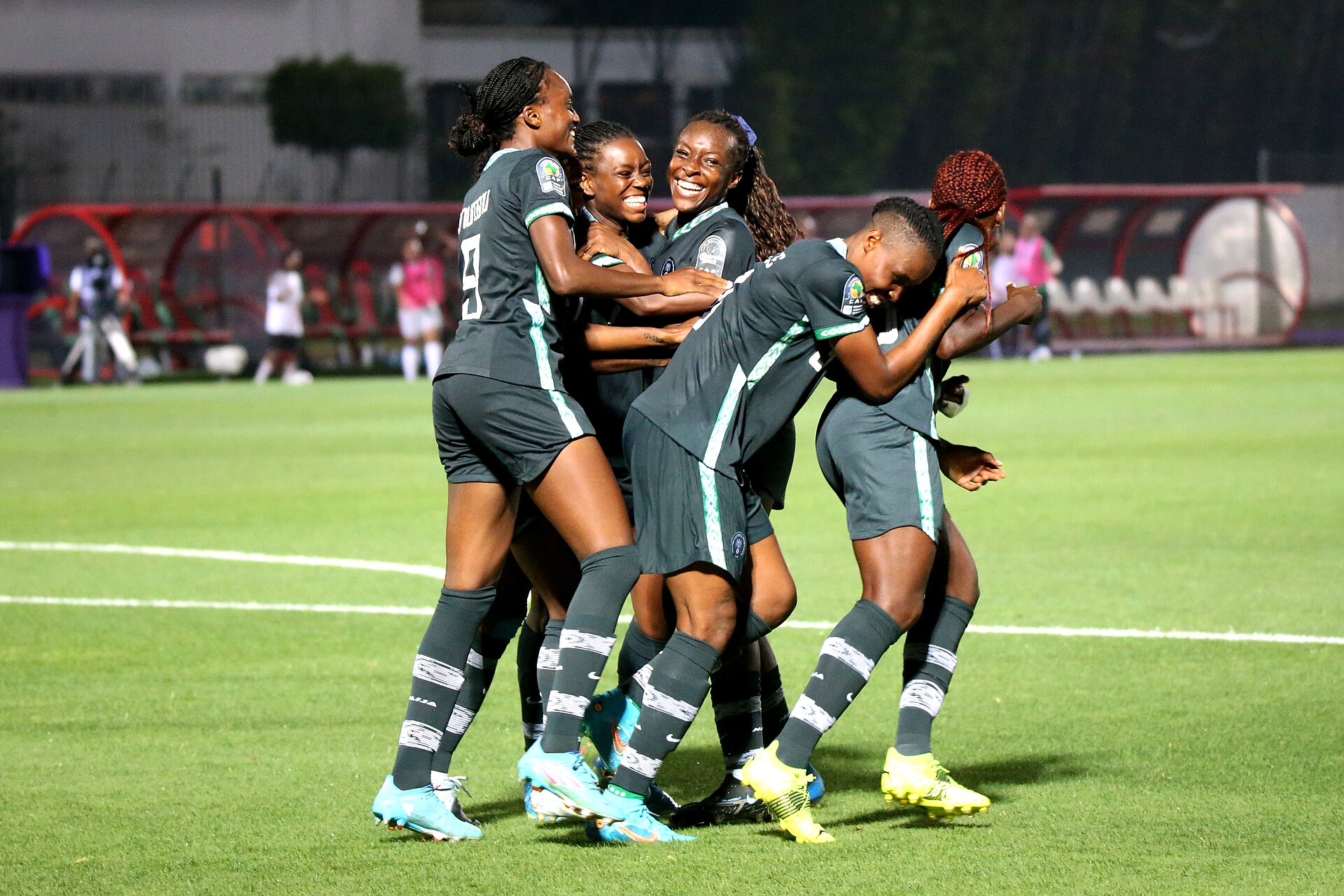
WAFCON has the stars and the stories. So why are its organisers failing to showcase them?
WAFCON. The Women’s African Cup of Nations. A biennial tournament that brings together the greatest national teams across the continent, as they all chase one goal: to be crowned champions of Africa. This year it is back bigger than ever in Morocco and is currently heading into the knockout stages. Yet it almost feels invisible.
Taking part in the tournament are some of the biggest names in women’s football, including 2024 BBC Women’s Footballer of the Year Barbra Banda and Asisat Oshoala, who won the same award nine years earlier and is also a record six-time African Women’s Footballer of the Year. Fans also get to watch NWSL Golden Boot winner Temwa Chawinga, alongside her sister, OL Lyonnes forward Tabitha Chawinga, as two of the game’s most exciting attacking talents take the stage. There is no better place to watch these stars, who are conquering their respective leagues across the world, fight for their countries on the pitch.
Though it is not only about the big stars, WAFCON is also a celebration of the growth of women’s football across Africa. This edition has expanded from 12 to 16 teams, its largest ever format, opening the door for nations like Cape Verde and Malawi to compete on the continental stage for the first time. The impact has already been clear, with debutants Malawi stunning ten-time champions Nigeria 2-3 in their opening match, while Côte d’Ivoire remains unbeaten in their return to the competition after a 12-year wait. Elsewhere, Banda scored a remarkable four goals against Egypt to lead Zambia to a 6-0 victory in their group stage match. Gone are the days when WAFCON was viewed as Nigeria’s tournament to lose; the gap is closing, and the competition is becoming more unpredictable than before.
The stakes have also risen alongside the growth of the format. The tournament this year is doubling up as qualification for the FIFA Women’s World Cup next summer in Brazil, meaning teams now have even more to play for.
So why, with such a rich display of talent and entertainment on offer, does it still feel as though much of the football world doesn’t know WAFCON is taking place?
Would this happen in the men’s game?
Desiree Ellis, South Africa Head Coach
The answer begins long before the opening whistle. Despite being the most ambitious edition of WAFCON yet, the competition was plagued by organisational uncertainty for months. Less than two weeks before the tournament was originally due to begin in March, the Confederation of African Football (CAF) had still not finalised the match calendar, allocated media accreditation, held media workshops, or confirmed the venues of the knockout rounds. Frustration over the lack of communication became increasingly public. South Africa head coach Desiree Ellis appealed: “If someone [from CAF] is listening, can they just give us a ‘yes’ or ‘no’” about whether the tournament would go ahead as planned. She then asked the pointed question: “Would this happen in the men’s game?”
Just 12 days before kick-off, CAF announced that WAFCON would be postponed until July, citing “unforeseen circumstances” and a wish to “ensure the success of the competition.” Although no official explanation was given, multiple reports suggested the delay stemmed from logistical challenges, including fixture clashes with Morocco’s men’s domestic league and concerns surrounding the country’s willingness to host following the AFCON final marred with controversy.
Regardless of the exact reasons, the postponement reinforced a trend that had become difficult to ignore. WAFCON had already been delayed in 2024 at short notice because of a scheduling conflict with the Paris Olympics, raising fresh questions about whether the women’s game is consistently treated as a secondary priority.
Stadiums that have a capacity of about 20,000 are barely being filled
The inadequate planning and communication from CAF let the players and staff involved down, as the late decision disrupted months of build-up across every level of the competition. National teams, including Nigeria and Ghana, had entered advanced training camps, with players having already pulled out of club duties.
For supporters, the disruption was particularly significant. Intra-African travel is often expensive, making it unrealistic for many fans to simply rebook travel and accommodation. Morocco had also introduced free electronic visas for supporters attending the men’s AFCON to simplify what can be a costly and time-consuming process, but no equivalent measure was in place for WAFCON. As a result, the late postponement may have priced out or discouraged supporters who had planned to attend.
The impact was also felt by the media. Journalists who had already committed to covering the tournament were left facing unexpected financial losses after rearranging travel plans at short notice. South Africa’s sport minister Gayton McKenzie backed those affected, calling for CAF to reimburse the journalists who had lost money, acknowledging the financially “rough period” that the media were going through.
This disorganisation completely upended momentum. The anticipation that had been building around the tournament dissipated, leaving CAF with the challenge of generating fresh interest ahead of the new dates, while also reducing the frustration they had caused.
Cut to the present day and the postponed version of the competition is still facing similar organisational issues. There has been little visible promotion of matches in host cities Rabat, Casablanca, and Fès, making it difficult to attract large crowds or create the atmosphere that turns a football tournament into a shared cultural event. The consequences have been plain to see: stadiums that have a capacity of about 20,000 are barely being filled, meaning that the spectacles that are happening on the pitch are not being met with the audiences that they deserve.
Fans in the UK were left with no sign of coverage on [Channel 4’s] television, web, or mobile platforms
Even the fans who do want to follow the tournament have had difficulty doing so.
Ticket sales for the matches only went live five days before the competition began, continuing the pattern of quick turnarounds that left little room to generate early hype, while making it harder for supporters to properly plan their attendance if they hadn’t done so already.
Meanwhile, fans across the world have not had a straightforward viewing experience either. A day before the opening whistle, CAF announced that it had secured a last-minute deal with multiple broadcasting companies to televise the tournament, one of which included Channel 4. However, come the first match, and fans in the UK were left with no sign of coverage on the network’s television, web, or mobile platforms. In response, CAF has since launched a YouTube stream, but the minimalist production comprised of a single camera angle, no studio pundits, and lifeless commentary, falls far short of the standard expected for a major international tournament.
Due to the lack of attendance, one could assume that the interest in African football is just not there, and that the sparse crowds can’t be helped if there is no audience for these matches to be catered towards. But, there is. There has been proof of that.
In 2022, more than 50,000 fans filled the Prince Moulay Abdellah Stadium in Rabat to watch South Africa defeat Morocco in the WAFCON final – a stark contrast to the half-empty stands this year. During the last tournament, public viewings in the capital of Zambia, Lusaka, also drew thousands, while the number of travelling fans started to grow, with one fan observing that she had “never seen this many families attending a football match together.”
When [WAFCON is] televised worldwide, it means a lot of people get to watch and a lot of people [can get] interested in so many players
Barbra Banda, Zambia captain
Following the promising signs of growth that the recent editions of WAFCON displayed, CAF general secretary at the time Véron Mosengo-Omba stated: “Success is not built in one day. The potential is there, but give us the time to work hard.”
With this work, Mosengo-Omba said he hoped to eventually reach the levels that their sister competitions like the EUROs have reached.
Time, however, is only one part of the equation. Yes, steps have already been made in terms of investment as seen in the increase of the prize money by 100% to £2 million and the expansion of the tournament. However, sustainable growth also requires a commitment to making the tournament more visible and providing suitable conditions to accommodate for existing interest. Greater coverage and stronger promotion are essential not only for attracting fans to stadiums and screens, but also for increasing the competition’s commercial appeal and creating opportunities for players. A lack of organisation just does the opposite of that.
Zambia captain Barbra Banda underscored the importance of visibility: “When it’s televised worldwide, it means a lot of people get to watch and a lot of people [can get] interested in so many players, us, our teammates, our coaches out there.”
The football has done its part; now the organisations involved in the tournament must do theirs
Wider exposure and stable planning puts players in front of scouts, draws the attention of sponsors and commercial partners, and gives broadcasters and advertisers greater incentive to invest long-term. That, in turn, generates the resources needed to improve the tournament and accelerate the growth that CAF says it is working towards.
WAFCON has already proved it has the players, the quality, and the drama to captivate audiences. The football has done its part; now the organisations involved in the tournament must do theirs. Continents like Europe and the Americas have shown what sustained investment and visibility can achieve for the women’s game. There is no reason Africa cannot follow a similar path. Until then, this exciting football tournament will continue to produce unforgettable moments that far too few people ever get to see.
African women’s football deserves respect, so it is about time they are shown it.
*Since the writing of this article, Channel 4 have secured broadcasting rights for all of the WAFCON knockout stage matches. Games will now be shown on the Channel 4 Sport Youtube Channel. This is the first time that the tournament will be broadcasted in the UK.
Comments