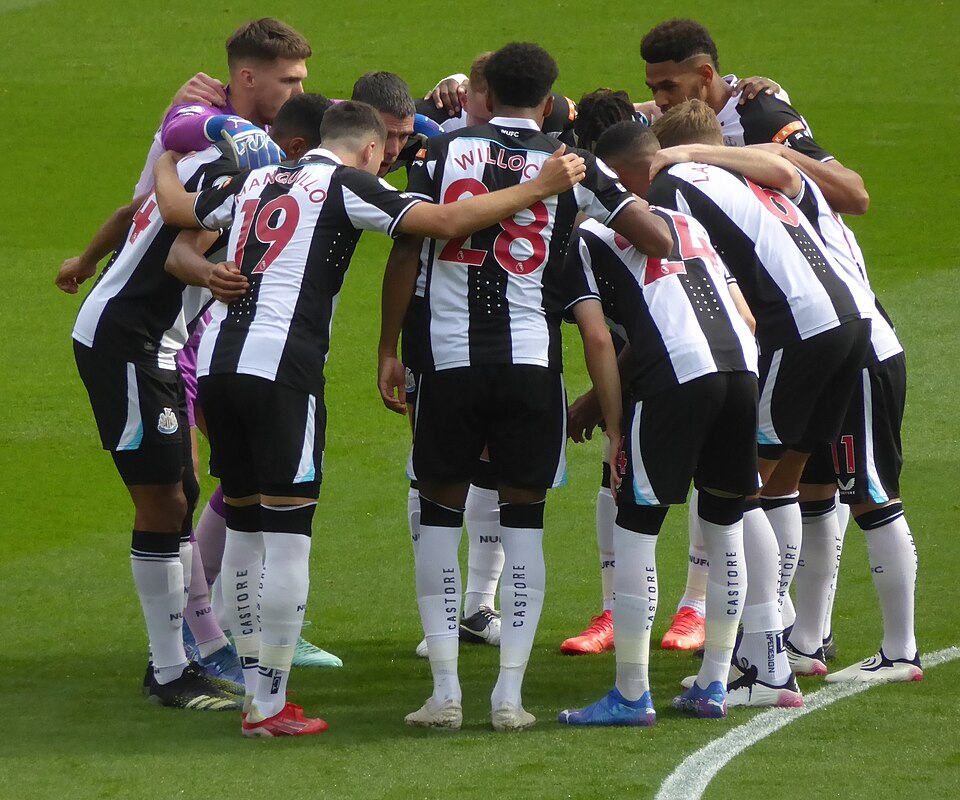
Guimaraes sale signals the end of Newcastle’s era of ambition
When the Saudi Arabian Public Investment Fund completed their takeover of Newcastle United in 2021, Amanda Staveley – the public face of the new regime – said that the club aimed to be competing for the Premier League within five years, and win it within ten. That always seemed an ambitious aim but, as they head into what was meant to be the final season before they began regularly challenging for trophies, the idea of the Premier League title at St James’ Park is more distant than ever.
This week, Newcastle confirmed the departure of their captain, the Brazilian international Bruno Guimaraes, to Arsenal. Guimaraes was the marquee signing of the first window under new ownership in January 2022, joining from Lyon in a £42m deal. Although the club made five additions that January, including the England international Kieran Trippier, it was Guimaraes’ arrival that really signalled Newcastle’s intent to join the big time. It wasn’t the fee – while significant, everybody knew that Newcastle had money now. No, what really signalled the start of a new era in the North East was that Guimaraes, a player who had serious and active interest from the likes of Dortmund and Juventus, was willing to walk away from European football at one of France’s biggest clubs to join a side who had been stuck in the Premier League relegation zone since August. What’s more, he joined without any mechanism to leave the club if they were relegated; during contract negotiations, Guimaraes made it clear he was prepared to spend a season in the second tier if needed, such was his belief in and unwavering commitment to the Newcastle project. He viewed this as a team he could grow with as one of its key players, where he could ultimately compete for the biggest trophies in world football. The likes of Trippier, striker Chris Wood, and defender Dan Burn were necessary short-term buys to stabilise the club in the Premier League and get results in the short term. Guimaraes? He was the face of the club for the next ten years.
From the moment of Guimaraes’ arrival, only four teams scored more points than Newcastle, and they stayed up with ease
For a while, it seemed like this vision was working. From the moment of Guimaraes’ arrival, only four teams scored more points than Newcastle, and they stayed up with ease. The following season, Guimaraes was central to a seemingly miraculous campaign in which Newcastle qualified for the Champions League, a competition in which they recorded a famous win over PSG. In the space of three transfer windows, a whole host of Europe’s most exciting players joined him at the Magpies: Sandro Tonali left boyhood club Milan to sign for Newcastle, whilst the Italian club and Manchester United were beaten to Dutch defender Sven Botman by Eddie Howe’s side. Newcastle also smashed their transfer record to sign Swedish striker Alexander Isak, whilst they hoovered up some of the best domestic talent – Tino Livramento, Lewis Hall, and Anthony Gordon have all become full England internationals since joining Newcastle. Even amongst all of these new arrivals, one of Newcastle’s biggest bits of business was tying Guimaraes to a new contract less than two years after joining, which could have kept him on Tyneside until 2029, when he will be 31.
Now, though, most of those stars are gone. After Isak’s acrimonious departure to Liverpool last summer, Guimaraes has joined Gordon and Tonali in leaving Newcastle this summer. Lewis Hall continues to be linked with a move to Manchester United, whilst Tino Livramento is refusing to sign a new contract and is therefore expected to depart at the end of this season. Of the five additions meant to herald a brand new era for Newcastle back in January 2022, only Dan Burn, at 33, remains. The mass exodus of £400m worth of talent has proven too much for Eddie Howe, who, after a five-year stint at the club in which three seasons were an unqualified success, securing two Champions League qualifications, has decided he can no longer continue in his post whilst his best players are sold from underneath his feet.
If a player wanted to leave Newcastle, they would ultimately be able to do so
The seeds for the mess Newcastle now find themselves in were sewn last summer with the sale of star striker Alexander Isak to Liverpool. With the Swede establishing himself as one of the best strikers in the world at Newcastle, second only to Erling Haaland in the Premier League, it was no surprise he was attracting interest from the likes of Liverpool, Arsenal, and Barcelona, all of whom had him earmarked as the player they wanted to build their frontlines around going forward. Newcastle were in a strong negotiating position, however, having signed Isak to a six-year contract upon his arrival from Real Sociedad in 2022. With three years remaining on Isak’s deal, there was no incentive to sell the striker for anything less than £150m, a valuation Newcastle would stick to almost all summer. They had a sensible long-term plan in place: sign Isak’s replacement in 2025, have them play together for a season, and sell the Swede at the apex of his value in 2026 if they could not convince him to renew his contract for the 2025-26 season. Even though rejecting Liverpool’s initial £100m bid for Isak in July meant losing out on their top target to replace him, Hugo Ekitike eventually, it was a no-brainer to reject such a derisory offer for a player worth far more.
Isak then put the club in a difficult position by expressing a desire to leave and refusing to play or train during pre-season or the opening encounters of the campaign, including a narrow 3-2 loss to Liverpool at home. When faced with this situation, Newcastle had two options: either hold firm in their position that Isak would not be sold for anything short of £150m, or accept a lesser fee early in the window, move on and sign numerous new players from a position of strength. In the end, they did neither, selling Isak with minutes to go on deadline day for just £125m. Due to the public nature of Isak’s exit and the limited time Newcastle had to replace him, they were making signings from a position of weakness; in the end, they brought in two strikers to replace Isak: they spent £64m on Nick Woltemade, who had scored 12 goals the previous season, didn’t fit Howe’s system, and ended the season fourth choice at striker and often deployed as a makeshift midfielder, and £55m on Yoanne Wissa, 29, who has never been worth close to that amount, will never be worth close to that amount and offered neither an increase in quality or resale value for Newcastle. Newcastle therefore came out of that summer – a summer that should have been spent using their Champions League status to entice more Isak, Tonali, and Guimaraes type signings – a weaker side, having not only sold their best player without anything remotely close to an adequate replacement, but also spent almost all of the money they received for Isak, meaning they wouldn’t be able to reinvest those riches in future windows either. It also set the precedent that if a player wanted to leave Newcastle, they would ultimately be able to do so.
The sale of Guimaraes takes Newcastle’s total income so far this summer to over £250m, as the third of three of Newcastle’s key players to depart this summer
History tells us that Newcastle did not have to fold here: Liverpool blocked approaches from Chelsea and Arsenal for Steven Gerrard and Luis Suarez, and both players eventually knuckled down and gave Liverpool their best seasons.
Phillipe Coutinho and Virgil Van Dijk had their big moves blocked for multiple transfer windows when the buying club refused to cough up the requisite fee, and when they did eventually leave Southampton and Liverpool, they did so for a higher fee than initially requested. Manchester United kept Cristiano Ronaldo for over a year after the winger expressed a desire to join Real Madrid. That is how big clubs, serious clubs, clubs with ambition, act. Folding to Isak and Liverpool’s will meant more than just one transfer. It was a tacit admission from Newcastle that they were not one of those clubs. That ultimately, if a world-class player wanted to leave Newcastle, they would be able to do so to join one of the so-called ‘elite clubs.’ It was the first sign that the ambitions expressed shortly after the PIF-led takeover of gatecrashing the ‘big six’ might no longer be viewed as genuinely achievable within Newcastle. They certainly felt the consequences of their weakness on the pitch, suffering a dismal campaign in which they finished 12th, their lowest league finish since the takeover (including the season when they spent three months bottom of the league under Mike Ashley). What became clear this summer is that the consequences have been grave off it as well.
The sale of Guimaraes takes Newcastle’s total income so far this summer to over £250m, as the third of Newcastle’s key players to depart this summer. The first, Anthony Gordon, was a sale the club themselves wanted to make; Newcastle needed a sale to meet financial fair play rules, and Gordon had enjoyed an underwhelming season in the Premier League. He remained respectful to the club, and they were able to agree a £70m package with Barcelona for the winger. Although they have sold him to one of Europe’s top clubs, they had done so from a position of relative strength, on their terms. The second sale was of a player they had hoped to keep, the Italian international Sandro Tonali. Like Isak, Tonali had three years left on his contract and expressed a desire to leave. Negotiations occurred whilst Tonali was on holiday, but it was not unthinkable that he would follow Isak’s example in refusing to return for pre-season training. Newcastle set an asking price of £100m for Tonali, which was broadly viewed as slightly higher than Tonali’s market value. They rejected three separate bids from Tottenham before Roberto De Zerbi’s side ultimately met their asking price, and Newcastle happily sold the midfielder on their terms. Given what has unfolded since with Guimaraes, one could speculate whether Spurs could have got him cheaper, but the fact is they didn’t: Newcastle held firm, and whilst they lost a player they had expected to keep, they did so on their terms and for a very generous price.
Bruno is different. Let’s survey the situation Newcastle faced this summer. Firstly, they’d already raised £170m from the sales of Tonali and Gordon, and had cut high earners like Aaron Ramsdale from the wage bill. Financially, they were (and are) rolling in it and had zero need for the money they could raise from selling Guimaraes. Secondly, Bruno had two years remaining on his contract at Newcastle, with the club holding the option to extend that by a further season until 2029. He was tied down for the long-term, which strengthened Newcastle’s position. Thirdly, Guimaraes is Mr. Newcastle. He’s been a fan favourite at St James’ Park since the day he arrived and has been captain for the last two seasons. In 2025, he became the first Newcastle captain to lift a domestic trophy in 70 years when he led Newcastle to the Carabao Cup. Within the dressing room, he is viewed as the crucial leader, and in a year when Newcastle will have their youngest squad in living memory, including many players who, like Guimaraes in 2022, will be living in England for the first time, his leadership and experience would have been crucial. And fourth – and most importantly – Bruno Guimaraes is really good at football. He starts for Brazil in midfield and is without any question Newcastle’s best player. After the departures of Tonali, Gordon, and Isak, he is frankly Newcastle’s best player by some distance. Given they are not in any European competition, it is highly unlikely that the club will be able to sign a player able to bring half of what Guimaraes does on or off the pitch.
Given all of this, it seems obvious that Newcastle had to take a firm stance on Bruno’s future. Either Arsenal or anybody else cough up £100m, a fee comparable to Tonali’s and the value of a now-expired release clause in Guimaraes’ contract, or Newcastle happily keep their captain at the club. Although Guimaraes did express a desire to join Arsenal, he was highly critical of Alexander Isak’s conduct last summer and had made it clear to the club he would not emulate the striker’s unprofessional conduct to force his way out – indeed, he returned to pre-season training as scheduled last Monday. Had no move materialised, the midfielder would have no doubt been disappointed, but ultimately got his head down and continued to play for Newcastle every week. That’s what Aston Villa did in 2022 when Arsenal tried to sign their Brazilian midfielder, Douglas Luiz. The Midlands club held firm, eventually got Luiz to renew his contract, kept him as a key player to get them into the Champions League and eventually sold him for over twice Arsenal’s offer to Juventus two years later. Perhaps most gallingly for Newcastle fans, their arch-rivals Sunderland were put in a difficult position this summer when Chelsea made an approach for their captain and talisman Granit Xhaka, who expressed a desire to move to Stamford Bridge. They took a radical approach that should have been watched carefully by their neighbours across the Tyne – they just said no. Under contract, Xhaka got on with his job, Chelsea moved on, and the Swiss international will continue to lead out the Black Cats next season.
Sources close to the manager have made it clear his decision to leave the Magpies was not, as Newcastle claim, to take a break from football
Unfortunately, Newcastle did no such thing. Despite the litany of reasons not to, they decided internally that they would sell Guimaraes, despite having zero incentive to do so, for £80m, a price which reflected a significant discount on his true value to Newcastle and not the sort of price he would have commanded had another club been selling him. Newcastle themselves acknowledge this, saying if the player had wanted to stay they would have dismissed Arsenal’s offer out of hand. Worse still, when they met Arsenal’s representatives to thrash out an eventual deal for Guimaraes, they compromised further, accepting a paltry £75m for a player they viewed as unsellable just weeks before. For Eddie Howe, the mastermind behind Newcastle’s (mostly) upwards trajectory in the last five years, this was the last straw. Although the Englishman accepted that Gordon’s sale was necessary for the club’s finances and that £100m for Sandro Tonali was simply too good a deal for the club to turn down, sources close to the manager have made it clear his decision to leave the Magpies was not, as Newcastle claim, to take a break from football, but because the club’s pathetic decision to fold on Guimaraes proves beyond all doubt they do not have the tools, desire or ambition to compete at a top level, or even to establish themselves as Champions League regulars. With four exits for Newcastle’s four best players in the space of just 11 months, it is difficult to argue with that assessment. Their recruitment this summer signals the club no longer has any ambition to compete at that top level.
The new manager, Mattias Jaissle, has been recruited specifically for his track record of working with young players, improving them and turning them into assets the club can sell for a profit. So far this summer they have signed 18-year-old midfielder Sam Steur from Ajax, winger Bazoumana Toure (20), goalkeeper Ewen Jaouen (also 20), and the comparatively ancient Lukas Hornicek, who has just turned 24. No doubt the eventual replacement for Guimaraes will be another fresh-faced young prospect ready to take on the Premier League after a breakout season somewhere on the continent. Given the events of this summer, there can be little doubt that if he is a success, Newcastle may prove to be simply a stepping stone for bigger and better things. Selling Newcastle to those players is easy. Selling it to the likes of Guimaraes is now impossible.
Perhaps with the luck of the draw, they will be able to win a domestic cup again at some point
There is now little to differentiate Newcastle from one of many other clubs in England’s top flight who operate on a business model of signing talented young players, developing them, providing them a platform to show the top clubs what they are capable of and ultimately moving to an elite club after a few years, generating Newcastle a substantial profit in the process. This is a model that has been executed with great success by the likes of Brighton, Bournemouth, Crystal Palace, and Brentford in recent years (although my own club, Southampton, are a testament to the fact it can all go horribly wrong). There can be no doubt that Newcastle are historically, financially, and infrastructurally a far bigger club than their fellow mid-table rivals. They will almost certainly enjoy numerous seasons of European football, albeit intermittently, under this model, and it would be a surprise if they do not at some point end up in the Champions League again. Perhaps with the luck of the draw they will be able to win a domestic cup again at some point, and will back themselves to build something long-term to establish themselves as ‘best of the rest’ in the Premier League.
That is unquestionably a better position than they were in when the PIF swooped in and saved them from an almost-certain relegation back in 2021, and one which most football fans in the country would do unspeakable things to find their own club in. It is not, however, the footballing juggernaut fans were promised Newcastle would become on that fateful October night; indeed, they have never seemed further from that ambition under Saudi ownership. If the sale of Alexander Isak last summer was the beginning of the end for Newcastle’s hopes of establishing themselves as a truly elite club, then the sale of Bruno Guimaraes this summer is the end of the end. The club may now well become immensely commercially successful and enjoy its best prolonged period on the pitch in history, but it will do so knowing its place in the footballing ecosystem it once set out to destroy. The ambition shown by Amanda Staveley to say Newcastle would win the Premier League within a decade that once fuelled a night of Sam Fender-fuelled ecstasy on Tyneside was admirable, but within less than half of that timeline the dream is dead. And whilst FFP, player power, and the establishment played their part, it was ultimately Newcastle themselves who killed it.
Comments (1)
Great and sometimes very loyal players can emerge and change the fortunes of football clubs. In the case of Newcastle that player, albeit in an upward state of embryonic change when he was let go, was Elliot Anderson. That piece of madness was the real start of the ride down the slippery slope which eventually took in Isak, Gordon, Tonali and Bruno. These were the magnets to pull in more and better talent. Once gone our remaining ‘magnets’ cannot attract such top talents and it will take another Elliot, Gascoigne or Beardsley (or all three at the same time) to change things. I would say loyalty to the club- an old fashioned concept in the modern age – is largely irrelevant if the selling price is high enough, but even the supreme case of Toon loyalty wrapped in top, top talent – one Alan Shearer – was not enough to force a change in wider perceptions of who we are.