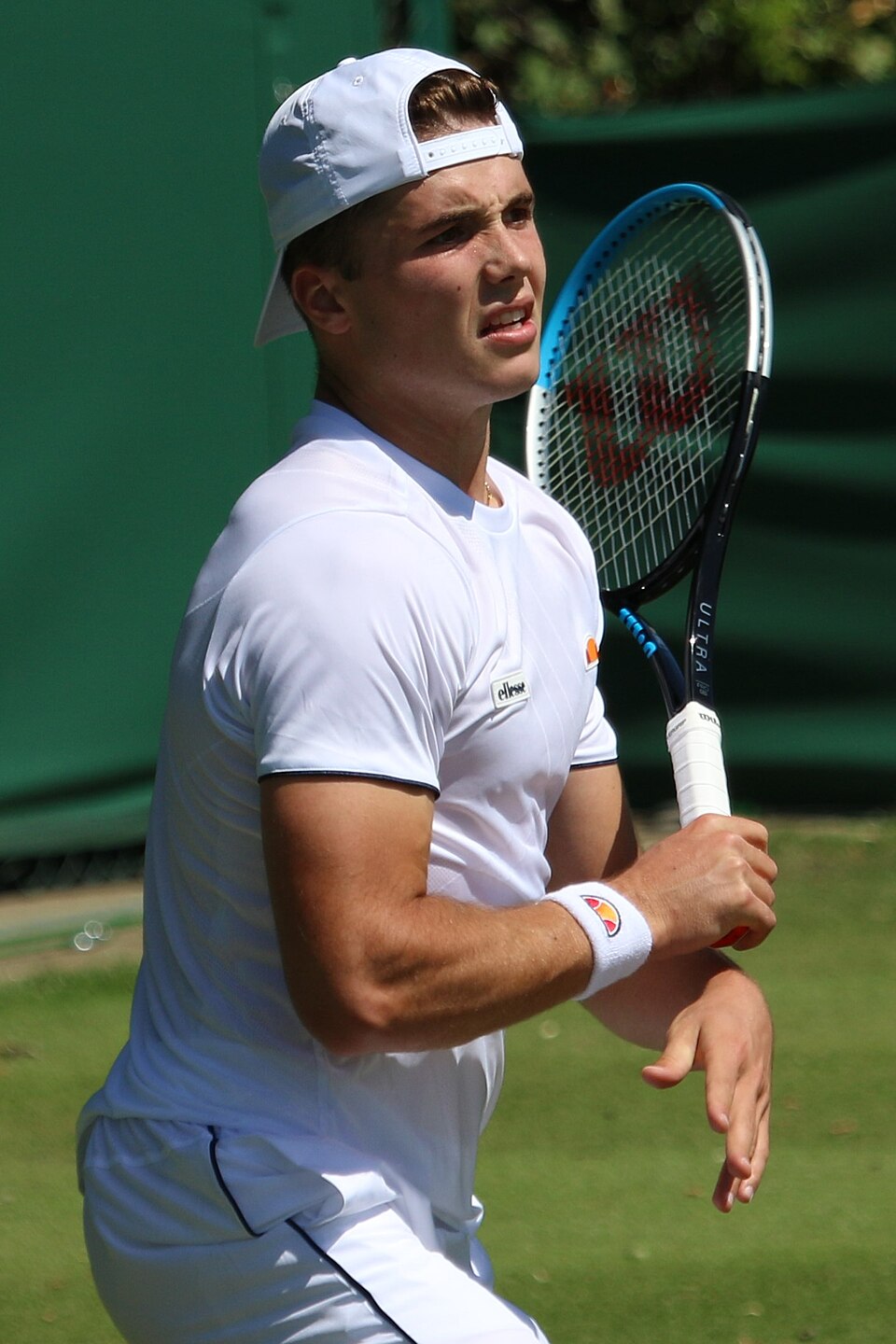
The wildcard that wowed Wimbledon: Why Arthur Fery’s run felt strangely familiar
Looking back at this year’s Wimbledon, there have been some very high highs and low lows depending on who you ask. But no matter where you are from or how much tennis you’ve watched, one thing is heavily agreed upon: Arthur Fery’s Wimbledon 2026 has been brilliant.
Arthur Fery’s history has certainly been a climb that he worked hard for. He grew up locally in Wimbledon to parents Loïc, a former hedge fund manager, and Olivia, a former professional tennis player. He then went to Stanford University, where he won a Pac-12 championship in 2021 and two ITA All-American Championships.
He then started off his professional career pretty slowly, initially only being a player present at Wimbledon and no other ATP Tour-level championships. During this period, he lost in the 1st round to Daniil Medvedev and Daniel Altmaier in 2023 and 2024, respectively. In 2025, he went one match further, beating 20th seed Alexei Popyrin in four sets but then losing to Luciano Darderi in straight sets during the next round.
In 2026, he qualified for two majors, first setting off to Australia to defeat 20th seed Flavio Cobolli in straight sets, before suffering a loss to Tomás Martín Etcheverry later on. He then qualified for the Miami Open, the first ever ATP Tour minor tournament he’s played, where he lost to the 11th-most successful male player by prize money, Stefanos Tsitsipas.
The quarter-finals were most impressive, with Fery sweeping Cobolli aside in a straight-sets win
As for his Wimbledon run, he came into the tournament ranked 114th, close enough for the main draw but just missing out on the automatic qualifiers. However, as one of the most prolific young British talents, he got himself a spot as one of the eight wild cards for the tournament. The ‘wild card’ is a way that a major tournament can field players with promising talent but who have not played as much tennis or as well as they would have had to have made the top 100.
Arthur Fery started with easy wins against Damir Džumhur and Otto Virtanen. Then came Zizou Bergs, a Belgian who had already dismantled one of the top French players, Ugo Humbert, in five sets, but it was Fery who showed the five-set prowess by winning the fourth and fifth set tie-breaks in a gruelling four hours and 39 minutes on Court 18. Then came Grigor Dimitrov on Centre Court, who had almost beaten Sinner last year had he not had a shoulder injury, where once again Fery came from a 2-1 set scoreline to win the fourth and fifth set in a tie-break in a match that lasted three hours and 55 minutes. The quarter-finals were most impressive, with Fery sweeping Cobolli aside in a straight-sets win as he did in Australia. The semi-finals would prove too much for him, as the 6’6” Zverev provided big serves which Fery couldn’t match, so he ended up losing a tie-break and two additional sets.
Let’s compare his achievements to a man at the complete opposite end of his career: Goran Ivanišević. By 2001, he had already established himself as one of the greatest grass court players of the 90s, making it to the final three times in 1992, 1994 and 1998; however, a dominant Pete Sampras made it impossible for anyone to take his crown between 1993 and 2000, winning seven titles out of eight, and Andre Agassi winning his only crown in a five-set thriller in 1992. His 1998 bout was also a five-setter, which gave Sampras the most ever Wimbledon and Grand Slam titles at the time.
Arthur Fery still has a lot to give to British tennis
Ivanišević’s status as a ‘wild card’ came due to his weaker performances after the 1998 final, not making it to the quarter-final of any slam in three years. In the earlier rounds, he swept past Fredrik Jonsson, Carlos Moyá, Andy Roddick, and home favourite Greg Rusedski. In the quarter-finals, he faced the winner of the previous US Open, Russian Marat Safin, whom he beat in four sets, having to play two tie-breaks on the way. Then came Tim Henman, the British home hero who had made it to the semi-final stage twice before; but a five-set thriller worked in Ivanišević’s favour, as with his experience he was able to turn around a 2-1 set disadvantage to win the match. Then came the final with Pat Rafter, last year’s finalist, whom he would dramatically overcome in five sets again, with the last set ending nine games to seven.
There seem to be a lot of striking parallels between these two runs. Both produced unforgettable five-set matches to come back from two sets to one, with loads of tie-breaks on the way. They were also both considered underdogs coming into the tournament, yet were on opposite ends of their careers. Ivanišević’s victory was one of the final chapters of a career spent chasing the Wimbledon title, while Fery’s run could very well be the beginning of one just as memorable. So, I believe that Arthur Fery still has a lot to give to British tennis, and if Wimbledon 2026 is anything to go by, we should all be excited about what’s to come.
Comments