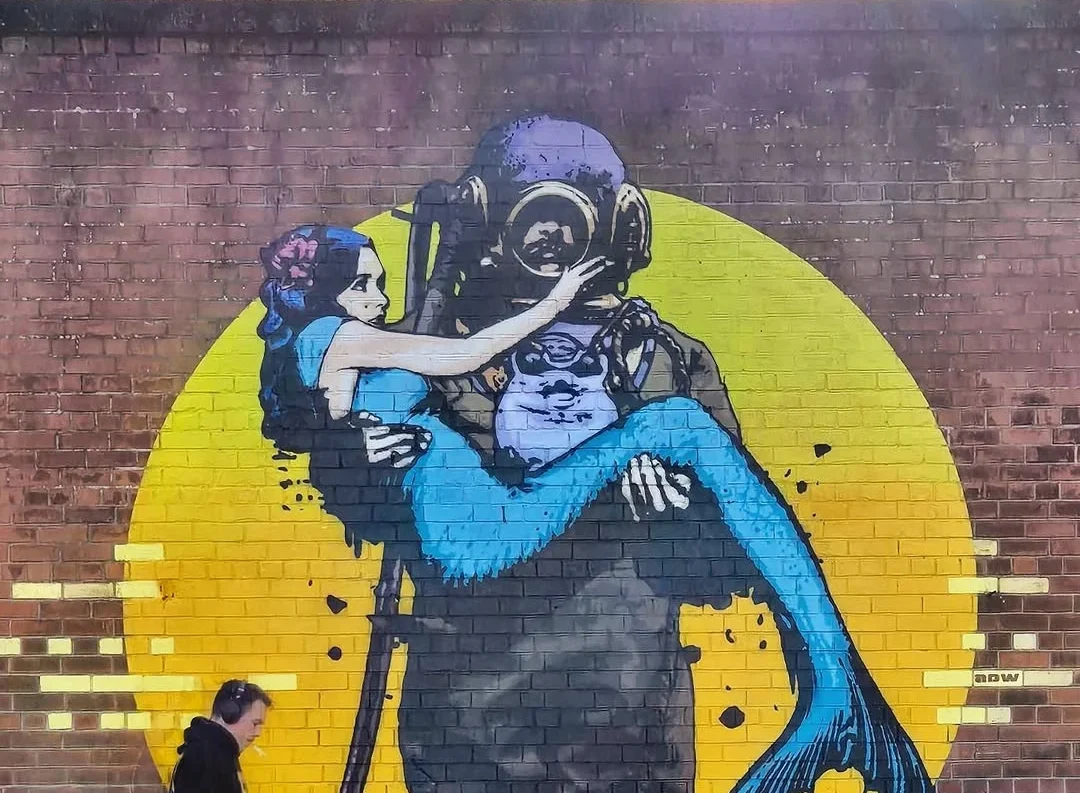
Graffiti: Underappreciated art or vandalism?
Graffiti is often viewed as inferior to more traditional art forms. However, this short-sighted dismissal fails to acknowledge the skill graffiti requires, its complex history, and its role as a symbol of creative expression.
Considering graffiti to be a ‘lower art form’ is also a type of art snobbery which disregards the fact that it is highly skilled and technical work
Graffiti art has a rich history. It has evolved rapidly over the years, with roots in caveman drawings and inscriptions on the walls of Pompeii. Nowadays, the first artist to come to mind when discussing graffiti would no doubt be Banksy. The street artist certainly has tapped into the heart of the art form, sparking meaningful and controversial conversations, giving voice to social issues. This is emphasised by his own anonymity, which ensures that his own identity cannot overshadow the messages conveyed through his often deeply political work.
Considering graffiti to be a ‘lower art form’ is also a type of art snobbery which disregards the fact that it is highly skilled and technical work. Mastering the medium of spray paint is nothing short of impressive, requiring immense precision and control in order to manipulate the effect, changing the distance, pressure, and the angle of the spray can. Stencil work is another technique often used in graffiti art, relying on the artist’s patience and ability to imagine the final piece ahead of time.
In the 70s, hip-hop culture fused with graffiti, highlighting its role as an urban and cultural phenomenon
Graffiti’s real reemergence after its initial beginnings took place in the 1960s and 70s in New York and Philadelphia, giving the young, rebellious, and unheard a platform. These self-proclaimed ‘writers’ tagged their names on buildings and subway cars, leaving their mark on the world. In the 70s, hip-hop culture fused with graffiti, highlighting its role as an urban and cultural phenomenon. Cities led anti-graffiti campaigns in the 1970s and 1980s as a response to the rapid increase of what was generally considered to be vandalism.
Artist Basquiat gained recognition in the 1980s New York art scene by demonstrating the potential of graffiti to shed light on themes of race, identity, and power. Initially working alongside artist and friend Al Diaz to tag buildings in The East Village and SoHo, Basquiat helped to bring street art into prestigious galleries and museums, through his collaborations with artists such as Andy Warhol.
Decades later, in 2009, the inauguration of The Wynwood Walls in Miami is just one example of how the general perception of graffiti and street art has changed. This outdoor gallery includes large-scale murals by a range of international artists, featuring artworks by the likes of Os Gemeos and Shepard Fairey.
The rise of graffiti stretches further, with many countries realising the potential value of the art form and subsequently capitalising on it in order to attract tourists
Fairey is best known for his Barack Obama ‘Hope’ poster and for his ‘Obey’ campaign. His instantly-recognisable style features colourful graphics and striking phrases which are synonymous with graffiti itself. Fairey’s works are then screenprinted and wheatpasted onto public walls.
The rise of graffiti stretches further, with many countries realising the potential value of the art form and subsequently capitalising on it in order to attract tourists. The Street Art Museum in Amsterdam is one example of this, showing how graffiti has stepped out of the shadows.
Closer to home for some of us, Brick Lane and the animated streets of Camden are home to some street art, with Brick Lane featuring work by Banksy and Stik.
It has so much more potential, as an art form which is rooted in breaking boundaries and engaging people in thought-provoking discussions
There is an argument that graffiti loses its meaning and power when it leaves its birthplace: the streets themselves. However, moving it to galleries allows the preservation of these artworks and allows the form to reach a wider audience by gaining more acceptance in the art world.
It is clear that graffiti is underrated as an artistic form, but that over the years it has risen to a fame nearly worthy of its complexities. It has so much more potential, as an art form which is rooted in breaking boundaries and engaging people in thought-provoking discussions, qualities which many artists will argue is integral to good art.
Comments