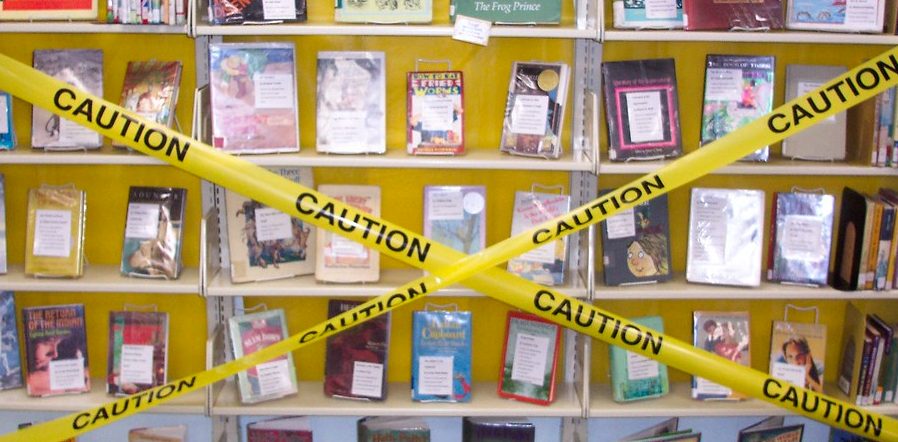
UK book banning on the rise
According to a recent UCL study, book-banning and censorship attempts are becoming more prevalent in the United Kingdom in recent years than they have ever been before. This research is specifically interesting in the face of a recent incident in Salford regarding the use of AI and intention to ban books in a school library.
In April 2026, senior staff at a school in Salford used AI to judge 200 books which they decided were inappropriate for school children. These books included George Orwell’s dystopian novel 1984, the fantasy favourite Twilight, Michelle Obama’s autobiography, and Laura Bates’ Men Who Hate Women: From Incels to Pickup Artists: The Truth about Extreme Misogyny and How it Affects Us All. The librarian at this school refused to carry out these bans and, though she later resigned, the school’s use of safeguarding to investigate the incident means that this librarian will never be able to work in a school again.
AI has no place in book banning – nor does anyone else
This use of AI represents its non-human, unambiguous perspective on literature, and shows how it is often difficult to decide whether an age group ‘should’ be able to read a certain book or read about a specific topic. Ultimately, that decision should not be made by an AI model, but instead by teachers, students’ parents, and the students themselves. AI has no place in book banning – nor does anyone else.
The school maintains that they did not ban any books, but instead carried out an ‘audit’ which found a few books which were not appropriate for any age groups. They claimed: “A very small number of books were deemed inappropriate even for older children due to their content and have been removed.”
The National Education Union (NEU) said that teachers will continue to “fight censorship” to ensure “intellectual freedom and children’s rights”. The NEU also maintained that they were not prepared to follow the same path taken in the United States, where book banning is both common and regular.
The books which are most heavily regulated focus on topics of race, racism, LGBTQ+ people or topics, and books with sexual references or discussion of sexual violence
Since 2021, there have been nearly 23,000 book bans in American public schools. The books which are most heavily regulated focus on topics of race, racism, LGBTQ+ people or topics, and books with sexual references or discussion of sexual violence. The most banned book across this time period was A Clockwork Orange, a 1962 dystopian satire by Anthony Burgess. This was followed by Sold by Patricia McCormick, which follows a 13-year-old girl in Nepal who is sold into prostitution. Only a little lower down the list were books such as Last Night at the Telegraph Club – which depicts a 17-year-old Chinese-American lesbian exploring her identity in the 1950s and falling in love – and The Perks of Being a Wallflower – banned due to its discussions of masturbation, sexual violence, and drug and alcohol use. These books were banned because of their content – but whose role is it to decide what people should and should not read?
Jonathan Friedman, Sy Syms Managing Director for US Free Expression programmes at PEN America, said: “Nobody benefits from classrooms where teachers are afraid of answering students’ questions and where students are afraid of asking certain questions.” It shows the risk that book banning poses to free speech, freedom of expression, and limitations of intellectual curiosity. Without new ideas brought about by intellectual curiosity, society would significantly stagnate.
These [bans] represent attempts to subdue literature commended by those in power as subversive or radical
Book bans are deeply and historically significant, with the act of book banning dating back to the Chinese emperor Qin Shi Huang in 213 BCE. Bans through the years have included Emperor Caligula’s ban on Homer’s The Odyssey, the Catholic Church’s attempts to condemn Galileo’s works in the 1600s, and the Nazis’ burning of ‘un-German’ books on 10 May 1933. These represent attempts to subdue literature condemned by those in power as subversive or radical – attempts to keep readers on the ‘straight and narrow.’ It is clearly so scandalous because it is a form of censorship which is intended to remove some ‘non-traditional’ ideas from the public domain.
Book bans are only becoming more common in the UK, and the same is happening under the Trump administration in the United States, where they are ramping up in banning books which fall against their limited ideology.
Comments