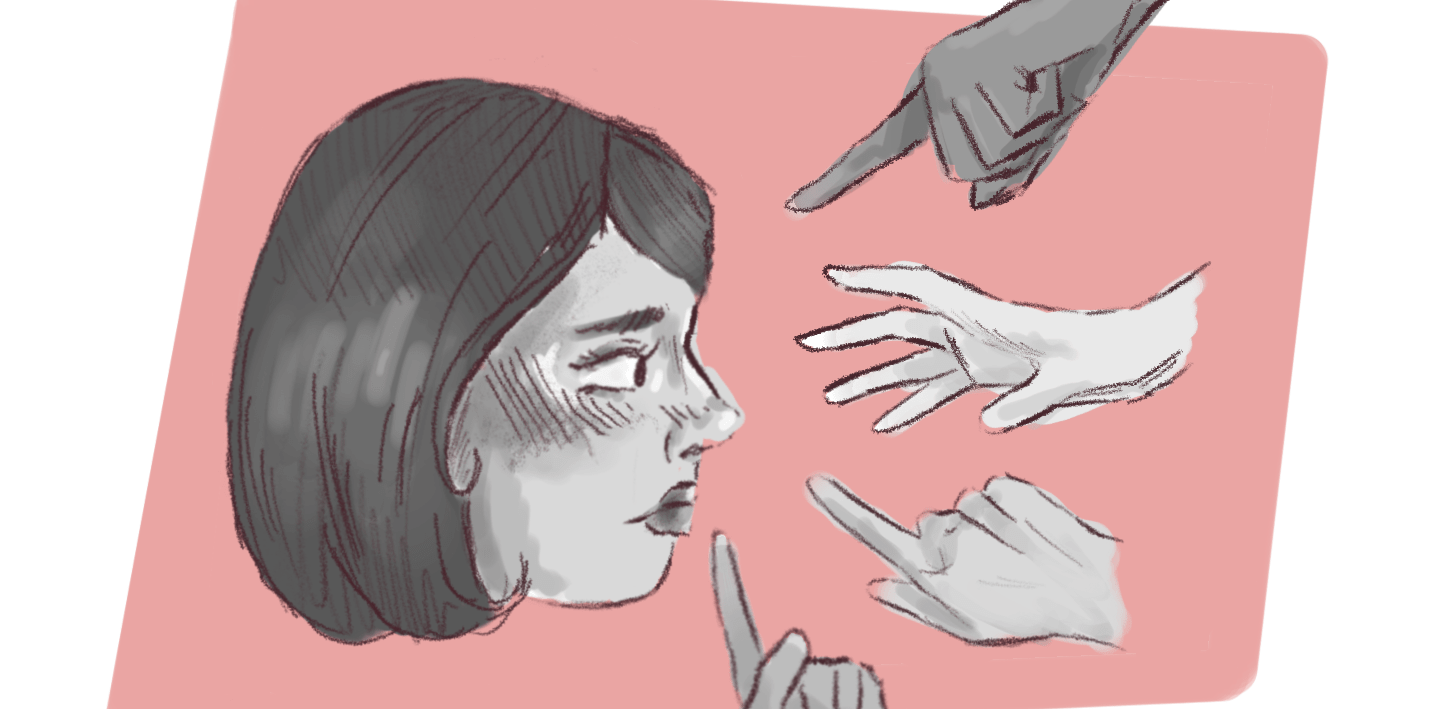
Too much or not enough, never just right
It’s the first lecture of the day, and students are filing in, shuffling into their seats, half-reading the slides they promise they’ll go through later. Someone’s spilt coffee on the desk, and another’s phone starts ringing with a screeching sound, and there’s got to be that one guy who forgot to charge his laptop. The room settles, fills up, and then goes quiet again. Now, go back.
Before the lecture, before the dreaded U1 frenzy, there’s a mirror. An outfit has been decided, reconsidered, and thrown in the bin all in the span of 30 minutes. Not because it was wrong. Because the girl in front of that mirror thought the sparkly white tights she bought on a whim, which reminded her of sunshine and feeling beautiful, thought to herself: Will this be the thing they see instead of me?
How many times has that hand come down? How many rushed mornings, how many mirrors? And did she really change the outfit because she didn’t like it
In a seminar, so many hands go up. It’s quick and casual, the way you usually do when it hasn’t occurred to you that the room might not want to hear you. Everyone’s talking amongst themselves, adding on to each other’s half-thoughts like building blocks. Somewhere in the middle row, another hand comes up to shoulder height and waveringly backs down. That girl is interrupted mid-sentence. Not nastily. Maybe, to an extent, not even consciously. It just … stops. How many times has that hand come down? How many rushed mornings, how many mirrors? And did she really change the outfit because she didn’t like it?
Once, Emily received a note from the business school about her attire. The note read that her outfit wasn’t business-appropriate. She was, in fact, wearing a suit. This is Emily, president of LINE (Warwick’s Fashion and Editorial Society), a management student at WBS, and apparently a woman who can’t be trusted to dress herself. Her daily routine involves wearing a skirt and heels to lectures without thinking twice about it. She’s an incredibly headstrong and confident person whom I’ve had the privilege to work with. The suit, though? It was “too much”.
While telling me this story, she hints at no anger. It’s like she’s processed this information in an organised filing cabinet, kept for when in use. She says her leadership style is relaxed, considering the departments she works with to be alongside her rather than below. But outside the society, she’s also a female DJ and event organiser, dealing with club owners and relevant industry figures. “I have to present myself as a lot more authoritative, a lot more sure of myself,” she says. “I can’t be particularly loose or friendly.” She pauses. “Also, because they might think I’m flirting with them.”
After all, what do you expect from a young adult navigating her 20s
She laughs, and that says a lot in itself. She wasn’t always this precise and calculated. After all, what do you expect from a young adult navigating her 20s? She says, in her own words, that she was prone to belittling herself and playing slightly stupid. “As I get older, I realise it actually works against you.” The way she said it sounded like a woman who had to figure it out the hard way, and she isn’t particularly shocked that she had to.
She told me about one room, where it was undeniably obvious that she was the only woman there. No words spoken. Just the incredibly soft lingering feeling of being the elephant in the room, no analysis needed. “I’m not going to change myself completely for a job,” she says, near the end. And I know she means it. The fact that this question was even asked and answered suggests that, among all the club owners, the suit and the incidents she didn’t mention, this question has been raised to her more times than it should have been.
How is it that the tone of the room set in the first 60 seconds sets the hands that follow accordingly
In 2018, researchers observed 250 seminars across 35 institutions in ten countries and found that women were two and a half times less likely to ask a question than men. The gender ratio, on average, was equal, so that erases the question of whether there were fewer women in the room. They were just less likely to speak. And if a man asked the first question of the seminar, the proportion of questions asked by women kept dropping. This is called gender-stereotype activation. How is it that the tone of the room set in the first 60 seconds sets the hands that follow accordingly?
A Yale study, one of the most cited in the field, sent the same job application to science faculties across the country. The same qualifications, same experience, basically the same everything. The only difference was that half received it under a man’s name and half under a woman’s. The male counterpart was rated as more competent, more hireable. Faculty were more than happy to mentor him and said they would pay him more. Notably, this wasn’t only the male faculty. Women evaluators held the same bias.
You’re switching the moment you walk into a meeting with a person of authority. The suit that wasn’t good enough
The data confirms what women already knew, but what other people refuse to hear. That is precisely the point. Underneath the CVs and the seminars lies the gap of how much you bring to a room and how much it actually lands. How is that quantified? Think about the hand that never raises itself. The calculation of a thousand words before you enter a room. You’re switching the moment you walk into a meeting with a person of authority. The suit that wasn’t good enough.
Molly, a biochemistry student, cries when she’s angry. Not because she’s sad. Because frustration has nowhere else to go. “It’s so difficult to express,” she says. “I just don’t even have the words.” It’s not that deep. It’s not that serious. So many reliable words from people who know nothing about the full picture, except that her reaction was too much. “A man can react,” she says. “A woman can only ever overreact.”
Knowing yourself is counted as intimidating, which is just another way of saying that you being confident is making someone aware of their lack of it
There is a particular kind of exhaustion in being ‘the problem’. Not the backhanded comments, not the overreactions, but the reaction in itself. The sheer volume of feeling something so strongly to show it. Men shout, and it reads as conviction and passion. A woman raises her voice, and the conversation moves away from what she’s saying to the way she said it. The point dissolves. And if she doesn’t shout? If she’s sure of herself? That’s an entire problem in itself. Resting bitch face. Arrogant. Cold. Call someone out on human decency, and suddenly you develop a superiority complex. Knowing yourself is counted as intimidating, which is just another way of saying that you being confident is making someone aware of their lack of it.
She was perfect when she was an idea. She’s ‘a lot’ now that she’s a person
The cool girl is an enigmatic concept. Unbothered, easy, low maintenance. What no one talks about is what happens when the walls that built the appeal come apart. The moment they do, she becomes a woman who screams and wants more than someone can give and holds people back. She was perfect when she was an idea. She’s ‘a lot’ now that she’s a person. So, women tone it down. They soften the edges of what they actually think to make it land more easily. You unknowingly make yourself smaller and call it a compromise. And it works. People are suddenly responding better, and the room is way calmer. And that begins an endless loop of losing yourself.
But women don’t stop. Molly didn’t. The pressure to be less made her achieve even more. “You don’t think I can do it,” she says. “Let me show you that I can.” These are the women who have decided that defying is much better than disappearing. When does she get to just exist, without proving, without the quiet calculation of how much of herself is too much for the room? Without changing the outfit twice, without crying because anger has nowhere else to go? When does she get to be too much and have that be completely fine? When does she get to take up the full amount of space she actually wants, say the thing she actually thinks, wear the thing she bought because it reminded her of sunshine? When does the hand just go up?
Comments