The history of the colour blue: Cobalt
After exploring the extremely expensive blue pigment, ultramarine, in my previous article, it seems fitting to discuss the pigment that was used as a more affordable, stable alternative: cobalt. The French government commenced a search for a cheaper ultramarine alternative which led to the discovery of a vibrant, stable, and affordable cobalt formula in 1802 by Louis Jacques Thénard, prior to the discovery of synthetic ultramarine in 1824. While the discovery of a stable cobalt pigment made cobalt a popular pigment to work with, the metal cobalt had been used for the colouration of glass and ceramics in ancient Egypt, Mesopotamia, and China for centuries prior.
The French government commenced a search for a cheaper ultramarine alternative which led to the discovery of a vibrant, stable, and affordable cobalt formula
Cobalt, derived from ores, has been used to colour glass, and is a fundamental component of smalt, a cobalt-based glass pigment. However, the intensity of the blue colour dulls over time and becomes a brownish-grey colour. Therefore, the dull tone of this pigment meant that natural cobalt was popular in the Victorian era, due to a preference for muted tones, and cobalt was even painted over the vivid ultramarine in paintings such as Sassoferrato’s ‘The Virgin in Prayer’. While metal cobalt is dull, Thénard’s cobalt pigment is lightfast and stable, which means that it maintains its vibrancy over time, which was cause for the pigment’s popularity with artists in the nineteenth century onwards.
Van Gogh’s exploration of the ‘divine’ nature of the pigment can be seen in his various depictions of rich blue night skies, as cobalt creates splendid traces of light
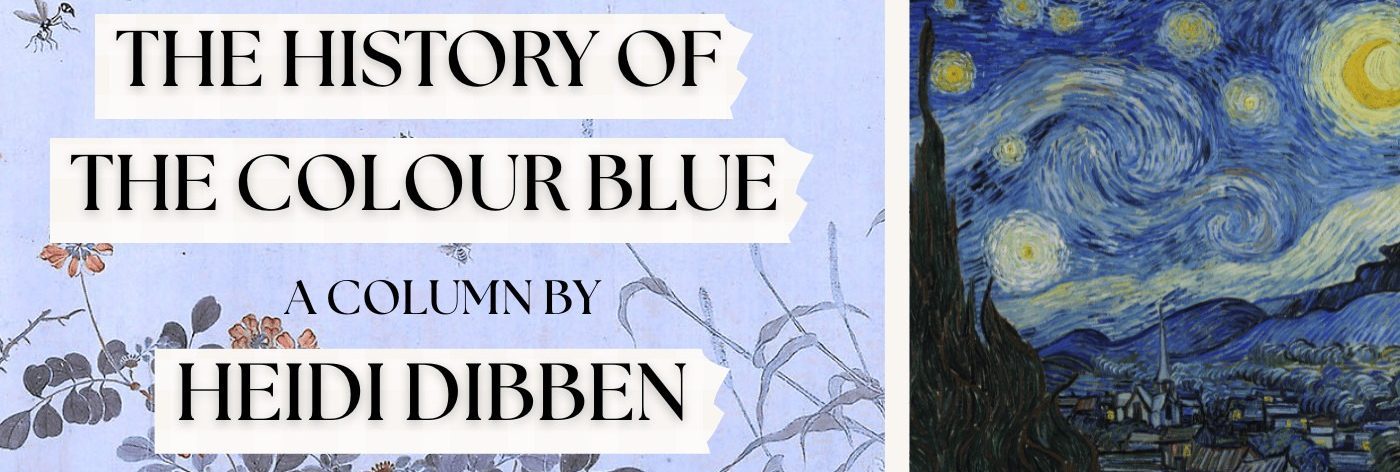
One of the world’s most famous paintings exhibits cobalt blue’s vibrancy, with Vincent Van Gogh utilising the pigment in ‘The Starry Night’. In a letter to his brother, Theo, Vincent declares his appreciation for this particular shade of blue, writing that it is “a divine colour, and there’s nothing so fine as that for putting space around things”. Van Gogh’s claim that cobalt blue is suited to “putting space around things” is reflected in ‘The Starry Night’, in which he implements the pigment in the light that emanates from the moon, as well as in the swirling lighter blue sections within the sky, which creates a dreamlike atmosphere. Within this painting, the vibrancy of cobalt blue is also enhanced through its contrast with varying shades of yellow, which emphasises the depth of the sky’s light and shadows.
In addition to ‘The Starry Night’, Van Gogh uses cobalt in his painting, ‘Wheatfield with Crows’, and, in a similar manner to ‘The Starry Night’, this painting utilises cobalt blue to create areas of light in a deep blue, ultramarine sky, depicting the marvellous light of the moon. Another parallel between these two paintings is evident through the contrast of blue and yellow shades, which Van Gogh employs in an overwhelming number of his works. Van Gogh’s exploration of the ‘divine’ nature of the pigment can be seen in his various depictions of rich blue night skies, as cobalt creates splendid traces of light.
Cobalt is a very versatile pigment as its raw mineral produces a dull, muted pigment, whereas its more stable formula, founded by Thénard, is much more vibrant, opaque, and ‘divine’
While Van Gogh employs cobalt for its vibrancy and to create light in his night skies, cobalt was also used to create a dull blue-grey colour. A mixture of cobalt and glass forms a product called smalt, which creates a muted shade of blue that was popular in sixteenth and seventeenth-century European oil paintings. Furthermore, its texture is coarse given that smalt is created through the grinding of glass and cobalt, which cannot be resolved through a more strenuous grinding process as this results in a lack of vibrancy. Smalt also makes an excellent glazing agent for ceramics due to its transparency, and it was extremely popular in the production of ceramics.
Cobalt is a very versatile pigment as its raw mineral produces a dull, muted pigment, whereas its more stable formula, founded by Thénard, is much more vibrant, opaque, and ‘divine’. This shade of blue can be found in the splendid light of the moon, the revered robes of the Virgin Mary, and even the body of Sonic the Hedgehog, as it has been a staple of artists’ pallets since its creation.
Comments (1)
Fascinating. Does anyone know how stained-glass artists achieve the color blue for their glass?