The Faculty of Arts building: Function or feeling?
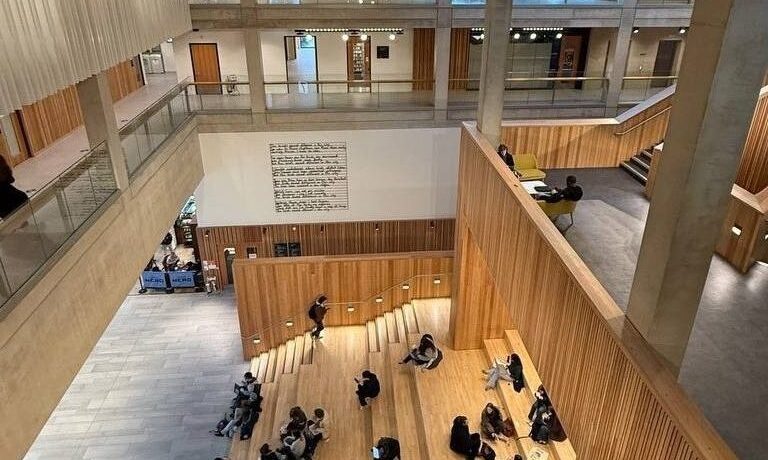
It has been over four years since the Faculty of Arts Building opened its doors to its students. Since 6 December 2021 it, as acclaimed by the university’s social media, has become a “campus icon” – a deserving title for a substantial £57.5 million expense. It is safe to say that the FAB’s architecture is well-loved, and the university’s vision for the building to enhance a sense of community between students, particularly those studying for humanities degrees, appears to have been successful. This feeling was clearly intentional in the FAB’s design, such as its centrality to campus, unification of different departments, vertically layered staircases, and communal work spaces (which are ideal for group study sessions). In discussion of its architecture, one student even highlights the idea of prospect-refuge theory which describes the attraction towards spaces that offer a position of security, while retaining the ability to perceive surroundings, and explains the appeal of the ‘elephant steps’ in the Agora. The FAB is also host to society events and serves students belonging to external departments, such as Politics, further encouraging the university’s aspiration for “interdisciplinary collaboration”.
It is safe to say that the FAB’s architecture is well-loved, and the university’s vision for the building to enhance a sense of community between students, particularly those studying for humanities degrees, appears to have been successful
The building’s beautiful appearance seems to have deeper impacts though, both on general sense of place and study habits, since more students tend to use the FAB for independent work than they do to attend seminars or lectures. Several individuals emphasise how its vast windows provide lots of “natural lighting”, a feature which encourages healthy study and is lacked by other areas across campus, like the library (the FAB’s biggest competitor). Many have described the FAB’s architecture as “inspiring”, “enriching”, and “calming”, suggesting that it fashions a “creative vibe” to mirror its departments. One student distinctly expresses how “the modern woody look is relaxing and therefore more accommodating to productive work”. In its contrast of such wood with industrial-style concrete walls, the FAB also allies the natural with the human, standing for the campus’ greener areas, wildlife (geese, of course), and lakes that surround its commercialised centre. The university upholds this culture in its emphasis on the sustainable practises involved in the FAB’s construction, revealing that ~264.8 tonnes of carbon were saved “compared to use of cement” and there are “photovoltaic panels installed on its roof” which generate eco-friendly electricity.
When students were asked to describe the FAB’s aesthetics, another frequent response was that it is “modern” and thereby feels representative of the diversity that the building brings to the university’s overall image. Students suggest that the FAB is “a monument of the arts and humanities, a visual representation that these degrees are equally as important as the STEM subjects that typically have more buildings and funding”, something which they “didn’t really see at other universities”. This sense of inclusion is reinforced by Matthew Raw’s vivid ceramic mural displayed on the FAB’s exterior, ‘Faith in the Miraculous’. Exhibited inside the Agora is the poem, historically a song, ‘Resonance’ by Raymond Antrobus, which has been made into a metal frieze and signifies the resolution of “conflicting faiths and beliefs” through self-identity. These pieces are, in alignment with the FAB, indicative of the university’s appreciation for the arts and feel characteristic of its staff and students’ creative energy – which we might need to get up those stairs.
Some students sense that appearance was prioritised much more than practicality
Some students sense that appearance was prioritised much more than practicality, however. While its busyness creates a sense of community, it also means that the FAB becomes overwhelming, only worsened during peak times, and to which students report feeling “tense”. The endless staircases, “insufficient” access to lifts, and “nightmarish” layout of the building mean it is “hard to navigate” (and make us feel sorry for the poor freshers). Although the strategic positioning of Caffè Nero is often suggested to be of great convenience, there is usually a considerable queue: in vogue with the FAB’s general over-crowdedness. Around 70% of students, most of which belong to its departments, feel the FAB cannot accommodate the volume of people who want to study there – only 8% believe it definitely can. Numerous individuals suggest it is “uncomfortable” in its promotion of communal work and is just “too loud” and “too fast-paced” for studying, causing them to feel easily “distracted”. Such issues are only likely to worsen with the pressure coming from the university’s increase in their annual intake of students, the effects of which have been most prominent this academic year and previously reported on by The Boar.
The FAB ultimately seems to be what the campus needed: a social study space aside from that of the library, which represents its dedication to the humanities and diversity of degrees
While most would probably agree that the University of Warwick would not be the same without the FAB, one student quite accurately describes it as a “paradox”. As some suggest, the building “has created a fresh idea of the campus aesthetic” and liaises with its mismatched building styles. It has been described as the “architectural sibling” to the Oculus and therefore balances between fitting in and becoming a stand-out icon; an art form in itself. The FAB ultimately seems to be what the campus needed: a social study space aside from that of the library, which represents its dedication to the humanities and diversity of degrees. Its function, though, has typically been sacrificed for feeling and aesthetic value, which seems to have created contrasting opinions – much like wood and concrete.
Comments