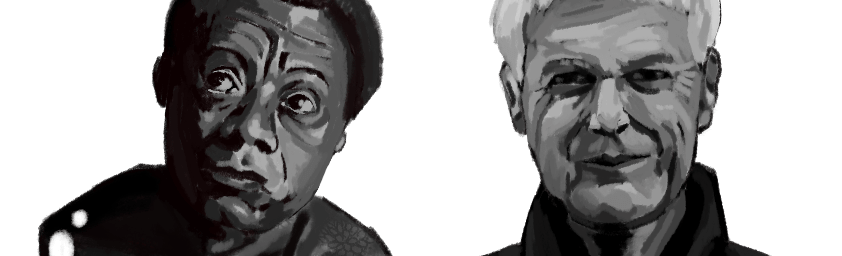
Spotlight on queer voices: James Baldwin and Dennis Cooper
This June, The Boar Books investigate the people behind the words of the novel: the authors who have had a fundamental impact on LGBTQIA+ literature!
James Baldwin
James Baldwin shouldn’t need an introduction, yet the one thing that has often been overlooked is his sexuality. Even in recent memory, his sexuality has been overshadowed by his other efforts, such as those in the Civil Rights Movement. His most prevalent LGBTQIA+ book, Giovanni’s Room, written in 1956, tackles internalised homophobia through the romance of the closeted David and the eponymous Giovanni.
Baldwin’s prose is biblically confessional and lyrically sensuous, investigating the depths of identity, desire, and vulnerability
Baldwin’s prose is biblically confessional and lyrically sensuous, investigating the depths of identity, desire, and vulnerability. David’s inability to love himself destroys the world around him. He lies to his girlfriend Hella who embodies his heteronormativity, even as her patriarchally affirmed identity gradually erodes. Giovanni, on the other hand, acts as a foil to David’s outwardly mild mannerisms and becomes a symbolic representation of David’s repressed anger. We learn that it’s not just David, but the entire ‘love triangle’ who express their self-hatred through external means, such as the misogyny Giovanni clings to within cut-throat social hierarchies. The novel concludes with David’s torturous decision between Hella and Giovanni.
Moreover, Baldwin’s novel explores the transnational literary movements that build upon Henry James’ semi-biographical novels, which critique American high society through an American protagonist. Baldwin moved to Paris in 1948 to escape America’s fierce social climate. Compared to Henry James, Baldwin is focused on the seams of American identity that were longing to escape, only to succumb to feelings of homelessness in Europe. This is the root of the many class tensions within David and Giovanni’s relationship. David is sent money by his wealthy father to find himself in Paris, traversing social circles with fellow bourgeois Americans in order to escape to a traditional life back home. Comparatively, Giovanni is a poor immigrant bartender who doesn’t have access to the luxury of escaping from his identity.
The novel’s initial reception was mixed. Its depiction of two gay white men was widely considered as controversial, alienating Baldwin’s core Christian and black nationalist audiences, let alone the wider public. With hindsight, Baldwin effectively avoided stylistic restraints in order to foreground his commentary on racial issues for the reader – a significant feat considering his increased prominence in the Civil Rights Movement upon his return to the US in 1957.
The world that Cooper orchestrates assumes everyone is queer and on a tragic trajectory
Dennis Cooper
In a similar vein, Dennis Cooper has been ostracised by many as a fringe cult writer – his exploration of thematic concerns has been seen to reflect Baldwin’s, but within the deep, transgressive, and depraved underbelly of the LGBTQIA+ community. The world that Cooper orchestrates assumes everyone is queer and on a tragic trajectory. The influence that Marquis de Sade has had on Cooper’s prose is evident, as he surgically utilises horror to peer into the reader’s desires and nightmares. Unlike many horror stories, Cooper isn’t dependent on the shock factor to engage with the reader. Rather, under the veneer of vice, there’s introspective philosophical rigour.
Cooper has an extensive bibliography in many mediums with his most infamous series being the George Miles Cycle. The series consists of five books that are semi-autobiographical tribunal experiences with his close friend, and later, lover. The meditative quality of Cooper’s prose stems from the anxiety evoked by the HIV/AIDS pandemic. He describes acts of intercourse through a raw, detached intimacy, with each moment presenting an objective impulse being acted upon. The body becomes a pivotal metaphor, encompassing the demand to express oneself, while simultaneously removing the protagonist from the sensational to the reality of flesh and bones.
Cooper’s scrutiny of artificial intimacy is the central theme of his internet novel The Sluts, published in 2004 and written in an epistolary style of forum posts. The novel takes place in the pre-social-media age of the internet, where forums dominated, in particular gay escort forums, in which the infamy of a young escort named Brad grabs the community’s interest. The forum posts mount a cyber trail of clues and theories that blur the lines between fantasy and reality until the stakes are raised to a fateful fall.
The voyeuristic nature of Cooper’s work allows us to examine our own obsessive nature, an effect reminiscent of films directed by Michael Haneke. Colloquially named ‘the rubbernecking phenomenon’, the effect leaves readers, upon closing the book, feeling disgusted at themselves for being an intensely curious reader. In this regard, Cooper’s wider explorations of our blind trust in the internet, the addictiveness of internet notoriety, and parasocial relationships that become more prophetic by the next internet sensation are most fascinating.
Baldwin and Cooper are integral figures in queer fiction
Both Baldwin and Cooper are integral figures in queer fiction, and they give us a reminder of the overlooked, subversive scenes within the LGBTQIA+ community. Their inspections into the depths of the human psyche remain impactful and influential to readers today – a testament to their vision and experimentation in the face of social pressure to conform.
Comments