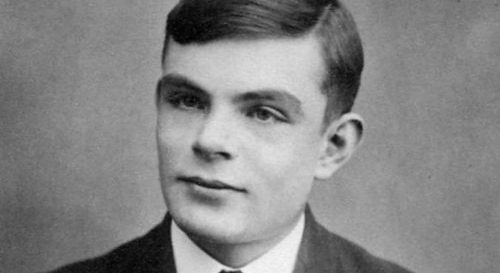
Alan Turing: A story of progress
Everyone uses computers these days: from the supercomputers we carry around in our pockets to the encrypted messages that have become the industry standard, computers are ubiquitous in the modern world. The mathematical framework for all these ideas was once introduced by Alan Turing; however, he was never able to see the world that he was instrumental in creating.
Turing also cracked the sophisticated German cipher Tunny, and at the end of the war, he was made an Officer of the Empire, earning an OBE
In 1951, he was awarded an OBE. Three years later, he was dead. This pride month, I think it is important to revisit his story, not just as a tragedy, but as a reminder of what the LGBTQ+ community has contributed to STEM – often whilst fighting for their right to exist.
In his youth, Alan Turing was a promising mathematician who then went on to graduate from both Cambridge (BA) and Princeton (PhD). At just 24 years of age, he made groundbreaking contributions to mathematics. Notably, in his seminal work “On Computable Numbers, with an Application to the Entscheidungsproblem“, he invented the concept of the universal ‘Turing Machine’ which was a device that could theoretically perform any calculation that a human was capable of. Despite it being purely conceptual at this stage, simply sketched out on paper, it became the foundation of every digital computer, from the phones in your purses to the large data centres being built around the world – every modern computer is a descendant of Turing’s ideas.
In 1938, his talent had caught the eyes of the Government Code and Cypher School (then a British intelligence agency), and when war broke out with Germany in September 1939, Turing was recruited to Bletchley Park, the wartime headquarters of the organisation. In World War II, the Nazi Enigma machine encrypted military communications in a way that seemingly couldn’t be cracked. In 1938, Polish cryptographers had built a code breaking machine known as the Bomba; however, the Germans changed their procedures in 1940, leaving the Polish methods redundant. Turing took it upon himself to design a new machine, the Bombe, which could systematically test possible enigma settings itself. By 1942, Britain was decoding around 39,000 encrypted messages each month, rising to 84,000 in 1943. This roughly translates to two messages, every minute, around the clock. Historians estimate that this shortened the war by almost two years and gave an incredible boost to British morale.
Moreover, Turing also cracked the sophisticated German cipher Tunny, and at the end of the war, he was made an Officer of the Empire, earning an OBE. Yet during this time, even whilst being trusted with some of the nation’s most important secrets, Turing was forced to hide a fundamental part of himself, as homosexuality was illegal in Britain.
He was 41 when he died and would have been capable of changing the world in many more ways if he had not passed so young
After the war, Turing was considered the founding father of both artificial intelligence and modern cognitive science – the exploration of whether or not machines could actually ‘think’. In 1950, he proposed what would become to be known as the ‘Turing Test’, which is a criterion for artificial computers, investigating the extent to which they can exhibit intellectual behaviour indistinguishable from a human. He also theorised that the human brain worked somewhat as a machine capable of computation. This would later become the foundations of modern AI and machine learning research.
In March 1951, Turing was elected as a fellow of the Royal Society of London, one of the greatest honours for a scientist in Britain. A year later, his life tragically came crashing down. In March of 1952, Turing was convicted of gross indecency – this was a legal term used that included people convicted of homosexuality. He was given the choice between imprisonment or chemical castration via hormone treatment. Picking the latter, Turing suffered catastrophic effects on both his physical and mental health, changing his life forever.
His criminal conviction meant he lost his position in the British Government and was cast out from scientific circles. Turing continued to work at the University of Manchester, but by June 1954, he was found dead from cyanide poisoning. He was only 41, halfway through his life before it was cruelly taken from him. The coroner’s report ruled it a suicide; however, there was no clear motive. Others have theorised that it was an accident from an experiment, or an organised attempt at neutralising a threat. The circumstances of his death remain debated to this day.
This Pride Month marks 72 years since Turing’s death. The world has moved on since his time: we carry supercomputers in our pockets, we make AI systems, and encrypt all our messages. These are all possible because of Turing’s groundbreaking work, but he was never able to see anything that he helped to create. Britain offered a royal pardon in 2013, 59 years too late. The Alan Turing Law in 2017 pardoned thousands of other men, unlawfully convicted for loving the ‘wrong’ person, and his face was put on the £50 note in 2021, but he was never able to see this come into fruition. He never got to witness the digital revolution he laid the groundwork for, nor got the chance to grow old. He was 41 when he died and would have been capable of changing the world in many more ways if he had not passed so young.
Turing’s story isn’t just about one brilliant man failed by his country; it is about the brilliance and the discoveries we will never know we lost because of the hatred held within history. Progress endeavours to ensure that no other voice will be lost like this.
Comments (1)
This is so so sad!