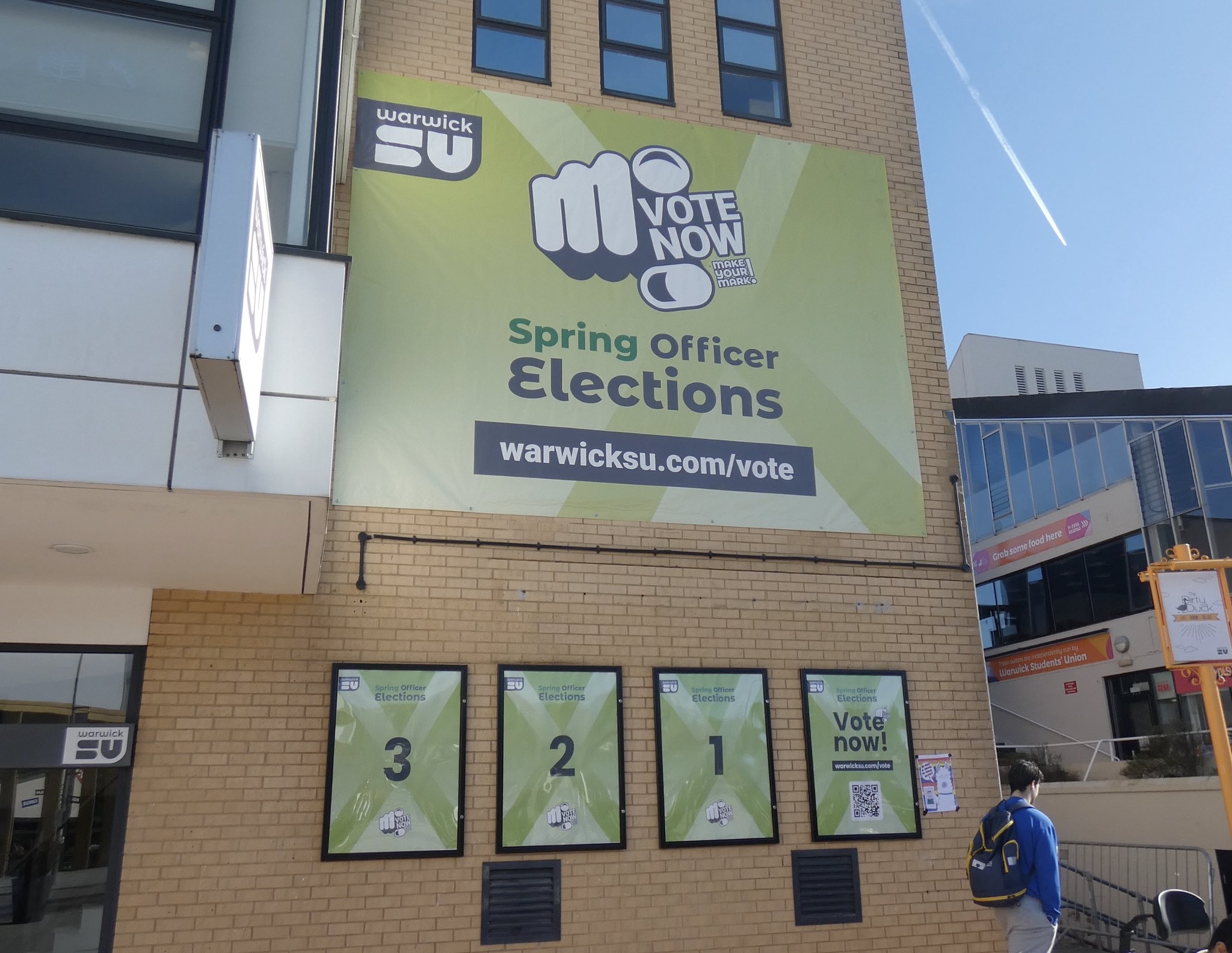
Why did only a quarter of us vote in the SU Elections?
The SU elections feel pretty far away and not very relevant right now, I’m sure. So let me start off by refreshing your memory. It’s campaign week, and you’re trying to get to your 1pm lecture, which you were running late for anyway. You might walk by the Atrium, especially if you just got off the bus. VARNEY – CHAPMAN – NAZ – HACKER – RONNY – the names flash out at you on their banners and posters. You get accosted with leaflets outside the Co-op and then again by the FAB. “Sorry, I’ve already voted,” you tell someone’s campaign manager, and to the next person who stops you, you promise to vote. Your friends might ask if you’re voting in the elections, to which you could respond that you don’t really care, but you probably will for the free drink. Does that ring any bells?
A lot of my friends told me they don’t really care about SU elections. The attempts made to persuade students to vote – a free drink at Curiositea, extra budget allocated to clubs with high voter proportions – didn’t manage to convince some of my friends, and a further 75% of the student population. The additional allure of participating in student democracy, which I’d argue is more meaningful in a campus like Warwick, had little to no sway.
Most of us will recall that 25% of the student population voted in the 2026 Spring Elections. If anything, this puts a bit less of the blame on the individuals who “forgot” or just have no idea what goes on in the SU, so they didn’t feel it was fair to vote. To be clear, I’m not trying to shame these people at all. Although, it is worth mentioning that almost more people liked @rootesdebauchery’s post about the elections than voted. It received around 4000 likes, and there were approximately 5000 votes per full-time officer and 6870 votes in total. Rootes Debauchery has 5,500 followers, and the University has more than 25,000 students, just saying…
As James Varney, the re-elected Vice President for Democracy and Development (VPDD), pointed out to The Boar when approached for a comment, 25% is not necessarily a bad statistic. “Voter numbers were at their highest here since at least 2013. It’s also great compared to other SUs – average turnout last year for the sector was 17.4%, and 25%+ turnout puts us in the highest NUS (National Union of Students) bracket. We also had record numbers of nominations, and some of the closest and most competitive election races in years.” So, we did well this year, the 25% of us who did actually vote. However, I’d like to point out that there aren’t just two camps, voters and non-voters; rather, there are subcategories of each camp in the student population, and some of these subcategories have more in common than they might think.
It’s years of unkept promises and exclusivity around the SU that make students feel like it’s not worth even reading the manifestos
Some voted in these elections because they personally knew someone running and wanted them to win. This voter wants their connection to be happy, but didn’t necessarily vote because they really believe in them. Some, as I have mentioned, voted for the free drink, and maybe because their society president told them to. In response to the question, “Did you vote in the SU Spring Elections? Why/why not?”, one anonymous third-year student summarised these reasons: “Yes, because I wanted to support someone running and get the free Curiositea drink”. Some voted because they believe in student democracy and possibly even have faith that the SU has the power to change all those annoying things about the University that they complain about. Although, upon further rumination, it is a little suspicious how many manifestos promised they would fix Stagecoach. Some of these voters don’t believe voting for incentives is a very good reason, to which I say: maybe when more of us are actually voting, we can start questioning motives.
Now we turn to the non-voters: the disengaged, the disenfranchised. In both surveys and polls conducted by The Boar, the majority of responders claimed to have voted. We, of course, know this is not representative of the student population. Nonetheless, a couple of non-voters chimed in with their reasons. One anonymous second-year student said the “SU was really weak on standing up for trans rights and Palestine last year, and so I don’t bother with it now”. Many non-voters claim to have forgotten to vote, or they genuinely believe the SU has no role in the day-to-day university experience. And to be fair, we’ve had years of candidates telling us they will fix the buses, bring down the cost of living, and help us win all our BUCS games.
An anonymous postgraduate student responded in a survey by The Boar: “Most of the student population do not feel the SU is useful to them, represents their interests or that any of the candidates have feasible manifestos that will meaningfully change anything”. It’s years of unkept promises and exclusivity around the SU that make students feel like it’s not worth even reading the manifestos.
Students need to feel represented by their Union, which is at the heart of the issue
The incoming President, Ollie Chapman, told The Boar: “The question as to why 75% of students didn’t vote is a tough one. I do believe it shows us that we still have a lot of work to do in proving to students the important role we play in their experience at Warwick, and that it is worthwhile making their voice heard when electing the groups in charge of this. Despite this, it has to be noted that 25% is a genuinely strong figure nationally and something our Student Voice team should be proud of. The strong mandates given to candidates like myself, the VPDD, VP Education, and VP Postgraduates, while running on the aforementioned issues suggests to me that the more we commit ourselves to crucial and material student issues, the more turnout will increase.”
Students need to feel represented by their Union, which is at the heart of the issue. Not all respondents had confidence in the candidates this year, with one anonymous postgraduate noting the “lack of good quality candidates” and stating “better vetting needs to be done […] Some ran on platforms of transphobia, racism, homophobia, which is legitimising bigotry by platforming these views”. An anonymous second-year respondent to The Boar’s survey said: “Some groups [of students] entirely are, in my opinion, glossed over. Take the issue of loneliness, for instance. Most of the candidates this year for Welfare and Campaigns promised additional emergency support, but nothing systemic to combat the real issue of loneliness in the University. This is a side effect of the SU’s culture, only representing a particular demographic of students”.
Postgraduate students were some of the most underrepresented students in the voting turnout, despite the abundance of candidates running to represent them this year. Ronny Whetton, the incoming VP for Postgraduates, said postgraduate students “often feel left behind and maybe not as represented” by the SU. As mentioned, the majority of respondents to polls and surveys by The Boar reported voting in the SU elections, with an almost reversal of the real statistic: in our poll, 77% claimed to have voted, while 23% said they did not. I’d say it makes sense that about 75% of our audience at The Boar is involved enough with campus culture to vote in the SU elections. But that means there are swathes of students at Warwick who aren’t involved at all.
Holding our representatives accountable, telling them what we want, and voting for the people we think will listen are the ways we can enact change on campus
Sometimes it feels like there is a lack of centralised culture at Warwick. As James Reglar wrote for The Boar Opinion last year, Warwick is a relatively new university. We don’t have the accumulated centuries of culture and identity that some of our more famous, and arguably much better-looking counterparts have, although one might prefer the Old Humanities Building to Oxford’s Radcliffe Camera if they were especially contrarian. And unlike London universities, Warwick can’t create an identity out of its surroundings like city universities, because Canley has maybe two shops in total (I don’t know, I never go to Canley).
As a campus university, we deserve to feel united. Our campus is isolated, and our local towns are relatively quiet and small, so in a way, I think we need each other. In my opinion, Campaign Week is the week when Warwick students are most united. We are united in our exasperation at the leaflet-try-hards, the queues at Curiositiea that make the free drink almost not worth it, the manifestos addressing the university-wide issues that nearly every student recognises and candidates pledging to fix them for us. I love the feeling that all of us are actually working together to improve our university lives and voting according to that.
Unfortunately, I don’t think I’m in the majority here. Responses showed that Campaign Week can put potential voters off, as some students disapprove of using incentives to encourage voting, and found campaigns “overwhelming” and “performative”. Warwick students don’t really seem to view the Students’ Union as a union. Nevertheless, that’s what it needs to be, and it can only be that way when students are involved in it. Holding our representatives accountable, telling them what we want, and voting for the people we think will listen are the ways we can enact change on campus.
So, I implore you, Warwick, to vote in the 2027 elections for something even better than a free drink: democracy (and moral superiority).
Comments