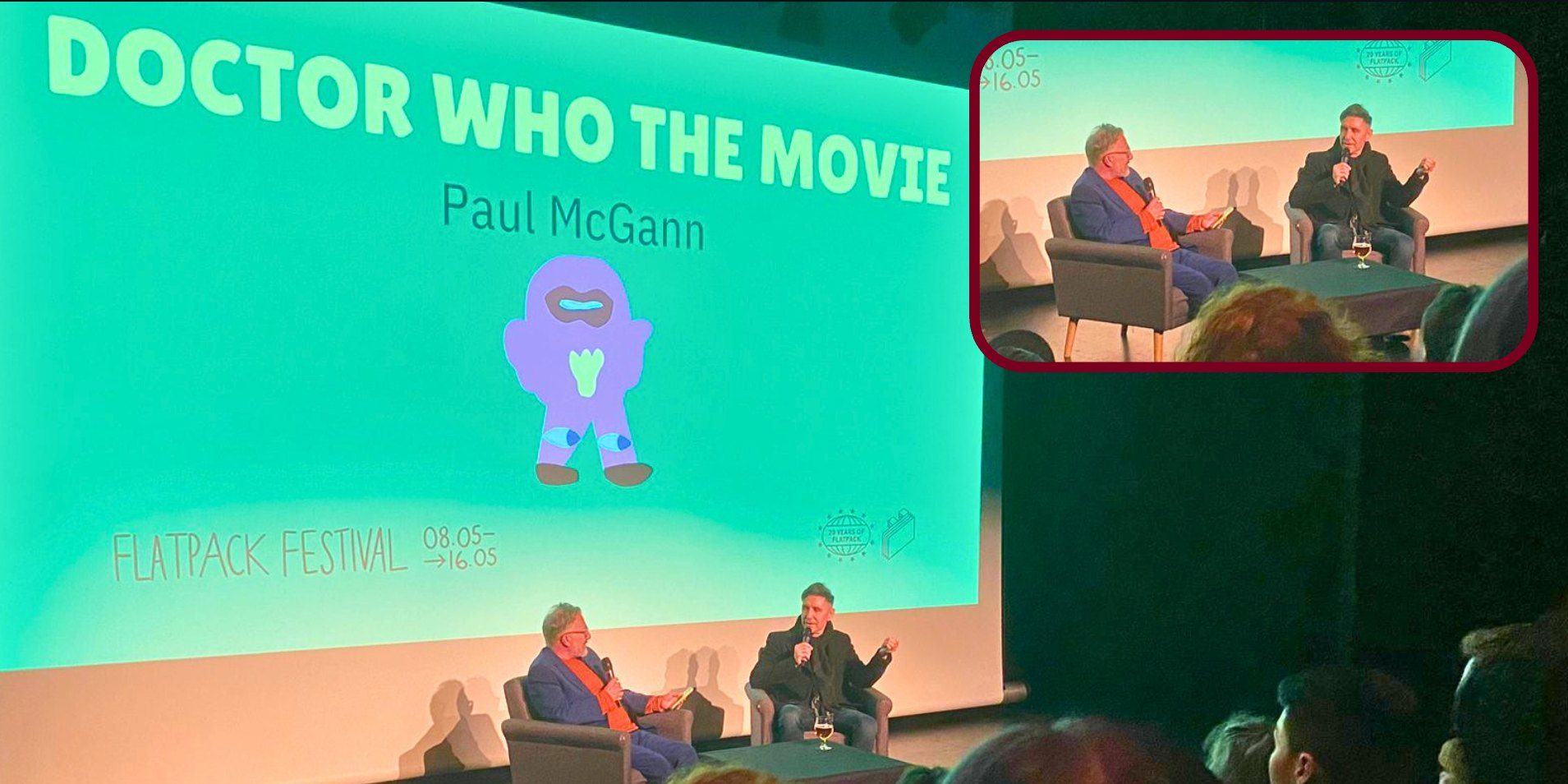
The Boar at Flatpack Festival: Paul McGann presents Doctor Who The Movie
On 15th May, I had the pleasure of attending one of the events at this year’s Flatpack Festival. Based in Birmingham, Flatpack is a charitable and creative organisation defined by its participants’ love for film and is renowned for their festivals’ “magnificently eclectic” programmes. Now in its 20th year of running, the Flatpack Festival stresses “the power of film to nurture creativity” and “bring people together”.
These values were certainly at the forefront of the event I attended: A screening of the Doctor Who TV movie, followed by a Q&A with the Doctor himself, Paul McGann.
It seemed as if Doctor Who’s position at the forefront of the BBC’s cultural identity had been irrevocably lost. That is, until the 1996 broadcast of Doctor Who’s TV movie
But first, let’s scale back a little. In 1989, after 26 years in production, Doctor Who was quietly decommissioned by the BBC. Despite persistent rumblings, it seemed as if Doctor Who’s position at the forefront of the BBC’s cultural identity had been irrevocably lost. That is, until the 1996 broadcast of Doctor Who’s TV movie. A co-production between the BBC and the USA’s Fox Network, this television film was designed to reboot Doctor Who for American audiences. However, further series were never commissioned, with Doctor Who’s official return to television only occurring nine years later.
Despite its status as ultimately something of an oddity in Doctor Who’s expansive canon, as a lifelong Doctor Who fan the offer to attend this event was one that I could hardly refuse. Watching Doctor Who’s recently restored TV movie on the big screen was one thing, let alone the Q&A afterwards.
However, what of the film itself? The TV movie sees Sylvester McCoy’s Seventh Doctor tasked with transporting the remains of his old nemesis the Master back to their home planet. However, before long, the Master has escaped, the Doctor has regenerated, and the Earth is at risk of being destroyed. In other words, fairly standard Doctor Who fare.
And indeed, as the failure to reboot Doctor Who for the 1990s suggests, the TV Movie is hardly the finest chapter in the programme’s history. Writer Matthew Jacobs takes several controversial liberties with said history while simultaneously alienating potential new audiences. Furthermore, the production as a whole tonally oscillates between gratuitous violence and Doctor Who’s traditions of camp.
McGann delivers an effortlessly exuberant performance … solidified in just ninety minutes as one of the Time Lord’s finest incarnations
Nevertheless, there is also much to love in the TV Movie. Doctor Who has never looked as good as it does in the hands of director Geoffrey Sax, while composer John Debney’s score propels the film’s paint-by-numbers narrative. Neither aspect has ever looked or sounded as good as it did on the big screen. However, the crowning jewel of the TV Movie is Paul McGann himself. Complimented by one of the Doctor’s finest costumes, McGann delivers an effortlessly exuberant performance. To me, McGann’s Eighth Doctor is solidified in just 90 minutes as one of the Time Lord’s finest incarnations.
Speaking of the man himself, the applause that the TV Movie received as the credits rolled was paltry compared to that which ushered Paul McGann into the auditorium. Besides meeting showrunner Steven Moffat in 2023, this was the closest I’d ever been to the programme I adore. And what an experience it was.
Hosted by journalist and author Matthew Sweet, McGann was on excellent form, eliciting continuous laughter from his audience while providing illuminating perspectives on his experiences in Doctor Who. Across the half-hour discussion, it became clear that McGann’s initial trepidation concerning the role has gradually transformed into unquestionable enthusiasm.
The biggest revelation? Had Doctor Who continued through the late 1990s, Paul McGann would have chosen none other than Rachel Weisz as his companion
To one audience member, McGann responded that he would “drop everything” if asked to return to Doctor Who today. But the biggest revelation? Had Doctor Who continued through the late 1990s, Paul McGann would have chosen none other than Rachel Weisz as his companion. As the discussion concluded, McGann welcomed further questions from audience members, leaving me with no doubt as to his generosity as a performer. My sentiments appeared to be shared by the rest of the audience, as the applause that accompanied McGann’s exit was even louder than that which welcomed him.
As I departed Birmingham’s Midlands Art Centre, I was left with an overwhelming sense of gratitude. Not only to McGann for his respect and engagement with his audience, but to Flatpack as a whole. As promised, the Festival had brought people together, providing a perfect example of the power and community of fandom and film.
Comments