Nolan’s Odyssey: Epic in the 21st century
In December 2024, Christopher Nolan announced his upcoming film adaptation of Homer’s epic poem The Odyssey. Since then, two trailers have been released, striking up many arguments and various controversy online.
The Odyssey, well-known to Literature and Classics departments, follows the epic hero Odysseus on his journey home from the infamous Trojan War. In an interview with Stephen Colbert, Nolan himself describes it as “the greatest epic in literature”, and it is no surprise that this story has been continually adapted and re-adapted for almost three thousand years since it was first recorded. The Odyssey (2026) is reported to have a $250 million budget, making it the most expensive yet of Nolan’s films. He has filmed in several countries across the world, including Morocco, Italy and Greece, intending to transport audiences back in time through incredible real-life scenery.
However, since the trailers have been released, viewers have highlighted the anachronisms within the footage. Glaringly obvious is the modern dialogue, most evidently in the scene between Antinous (played by Robert Pattinson) and Telemachus (played by Tom Holland), which has brought about some conflicting responses: “you’re pining for a daddy you didn’t even know, like some snivelling bastard”. Pattinson is certainly portraying the villain well, but did Nolan really have to use “daddy” in the script? A similar discomfort is brought about in Telemachus’ line “my dad is coming home”. Was it a deliberate choice to not use “father” in either of these scenes? It seems so. Others have drawn attention to the American accents in the trailer. Both Pattinson and Holland are British actors, and many have argued the forced accents are distracting. A final anachronism in the trailer was the cry of “let’s go!” as Odysseus leads his men into battle. Nolan has emphasised the fact that The Odyssey was “the Marvel of its day”, but is this taking it too far?
Such a large all-star cast raises the question whether seeing so many familiar faces will distract from the story
The cast of The Odyssey is stacked, full of famous actors such as Matt Damon, Anne Hathaway, Zendaya, and Mia Goth. Such a large all-star cast raises the question whether seeing so many familiar faces will distract from the story. As new cast members are being released, controversy is developing on social media – something that has quickly turned cruel and derogatory. There has been a lot of discourse about the confirmed casting of actress Lupita Nyong’o as Helen of Troy. One Independent article describes the “racially charged and misogynistic posts” that have been circulating online. Abbie Ree explores this more in her YouTube video ‘We Need To Talk About The Odyssey Drama’, stating the backlash makes her “so mad and disgusted”.
It is confirmed that music artist Travis Scott has been cast as Demodocus, the performing bard in the epic. Nolan has emphasised the historical fact of The Odyssey being “handed down as oral poetry”, which he finds “analogous to rap”. This addition to the narrative expands what epic can be interpreted as in the modern world, and I think it is an insightful choice by Nolan to have the story’s bard portrayed by (arguably) his modern equivalent.
Nolan has explained how he drew on Emily Wilson’s 2017 translation of The Odyssey as his source material, a text well known for Wilson’s intent to “contextualise The Odyssey within our current climate”. As with any film adaptation of literature, questions of what makes a good adaptation have been raised regarding The Odyssey (2026). In an interview with Time magazine, Nolan explained “like the Trojan Horse, The Odyssey can be enjoyed as pure spectacle – or it can be cracked open to reveal something deeply human”. From what we’ve seen so far, I’d argue Nolan is leaning more towards spectacle in his adaptation.
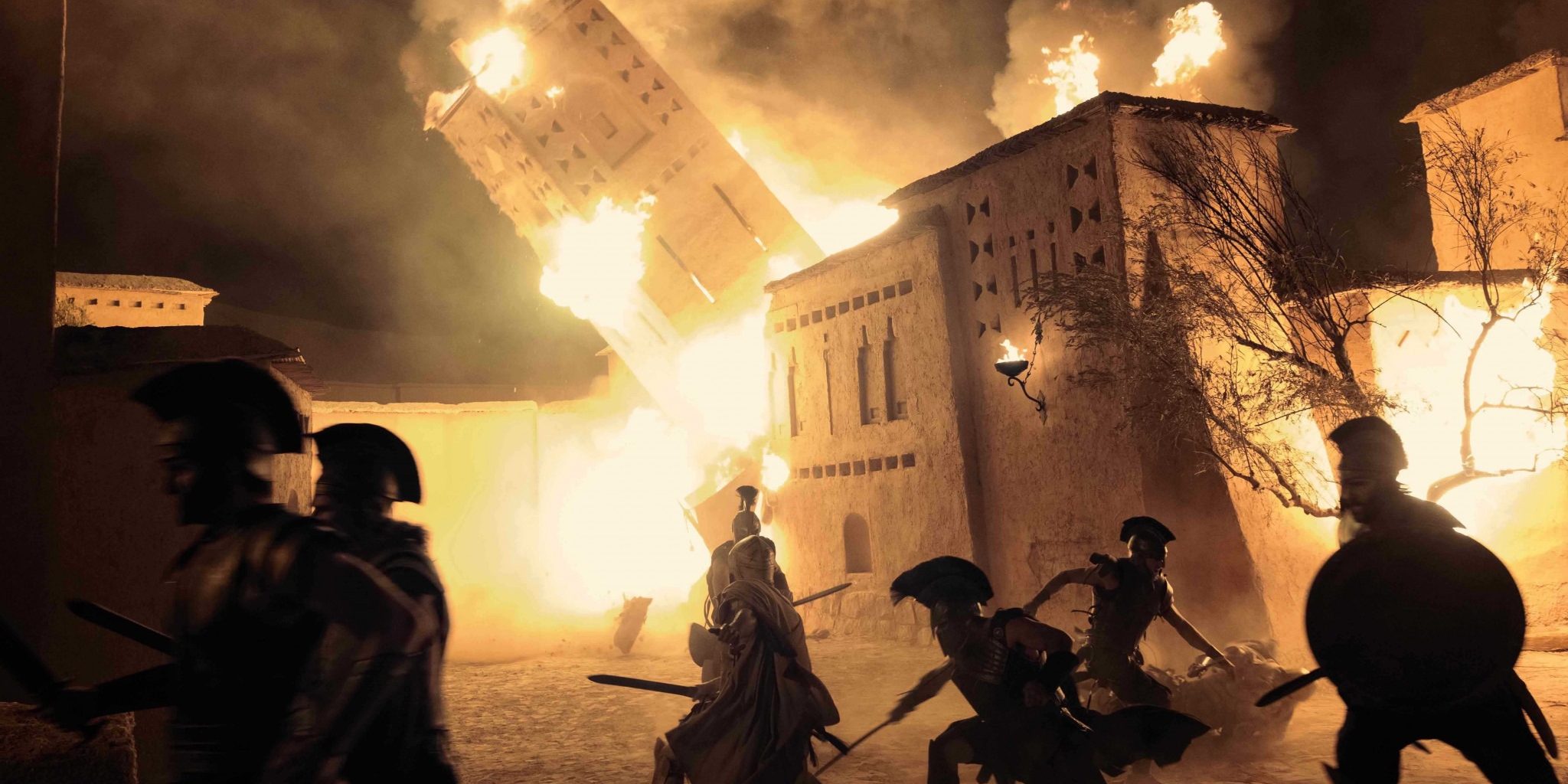
Controversy has also grown over Nolan’s choice of costumes in the trailers. Many viewers have compared Agamemnon’s helmet to Batman’s, and there has been many an argument about whether the armour shown in the trailer is historically accurate.
Does the faithfulness of an adaptation determine its value, or does its success instead reflect the desires of the audience who watches it?
Could we argue Nolan’s film is a ‘modern’ adaptation of Homer’s epic? If so, what does this mean? Does the faithfulness of an adaptation determine its value, or does its success instead reflect the desires of the audience who watches it?
Inevitably, Nolan’s film assumes that not everyone who will be watching it in cinemas has a wide understanding of the original epic, and instead will draw on the action elements of its plot. Can we interpret the modern elements seen in trailers so far as an attempt to ‘modernise’ The Odyssey for contemporary audiences?
I would argue that the modern language used and the Batman-esque armour reflect exactly that – after all, a film is made to attract audiences’ attentions. Nolan’s modern choices in his adaptation mirror those who are going to watch it – viewers will be expecting an action film they can enjoy as entertainment. As Nolan himself says, “hopefully they’ll enjoy the film, even if they don’t agree with everything”.
The Odyssey will be released in UK cinemas on the 17th of July.
Comments