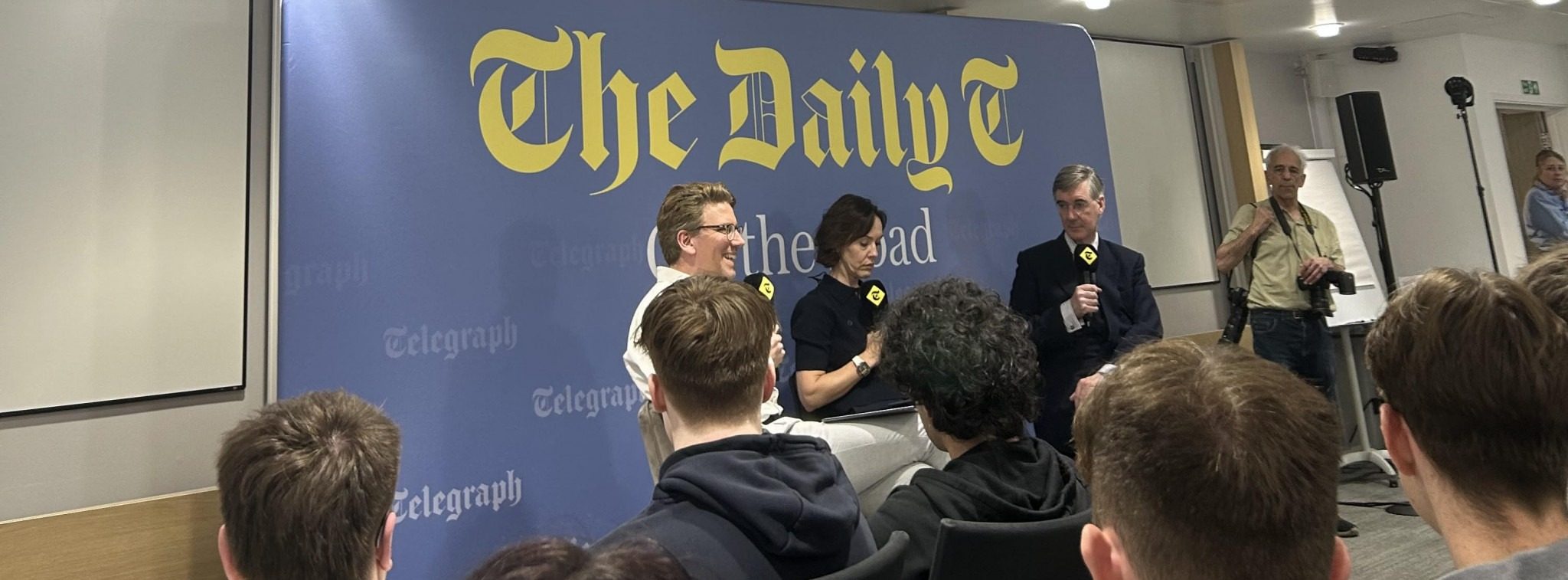
Jacob Rees-Mogg visits the University of Warwick for podcast and Q&A
On 29 April, Jacob Rees-Mogg visited the University of Warwick, alongside Camilla Tominey and Tim Stanley, to record an episode for The Telegraph’s Daily T Podcast.
The talk was structured into three parts, starting with a general conversation between the hosts and Rees-Mogg about PMQs, political violence, free speech, and the value of university. The event was sold out, however, there were empty seats in the audience.
The hosts began by explaining that Rees-Mogg had spoken at the University about ten years ago, when he was invited by a student from the Warwick Brexit Campaign. Rees-Mogg later shared that he had glitter thrown on him in protest when he visited campus.
He was also asked whether he “partied hard” during his time in Oxford University (no, he didn’t), and whether or not he had smoked weed: “certainly not”.
The conversation moved onto the end-of-term PMQs that took place last week. Rees-Mogg considered Kemi Badenoch’s desire to move on from inquiries over Peter Mandelson a good idea, and questioned how much longer Starmer will be around to answer PMQs.
Angela Rayner, Ed Miliband, and Andy Burnham, despite not being an MP, were the names Rees-Mogg mentioned as potential future leaders of the [Labour] party
“Keir Starmer’s a dud”, Rees-Mogg told the audience, before suggesting that other Labour Party members would be much better-suited to running the party. Angela Rayner, Ed Miliband, and Andy Burnham, despite the not being an MP, were the names Rees-Mogg mentioned as potential future leaders of the party.
Rees-Mogg also said that it might seem that Labour and Conservative were the “losing parties” of the local elections, losing votes to both Reform UK and the Greens. When discussing this, he shared his belief that the Conservatives and Reform should consider a coalition.
The hosts then directed the conversation towards political violence and discourse, “welcoming” the protests against Rees-Mogg’s appearance on campus.
However, Tominey brought up the stabbing of two Jewish men on the morning of the same day, linking this to the arson on the Jewish charity ambulances on 23 March and the Manchester synagogue attack in October, and referring to these attacks as politically violent.
She also revealed that Nigel Farage recently shared in an exclusive with The Telegraph that an “incendiary device” was put through his letterbox last year.
“Are we unable to have civilised conversation in this country that doesn’t devolve into protest and violence?” Stanley asked Rees-Mogg.
Rees-Mogg here pointed out that there has been violent protest in the UK for centuries. “We sometimes forget that the world has always been quite dangerous”, he said, but declared that as a politician, he did not feel overly worried about his safety.
Believing you should have secure borders is not a racist view of the world
Jacob Rees-Mogg
When Stanley asked if there should ever be limits on free speech when speech might cause harm or danger to others, Rees-Mogg said there was nothing he had said, or that Nigel Farage had said, that questioned the way people wanted to live their lives.
He also maintained that “believing you should have secure borders is not a racist view of the world”. He went on to say that any limits that could be imposed on free speech due to causing harm would be “enormously subjective”.
The conversation then moved to university and value for money, at which point the audience was asked to participate. We were asked to raise our hands if we believed university was value for money (to which there were very few hands raised), and whether we believed university was necessary (to which there were many hands).
Rees-Mogg agreed with Tominey that not all careers require degrees, but employers predominantly hire university graduates nonetheless. He said that doing a degree was about “keeping your options open for longer” and it is important to “tick the box”, which is why he would encourage all of his children to go to university.
All three of the event’s speakers shared that they did not pay for their undergraduate degrees, and asked the room how many people had to work to sustain their living at university. About a quarter of the room raised their hands.
Then, Tominey asked Rees-Mogg questions that students had submitted prior to the event. The first question asked whether Rees-Mogg was concerned that evidence shows fewer young people are moving to the right-wing as they get older. Rees-Mogg replied that this has to do with fewer young people being able to get on the housing ladder and owning property.
He also stated that people don’t want to be in the “middle mush” of political parties, preferring to vote for less-centrist parties such as the Greens and Reform. He used this as further argument for his belief that Reform and Conservatives should consider merging.
The second pre-submitted question asked about Rees-Mogg’s opinions on Starmer’s policy on the voting age being lowered to 16. Rees-Mogg shared that he did not think the policy was in line with how we treat 16-year-olds more generally, as they are unable to legally drink or smoke, and he did not believe the policy had been well-researched. He also expressed that he does not think the policy will benefit Starmer’s Labour.
Rees-Mogg was also asked if he thought British culture was “at risk”. He said in response that “We are a great country”.
The final pre-submitted question asked whether he believed there were too many public inquiries in modern administration, to which his answer was relatively simple: yes.
Rees-Mogg encouraged the audience to vote Conservative at the end of the episode.
When asked which policies the [Conservative and Reform] parties could unite over, Rees-Mogg answered that they would be united on securing borders, and reducing the size of the welfare state
Finally, once The Telegraph stopped recording for the podcast episode, students were encouraged to ask more questions, which The Telegraph journalists also answered.
One student asked whether the speakers could see the value in university for young people without a leg-up in life, i.e., due to having wealthy or well-connected families. The journalists spent more time answering this question than Rees-Mogg did, describing the value in university outside of degree courses.
Tominey said that work experience is often more valuable to careers than a degree, and Stanley said that there was value in spending three or four years living away from home, surrounded by peers of a similar age group. He also described the “capitalist problem” of universities being turned into businesses and degrees being turned into products.
Both journalists agreed that university was too expensive. Rees-Mogg chimed in to disagree, but said that the interest rate on loans was an issue.
Another member of the audience asked about Rees-Mogg’s claim that Reform and Conservative needed to work together, or even form a coalition, wondering how Reform’s working-class brand would fare in a coalition with politicians such as Rees-Mogg, who have been privately educated and come from wealthy backgrounds.
Rees-Mogg denied there being a wall between these values, stating that he and Nigel Farage get on well and agree on many policies. When asked by the same audience member which policies the parties could unite over, Rees-Mogg answered that they would be united on securing borders, and reducing the size of the welfare state.
It was a well-run and informative podcast. We’re grateful that those inside and outside the event were able to express their opinions effectively and safely.
Warwick PPE Society
The event attracted backlash from Warwick Against Hate, who also protested and boycotted George Finch’s visit to campus in January of this year. They, alongside members of Warwick’s Left Society and Students’ Union officers, protested the event before it took place, during the talk, and afterwards.
Before the event, police cars could be seen around campus, and security around the event was tight.
The main protest was positioned on the grass bank between the Radcliffe Building and the Warwick Business School. Their chants could be heard during the podcast recording. After the event, the group convened at the exit of the event to continue exercising their legal right to protest.
Some members of the audience began a counter-chant as they left, but did not stay to counter-protest.
Following the event, The Boar reached out to Warwick PPE society, who collaborated with the Daily T podcast team to host the event, who said that “it was a well-run and informative podcast. We’re grateful that those inside and outside the event were able to express their opinions effectively and safely. We’d also like to thank those involved in the running of the event, including the Daily T team and those from the university.”
The Boar also reached out to Warwick Against Hate, who organised the protest against the event, for a comment, but they did not respond.
Comments