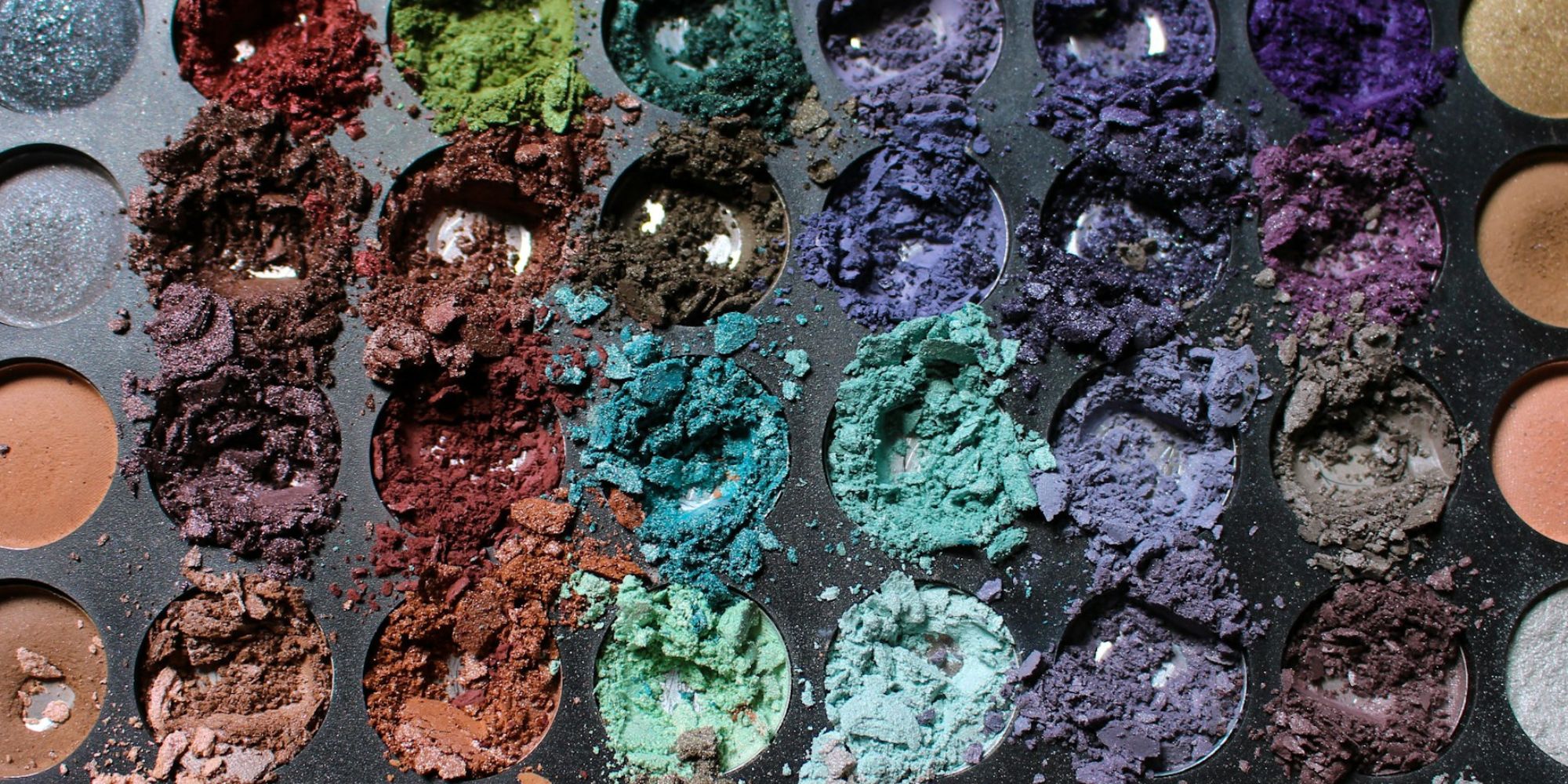
Death of the clean girl: Is maximalist makeup back?
The clean girl has died, and in her place, maximalist makeup has returned: behold the revival of 2016 makeup. It is undeniable that statement eyeshadow is making a return, following several years in which beauty culture has been shaped entirely by the clean girl aesthetic and its insistence on supposedly effortless neutrality, free from unique expression.
But the question is not simply whether bold eye makeup is ‘back’ – it is what it means for it to return at this particular moment, and whether this shift represents genuine aesthetic change or perhaps something more uncomfortable about how both the beauty industry and society in general are beginning to change.
Beginning to understand this requires recognising that the clean girl aesthetic did not emerge in isolation, but aligned with a broader cultural movement towards optimisation and reduction, where appearance is increasingly structured for efficiency and ease of replication. The face becomes something that must be instantly readable, and in that process, it is subtly standardised, even when presented as individual expression. This phenomenon is not solely restricted to makeup, but also to surgical and drug-induced changes, as Ozempic and botox begin to dominate the public’s view on appearance.
The eye becomes central again, rather than secondary to skin perfection, and that change subtly alters the hierarchy of the face itself
Of course, this is not a new dynamic. Beauty trends have always oscillated between excess and restraint, and statement eyeshadow itself is not an invention so much as a return to a previous language of makeup that was louder, more deliberate, and much less concerned with appearing effortless. The most interesting aspect of this shift is not the return of colour or pigment, but the return of emphasis. The eye becomes central again, rather than secondary to skin perfection, and that change subtly alters the hierarchy of the face itself. What was once softened into the background is now reasserting itself as the primary site of expression, whether through smudged shadow, graphic liner, or saturated colour.
This is already visible in fashion, particularly on the runway, where recent collections from houses such as Dior and Schiaparelli have reintroduced heavy eye focus through blurred pigment, smudging, and exaggerated framing that resists the precision of earlier seasons. Blumarine’s continued use of frosted lids and Y2K references further signals a willingness to reintroduce visual excess, although in a more controlled and curated form than its earlier iterations. Even Versace, traditionally associated with maximalism, has placed increasing emphasis on eye definition as the central feature of makeup styling rather than solely an accessory.
The circulation of these looks is so heavily shaped by social media platforms that reward immediacy over depth
Celebrity styling reflects this same shift, although in a more fragmented and less coherent way. Jenna Ortega’s consistent use of smudged, gothic-toned eye makeup has normalised a more undone aesthetic that still reads as intentional. Zendaya moves between structured metallic emphasis and restrained minimalism depending on context, and Doja Cat operates almost entirely outside stable aesthetic identity, but what connects these approaches is the increasing centrality of the eye.
Then again, it would be far too simple to treat this as pure aesthetic liberation, particularly when the circulation of these looks is so heavily shaped by social media platforms that reward immediacy over depth, where visibility is governed by what can be read instantly rather than what develops over time. In that environment, statement eyeshadow performs efficiently because it is visually immediate, relying on contrast and saturation that registers within seconds.
Minimal looks have begun to become associated with populism; thus, statement eyeshadow could be seen as a rejection of that
There is also a more practical dimension that often gets overlooked, namely, the way cosmetic formulation has reduced the technical threshold required to achieve what once counted as statement makeup. Cream shadows, liquid pigments, and stick formulations compress what used to require layering and precision into something immediate, which changes what is actually being signalled when these looks are produced outside editorial contexts.
But perhaps this shift isn’t solely related to identity. It’s undeniable that the economic and political situation of the world is increasingly bleak, as recession slowly begins to set back in. As well as this, minimal looks have begun to become associated with populism; thus, statement eyeshadow could be seen as a rejection of that.
Ultimately, the return of statement eyeshadow is less about nostalgia for earlier aesthetic cycles and more about the limits of uniformity itself. When minimalism becomes too successful in producing sameness, it begins to erase the very distinctions it originally claimed to refine, and what returns in response is not chaos, but a controlled reintroduction of difference into a visual culture that had begun to smooth everything into equivalence.
Comments