Half a million on the streets: Inside Britain’s largest anti far-right march
On March 28, Kevin Courtney, General Secretary of the National Education Union and rally co-organiser, stood in central London and spoke the following words: “Our estimate is now that there are half a million people on this demonstration – the biggest demonstration ever against the far right. And it gives us all confidence to carry on. Thank you very much.” His words spoke to the feelings of determination, anger, and tentative hope that many in the crowd were experiencing as they stared back at him.
The march, organised by the Together Alliance, saw around 500,000 people, based on organisers’ estimates, descend on Whitehall near the Houses of Parliament. They protested a political system that is currently at risk of being pushed towards far-right politics of hate and division. The Together Alliance is a collective, aiming to “turn the tide” against politics that uses hate to exploit people’s fears and vulnerabilities. It represents over seven million people through a collection of more than 500 groups, including the Trades Union Congress, Palestine Solidarity Campaign, and Amnesty International UK.
They made London their stage to show a collective resistance to hate, populism, and far-right violence
It was formed on 2 December 2025 in direct response to the ‘Unite the Kingdom’ march in September 2025, organised by Stephen Yaxley-Lennon, who refers to himself as ‘Tommy Robinson’. It saw around 150,000 people take to the streets of London to express strong anti-immigration sentiment. It was the largest far-right demonstration that has been seen in Britain, with Elon Musk appearing via video call in Whitehall, and Yaxley-Lennon referring to it as the “freedom of speech festival”. The march fed into many people’s fear that the British far right is now “bigger, bolder, and more extreme than ever before”.
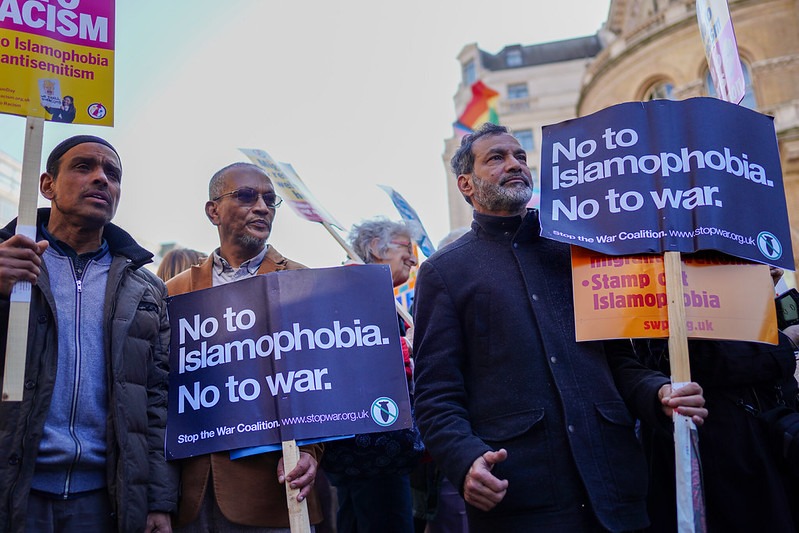
On March 28, the alliance brought together a diverse group of people of all ages, backgrounds, and faith groups. They made London their stage to show a collective resistance to hate, populism, and far-right violence. They marched with their placards and were led in chants such as “Fascism: Shut it Down.” Their messages echoed around the buildings of political power that make up the City of Westminster. Many politicians were in attendance, including Jeremy Corbyn, Diane Abbott, recently elected Green Party MP Hannah Spencer, and Green Party leader Zack Polanski. Notably, Polanski told the crowd: “There have been dark times. I know many people have been scared, and we have been afraid, but days like this are here to send a message, a message to Tommy Robinson, to Nigel Farage, to those who appease them … The message is, when we turn up, in our hundreds, in our thousands, in our hundreds of thousands, we are unstoppable.”
However, the Together Alliance did face some criticism regarding their ‘coalition’ prior to the march. Both the Jewish Leadership Council and the Board of Deputies of British Jews raised concerns that Jewish organisations and leaders had been ‘frozen out’ of the march at the same time as groups that they perceive to be pushing antisemitic rhetoric were welcomed. Speaking to The Times, the Board of Deputies stated: “British Jews know the dangers of far-right extremism all too well. However, we are concerned that Together Alliance foregrounds groups whose demonstration or activities have been venues for extremist rhetoric and outright antisemitism, with no attempt to engage representatives of the mainstream Jewish community.”
In response, a spokesman for the Together Alliance re-emphasised the collective’s support from the Jewish Socialists’ Group and Jewish Voice for Liberation. They also stated that “this Saturday’s march will demonstrate that clearly, in a powerful and vibrant display of unity against all forms of racism, including antisemitism and islamophobia. We expect this to be one of the biggest marches against racism in British history.” These tensions speak to the wider problems in the United Kingdom in terms of forming a united front against far-right populism.
True, painful grief is weaponised to spread racial hatred and fulfil cynical political ambitions
It is difficult to look at the Together Alliance or Yaxley-Lennon’s ‘Unite the Kingdom’ march without thinking of the three young girls who tragically died in Southport in the summer of 2024, and the exploitative wave of hatred and rioting that followed. Violence began after Elsie Dot Stancombe, Alice da Silva Aguiar, and Bebe King were brutally murdered at a Taylor Swift-themed dance class. Rioting across the United Kingdom began on July 30 after false claims were circulated by far-right accounts on social media that the perpetrator was a Muslim asylum seeker. A research paper published in The Guardian argues that the summer 2024 riots had significant similarities with the violent, hateful race riots that took place in London in 1958, rather than simply being a far-right demonstration. This is a stark reminder of the history of far-right hatred in our country. True, painful grief is weaponised to spread racial hatred and fulfil cynical political ambitions. It also shows the new threat, the speed at which online far-right networks can turn digital outrage into street-level violence.
The threat from the far-right is arguably extremely dangerous and imminent. However, sights such as that which London witnessed on 28 March, along with recent data showing that Reform UK’s polling average has fallen five percentage points since August, can lead many to have hope. Their decline reignites the fight for a society and political system that are built on compassion and logic, rather than one that is fuelled by hatred and fury. A phrase commonly thrown around in the media and in politics recently is that ‘Britain is Broken’. Whilst this may apply to the tired, outdated institutions of government or the corrupt bubble of Westminster, it does not apply to the half a million people who lined the streets of London on March 28, and those who lent their support from their home cities.
The crowd of half a million cheered at the words of Courtney and Polanski, who have clearly learned the countless lessons from history of how hate can poison and divide us, instead choosing to be guided by hope and compassion for others. Whether this support can be translated into meaningful, long-lasting political change, only time will tell.
Comments