From Miracle to Misery: How Leicester went from PL winners to League One
Next week will mark ten years since Leicester City shocked the world and gave hope to football fans across the country by somehow, impossibly, winning the Premier League.
What a difference a decade makes. Today, that same club went into the final fixtures of their Championship season knowing that, despite spending last year in the Premier League and boasting the biggest wage bill in the division, they will spend next year in League One, England’s third tier. Having triumphed over the ‘Big 6’ in 2016, 2026 will see the Foxes face the likes of Bromley, Burton, and MK Dons in league fixtures, whilst they will sit a division below Lincoln City and Wrexham, who were both in the fifth-tier National League the year Leicester won the title.
Building on the Dream
Despite starting the season as 5000-1 rank outsiders back in 2016, Claudio Ranieri’s underdog side (who had to pull off a ‘great escape’ the previous year to keep their place in the Premier League) stormed to the title, winning it by ten clear points. Whilst their main rivals for the title, Tottenham Hotspur, boasted superstars like Harry Kane, Christian Eriksen, and Heung-Min Son, Leicester had built a squad of relatively unknown players for a total cost of £72 million. To put that into context, striker Gonzalo Higuain cost Juventus £75m that summer. It was a remarkable feat in player identification, recruitment, and development and a fairytale in every sense of the word.
However, just because Leicester’s squad was cheap does not mean it was lacking in quality. At the core of the team were Danish goalkeeper and Manchester City reject Kasper Schmeichel, son of United legend Peter; Jamie Vardy — who Leicester signed from non-league Fleetwood Town — unknown Algerian winger Riyad Mahrez, and a young midfielder from Caen by the name of N’Golo Kante. Although the vultures inevitably came to try and break up Leicester’s side — Kante joined Chelsea the summer after winning the title, whilst other key men like Mahrez and Danny Drinkwater left by the end of the decade — Thai ownership group King Power, led by billionaire Vichai Sviraddhanaprabha, were determined to ensure Leicester’s success was not just a flash in the pan. They managed to keep the likes of Vardy and Schmeichel at the club, whilst investing the proceeds of Leiceter’s success in new players to build a team that could consistently fight at the top of the table on merit, and with far shorter odds than 5000-1.
Their ambition was most obviously on show in February 2017, when, despite helping the team qualify for the knockout stages of the Champions League, Claudio Ranieri was dismissed a mere nine months after his — and Leicester’s — crowning achievement. A series of managers came and went as King Power aimed to take the club to the next level. During that period, Craig Shakespeare, who ran Atletico Madrid close in the Champions League Quarter finals, and Claude Puel both delivered strong mid table finishes, but this was ultimately not enough to satisfy King Power, who sacked both before they turned to former Liverpool manager Brendan Rodgers.
Rodgers achieved by far the most of any Leicester manager in the post-Ranieri era
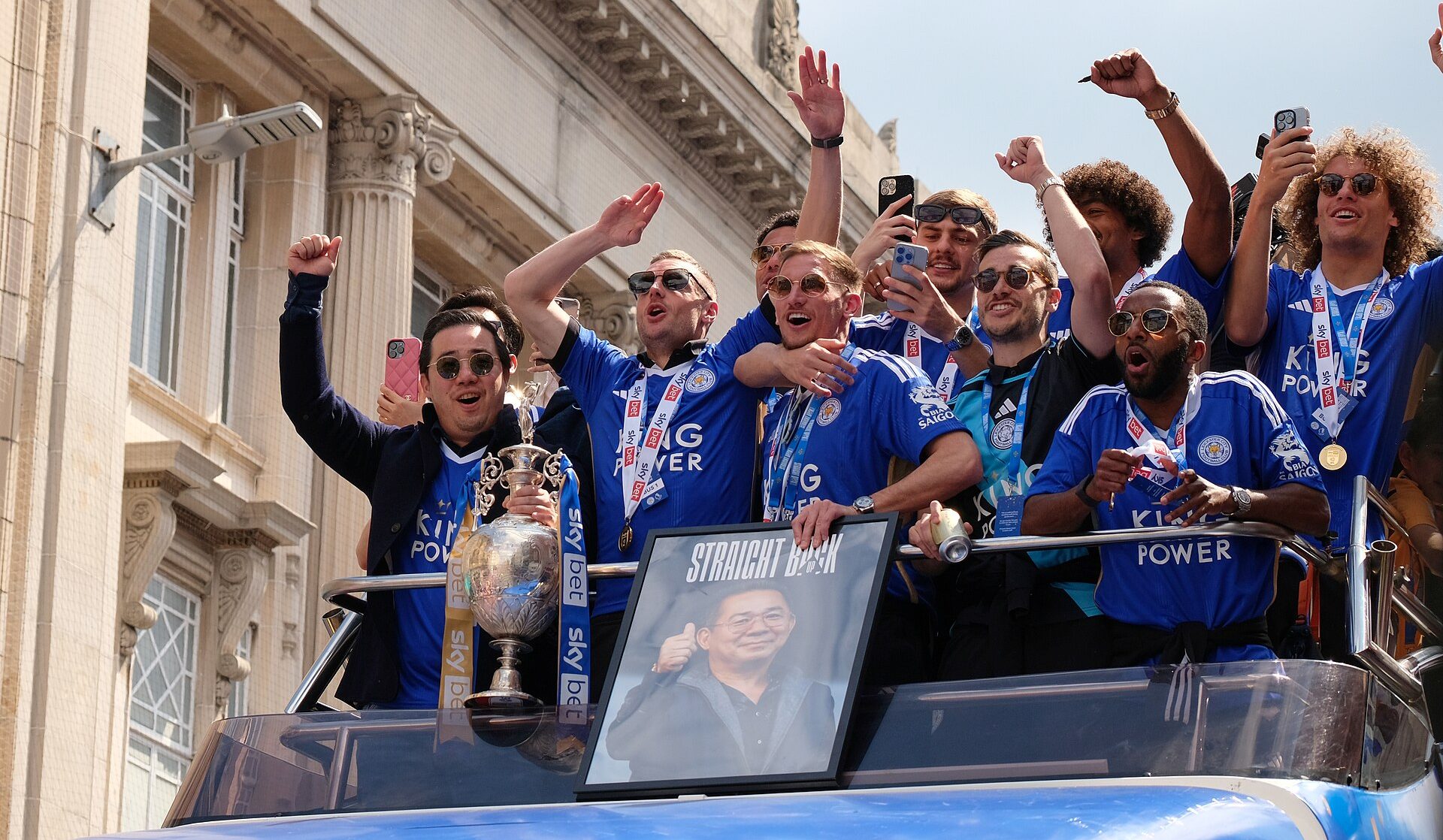
Rodgers took over in the aftermath of a tragedy that rocked the club to its very core. Following a 1-1 draw with West Ham United, club chairman Vichai Sviraddhanaprabha was killed in a helicopter crash alongside four others. The accident prompted a mass outpouring of grief from fans and players alike, as well as the wider footballing community. Vichai’s death continues to have a lasting emotional impact on Leicester, and a statue in his honour was unveiled at the King Power Stadium in 2022. A consequence of his death, understandably not given much coverage at the time, is that control of the club passed to Vichai’s son, Aiyawatt, known as Khun Top, or simply ‘Top’. Khun Top, a polo player, had little experience that equipped him to run a club like Leicester, and throughout his tenure he has given his father’s right-hand man, Director of Football Jon Rudkin, unchecked and unrivalled authority. With hindsight, it is clear this was one of the pivotal moments in Leicester’s decline, although its effects would not be clearly felt for some years.
Rodgers, who had previously enjoyed great success at Scottish side Celtic, achieved by far the most of any Leicester manager in the post-Ranieri era, delivering three successive top-half finishes, including two fifth placed finishes in 2019/20 and 2020/21, in both cases qualifying the club for the Europa League. There were many highlights along the way, including a record-breaking 9-0 win away at Southampton, but the apex of Rodgers’ time at the club is unquestionably the historic FA Cup victory in 2021, the only time Leicester have won the competition in their history. It was the first instance of silverware since the title win, and ostensibly a vindication of King Power’s continued investment in the Foxes.
The Downward Turn
2021, however, can be seen as the clear turning point where things started to go wrong for Leicester. Although the pair of fifth-placed finishes achieved by Rodgers were objectively impressive results for a side of Leicester’s stature, City really ought to have finished in the top four on both occasions, winning only two of their last nine and one from their last five in both seasons to slip down to fifth. Finishing in the top four in either season would have qualified Leicester for the UEFA Champions League, rather than its junior partner, the Europa League, which whilst a benefit to Leicester, proved substantially less lucrative than a season in Europe’s most prestigious competition would have been.
Leicester were in dire financial trouble, and they knew it
To achieve success under Rodgers, Leicester had spent heavily, and were thus faced with a challenging financial dilemma at the beginning of the 2021 season — either they could cut the wage bill, sell a couple of key players, and continue to responsibly challenge England’s elite, or they could throw everything at Champions League qualification, knowing that failure to qualify would force them to downsize financially and set them back years. Ultimately, the scale of the prize proved too tempting, and Leicester went all in on the 2021/22 season as the year that would take them back to the elite. Despite spending £65m on new players, as well as offering lucrative wages to free agent Ryan Bertrand, Leicester made no meaningful sales, departing from their sustainable and successful model of selling one key player every year that they had previously followed. Unfortunately, all four of their new additions were subpar, which would become a recurring theme for Leicester in the coming years. In the end, the club finished in eighth place, failing to qualify for any European competition.
Now, Leicester were in dire financial trouble, and they knew it. The decision was made not to sign loanee Ademola Lookman for £14m on the basis that Leicester simply couldn’t afford it, despite the Nigerian winger enjoying a successful season, wanting to stay, and Rodgers pushing to keep the player. Star centre back Wesley Fofana was sold to Chelsea for £75m, and was replaced with Wout Faes from Reims for a fifth of the price. Faes, respectfully, isn’t even a tenth of the player Fofana is, a fact demonstrated by the fact that he is currently out on loan, deemed not good enough for the side 23rd in the Championship. When veteran keeper Kasper Schmeichel asked to leave, Leicester decided not to sign a replacement, hoping number two keeper Danny Ward could step up (Ward was dropped halfway through the season, having proved nowhere near good enough for the Premier League).
The Foxes were relegated despite having the eighth-largest wage bill in the division
Those players who remained at Leicester had been signed believing the club would compete for European places and were on wages to match, yet they — and, it must be said, Rodgers — did not show the ability or desire needed to get close to that level. Sitting mid-table in January, Leicester elected to sign just one player, the Brazilian winger Tete, on loan, hoping they would be able to rebuild in the summer and start looking up the table again. Yet the results did not come for Leicester, and a 1-0 loss away at last place Southampton rang the alarm bells, prompting some journalists to speculate that relegation was a possibility. In response, Leicester’s star player, James Maddison, dismissed these fears as “rubbish” and insisted Leicester would be “absolutely fine” in a now infamous tweet (spoiler alert: they weren’t).
Three games later, and Leicester’s owners, realising it was not in fact going to be “absolutely fine,” sacked Rodgers, despite not having any succession planning in place. Seemingly completely unaware of the club’s league standing, Leicester spent days and weeks they did not have trying to convince the former Chelsea manager, Graham Potter, to replace Rodgers, before turning to Dean Smith, who had been sacked by Championship side Norwich City earlier that season. Smith did turn Leicester’s fortunes around but was ultimately unable to prevent them from becoming the second former PL winner relegated from the top flight, although Leicester’s seven-year gap between becoming Champions and the Championship is less than half of the 18 years it took Blackburn Rovers. They were relegated despite having the eighth-largest wage bill in the division, higher than Newcastle United, who finished fourth.
Papering Over the Cracks
In what should have been taken as a sign that the ownership would not learn from their mistakes, Leicester spent the first month after relegation desperately trying to persuade Potter to take the job in the Championship, which he very predictably never showed any willingness to do. Defeated, Top and Rudkin turned to Pep Guardiola’s assistant manager, Enzo Maresca, hoping to replicate Vincent Kompany’s title winning campaign with Burnley the previous year. Whilst key players like Maddison and winger Harvey Barnes were sold, Leicester knew they would breach Profit and Sustainability Rules (PSR), which could lead to a points deduction. However, the club found a loophole in the rules, which effectively left them unpunishable due to relegation.
Despite a late wobble and failed attempts by the EFL to impose a points deduction, Leicester won the league with 97 points
Whilst this was a welcome lifeline for Leicester, it should have been seized upon as an opportunity to reset and ensure the club would comply with the rules going forward. Unfortunately, Leicester made no such efforts, keeping key players like Jamie Vardy and Wilfried Ndidi in the Championship despite the former earning £91,000 a week. That’s over four and a half times what the highest earner at Ipswich Town, who finished second, would make, whilst fellow relegated club Southampton paid no more than £42,000 a week to any player. To exacerbate this issue, Leicester signed former England internationals Harry Winks and Conor Coady, both on similar wages to Vardy and both on long-term contracts that would come to haunt the club in the future. They also spent the most of any side in the division, including an unfathomable £8m (for non-Championship fans, that’s a lot!) on Tom Cannon to be a fourth choice striker — despite Maresca only ever playing one striker at a time and those ahead of him consisting of Vardy, as well as Patson Daka and Kelechi Iheancho, who had cost the club a combined £48 million already.
Whilst this approach to the season might have been hugely irresponsible, it did ensure Leicester had by far the best squad in the league, however questionable the manner in which it was assembled. Despite a late wobble and failed attempts by the EFL to impose a points deduction, Leicester won the league with 97 points, earning a promotion they had always expected and firmly anticipated would mean that they had spent their last season in the second tier.
Back in the Premier League, Leicester had hoped to return to the days of top half finishes, yet the closing of the PSR loophole used to avoid punishment meant that their best player, Kiernan Dewsbury-Hall, had to be sold to Chelsea for £30m, whilst Chelsea also poached Maresca away from the King Power. Star winger Abdul Fatawu suffered a season-ending ACL injury just weeks into the season, and the club ultimately failed to recruit well enough in the market to field a team good enough to stay in the league (they did, however, manage to sign Jannick Vestegaard to a new three year contract on £70,000 a week, despite the defender being 31, and having been surplus to requirements in the club’s previous PL campaign).
Fan sentiment had turned against Top and Rudkin, with the penultimate home game of the season against Southampton dominated by chants of ‘sack the board’
Despite this, new manager Steve Cooper managed to keep Leicester out of the relegation zone, but fans, perhaps influenced by his history with Nottingham Forest, viewed by many Leicester fans as rivals, never took to the Welshman. There are many reasons Cooper never won the fans over outside of his connections to Forest. He was consistently criticised for his team selections and perceived negative football, but Cooper believed his style, whilst not the most entertaining, was effective. The likelihood is that over the season Cooper would have been unable to keep Leicester up, but it is a fact that they were sat in 16th, which would represent a positive season. Yet, Rudkin decided to pull the trigger and sack the 44-year-old. In his place, Leicester turned to Ruud Van Nistelrooy (although not before trying to appoint, you guessed it, Graham Potter), who tried to implement a more attractive, possession based brand of football. Unfortunately, Leicester did not have the players to win games in the Premier League playing this way, and the club was relegated with four games to spare.
Unlike the relegation two years prior, Leicester could not dig its head in the sand and pretend that this was a fluke. Fan sentiment had turned against Top and Rudkin, with the penultimate home game of the season against Southampton dominated by chants of ‘sack the board,’ even as Leicester ran out 2-0 winners. However, although Van Nistelrooy was replaced by the former QPR manager Marti Cifuentes, Leicester did not attempt to implement meaningful change on or off the pitch, with Rudkin remaining in post and Leicester trying to keep as much of the 2023-24 promotion winning squad together as possible — even though this meant keeping the likes of Winks and Vestegaard on wages they could scarcely afford. Vardy, however, chose not to renew his contract, becoming the last member of Leicester’s title winning squad to leave.
Freefall to League One
Due to their spending power being limited by PSR and their crippling wage bill, Leicester were forced to rely on loans during the window, whilst multiple youth players were promoted to the first team set up, as the club did find the money to hand a long-term deal to Jeremy Monga, who at 16 Leicester believed could already be one of the best players in the Championship. Whilst the squad at Cifuentes’ disposal was not the title quality side of two years before, it was, without question, good enough to earn a playoff place. Unfortunately, however, whilst the players may have been good enough to see Leicester mount a promotion charge, they have at no point looked likely to do so.
Relegation has clearly been a possibility for much of the season
Whether it is a sense of frustration that this is not what they signed up for, a belief that they are better than they are, or a sense of entitlement that because they play for Leicester and earn £50,000 a week, teams should be easy to beat (in all honesty, it is likely all three), Leicester’s players have not shown up. Despite the eerily familiar moment of a key player (this time Jordan James) labelling relegation impossible, a multitude of embarrassing results have befallen Leicester, perhaps most notably a home game to Southampton, where having led 3-0 at the hour mark, Leicester somehow conspired to lose the game 3-4 with the last kick of the match. Cifuentes was sacked in January and eventually replaced by relegation specialist Gary Rowett, who was unable to arrest the slide and labelled the team “embarrassing” following the 1-0 loss at Portsmouth, which extinguished all hope of another great escape. Following that game, as they have been for almost every fixture since the turn of the year, Leicester’s players were berated with chants of “you’re not fit to wear the shirt,” which £90,000 Harry Winks proved beyond doubt when he told a fan to “f off” after the game, whilst having to be physically restrained and bundled onto the team bus.
Whilst on one level it is of course immensely surprising to see a team of Leicester’s resources, size, and history get relegated to the third tier, in many respects this outcome was all too predictable. Relegation has clearly been a possibility for much of the season, yet nobody, either on or off the pitch, has looked capable of doing anything to address the slide, as was the case with the relegations of 2022/23 and 2024/25.
A Club at Risk
It does not bear thinking about what could happen to the club should they get stuck in the third tier
What will be most concerning to Foxes fans is that, despite three relegations in four years, it is remarkably the same people running the club. Khun Top, desperate to live up to his father’s legacy by returning Leicester to glory, refuses to sell the club despite widespread fan pressure to do so, whilst the much maligned Jon Rudkin still runs the club on a day to day basis, although he no longer holds the title of ‘Director of Football.’ The players, too, will not all change as the club drops into League One. Winks and Vestegaard, even after relegation wage cuts, will be the highest paid players in League One history if a buyer can not be found in the final year of their contracts. What quality Leicester do have, such as Fatawu, is likely to be sold at a heavily discounted rate, as Leicester will have zero leverage given their league status and financial position. Even the likes of Monga have attracted interest from Premier League sides in recent weeks, and may have to be sold to cover the huge losses the club will inevitably accrue in League One.
In an interview with club media in January, Khun Top promised Leicester fans that “next season, we promote.” At the time, he meant from the Championship, but there will be no excuses in League One next year for Leicester. They have to go up — not only do they owe it to their fans, but they may well need to financially. In recent years, many clubs have suffered huge financial issues when relegated to the third tier. Some, like Southampton and Derby, quickly recover. However, some, like Portsmouth and Bolton, take years to recover. And some suffer the same fate as Scunthorpe and Morecambe, relegated again to the depths of non-league. It does not bear thinking about what could happen to the club should they get stuck in the third tier, or worse.
Having failed the club and its fans so many times before, it is essential that Top delivers a promotion next season in an attempt to begin undoing the cataclysmic damage he and King Power have inflicted upon Leicester over the past five years. In a year when the anniversary of their title triumph should have provided some warmth for Leicester, it is the bleakest moment in living memory for the Midlands side. Ten years on, their footballing fairytale has turned into a nightmare.
Comments