American vs UK adaptations: Ghosts
The US has been remaking British TV for decades. Sometimes it works – The Office arguably became even bigger than the original British version, however other times this is less true. More recently, the UK has even started returning the favour, adapting the long-running American staple Saturday Night Live. But one of the biggest recent crossovers is Ghosts, which launched its US remake five years ago and has since inspired versions in France, Germany, and Australia. So, the real question is: how does the American version stack up against the UK original?
Warning: light spoilers ahead.
Both shows follow the same basic setup: a young couple inherit a crumbling old house, only to discover it’s full of ghosts. After a near-death experience (caused by one of said ghosts), the wife gains the ability to see them. Chaos ensues as the couple tries to keep the house running while dealing with their very opinionated undead housemates. In the UK, it’s Alison and Mike; in the US, Sam and Jay.
Where things really differ between the shows is the ghosts themselves
Where things really differ between the shows is the ghosts themselves. Because both programmes draw on completely different histories, the characters feel distinct – even when they’re clearly meant to be equivalents.
Robin vs Thor
Robin is a prehistoric caveman who wandered into Britain before it was even an island. He’s surprisingly thoughtful, a bit odd, and quietly wise after thousands of years of observing human life (and the moon, which he loves). Thor, on the other hand, is a Viking – loud, proud, and very much stuck in warrior mode. Both were killed by lightning and are the oldest ghosts in the house, but that’s where the similarities end. Robin feels ancient in a philosophical way; Thor feels ancient in a “still yelling about battle” way.
Fanny vs Hetty
Both are former owners of the house and related (distantly) to the current heir. Fanny, from the Edwardian era, is deeply repressed and proper, even by ghost standards, while Hetty, from America’s Gilded Age, is a bit more expressive – though still very much shaped by her time. Fanny’s death is revealed early on, whereas Hetty’s takes longer to unfold. Both are great examples of how similar roles can be played very differently.
This is probably the closest match across both versions
The Captain vs Isaac
Both are soldiers, but from very different wars: the Captain from World War II, and Isaac from the American Revolution (complete with a petty rivalry with Alexander Hamilton). The key similarity is that both are gay – something they struggled to express in life. Isaac leans into this much more openly (and often hilariously), while the Captain is all quiet longing and emotional repression. The latter’s storyline, especially involving Lieutenant Havers, is genuinely heartbreaking.
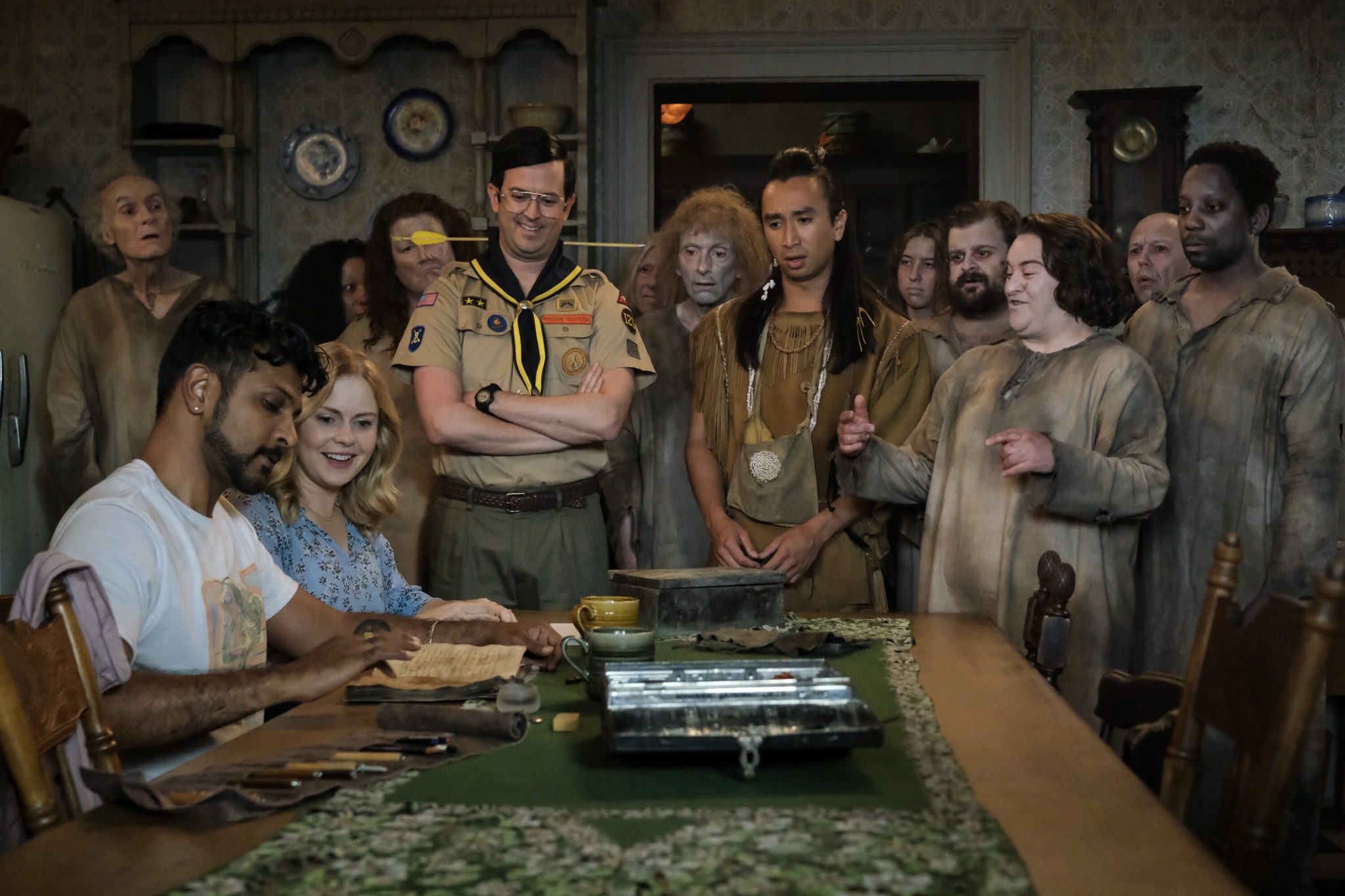
Pat vs Pete
This is probably the closest match across both versions. Both are scout leaders who die in a tragically stupid archery accident (arrow to the neck). Both also discover after death that their partners were unfaithful. Pete (from the American version) gets some closure when his wife later becomes a ghost, while Pat finds peace in a more understated way. Pat focuses on bringing the ghosts together with activities and clubs, while Pete tends to help out more practically with his ghost abilities.
Julian vs Trevor
A dodgy British politician vs a sleazy Wall Street banker – both stuck reliving their questionable 90s glory days after dying during, let’s say, less-than-dignified circumstances. They’re both walking innuendo machines, but each gets some surprisingly emotional development: Julian dealing with his failures as a father, and Trevor processing his parents’ divorce.
The US version, by comparison, leans more into big plot twists, ghost ‘powers’, and faster-paced storytelling
Not every ghost lines up neatly. Alberta, the American jazz singer, is nothing like Kitty, the endlessly optimistic Georgian noblewoman. And while Sasappis and Thomas both love storytelling, that’s about where the similarities stop.
So… which is better?
It’s subjective, but for me, the UK version just edges it. It strikes a better balance between comedy and genuine emotional depth, and it knows when to let quieter moments land. The house itself feels like part of the story – crumbling, lived-in, and full of history. The US version, by comparison, leans more into big plot twists, ghost ‘powers’, and faster-paced storytelling. It’s fun but sometimes feels a bit gimmicky.
Both shows are worth watching, but if you’re choosing one to start with, the UK original still has that extra bit of heart.
Comments